CM Rekha Gupta Pays Tribute to Raja Ram Mohan Roy on Birth Anniversary
Synopsis
Delhi Chief Minister Rekha Gupta paid tribute to Raja Ram Mohan Roy on his birth anniversary on 22 May 2026, calling him a pioneer of the Indian Renaissance and crediting him with challenging sati and child marriage to build a more equitable society.
Key Takeaways
Delhi CM Rekha Gupta posted a tribute to Raja Ram Mohan Roy on his birth anniversary, 22 May 2026 .
Roy, born 22 May 1772 , is credited as a founding figure of the Indian Renaissance and the father of modern Indian social reform.
His advocacy against sati pratha led directly to the Bengal Sati Regulation of 1829 , which outlawed widow immolation.
Roy founded the Brahmo Samaj in 1828 , a movement promoting monotheism, women's education, and rational inquiry.
Demands he articulated in the 19th century contributed to the Child Marriage Restraint Act of 1929 .
CM Gupta's tribute reflects a broader political tradition of invoking 19th-century reformers to connect current governance with progressive historical legacies.
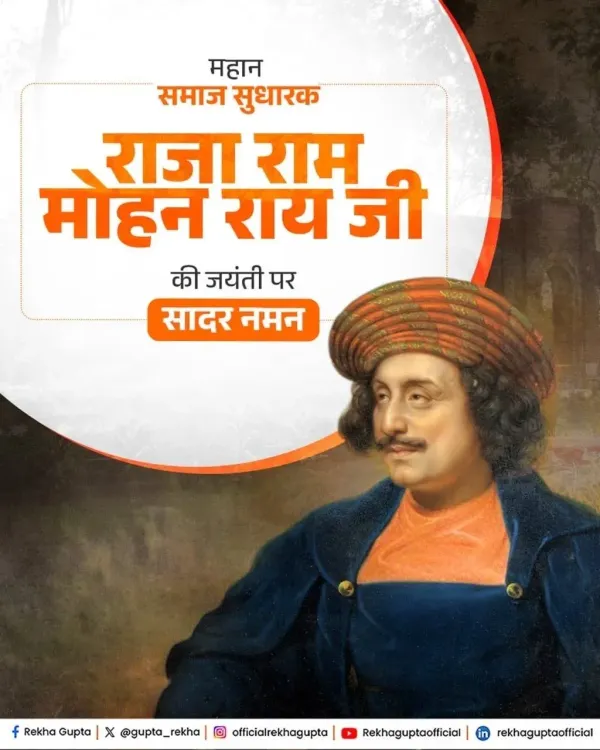
Delhi Chief Minister Rekha Gupta on Friday, 22 May 2026, paid tribute to Raja Ram Mohan Roy on his birth anniversary, honouring the 19th-century social reformer as a pioneer of the Indian Renaissance and a relentless voice against social evils.
In her post on X, CM Gupta wrote: 'महान समाज सुधारक और भारतीय पुनर्जागरण के अग्रदूत राजा राममोहन राय जी की जयंती पर उन्हें कोटि-कोटि नमन' — translated as: 'Heartfelt salutations to the great social reformer and harbinger of the Indian Renaissance, Raja Ram Mohan Roy, on his birth anniversary.' She further noted that by raising his voice against social evils such as sati pratha (widow immolation) and child marriage, Roy showed society a new path of progress, and that his thoughts and efforts would continue to inspire the building of an empowered and egalitarian society.
Context
Raja Ram Mohan Roy was born on 22 May 1772 in Bengal and is widely regarded as the father of the Indian Renaissance. A scholar fluent in Sanskrit, Persian, Arabic, and English, he challenged orthodox social practices through writing, petitioning colonial authorities, and public advocacy. His work laid the intellectual groundwork for modern India's social reform movements.
Roy founded the Brahmo Samaj in 1828, a reformist Hindu movement that promoted monotheism, rational inquiry, and women's education. The organisation became a crucible for subsequent generations of reformers across Bengal and beyond.
Policy Backdrop
Roy's most consequential campaign was against sati pratha — the practice of widow immolation. His sustained advocacy through petitions and writings directly contributed to the Bengal Sati Regulation of 1829, which outlawed the practice under British Indian law. It remains one of the earliest examples of a reformer successfully converting social argument into legislative action in the subcontinent.
The demand for a minimum marriage age, which Roy and his contemporaries articulated in the 19th century, was eventually codified in the Child Marriage Restraint Act of 1929. These legislative milestones are frequently cited in contemporary debates around women's rights and social equity in India.
Stakeholders and Impact
Roy's legacy is claimed across the political spectrum in India, but tributes on his birth anniversary have become a fixture in the political calendar, with leaders using the occasion to connect current governance priorities — particularly women's empowerment and social justice — to 19th-century reformist traditions. BJP leaders, including CM Gupta, have consistently framed such reformers as symbols of indigenous modernity that predate and parallel the party's own social agenda.
Women's groups and civil society organisations also mark the anniversary, often using it to draw attention to unfinished reform agendas, including the persistence of child marriage in parts of India despite legal prohibition.
What's Next
Commemorative events, school programmes, and cultural functions are typically held across Delhi and West Bengal around 22 May each year to mark Roy's birth anniversary. The occasion also provides a platform for renewed discussion on ongoing legislative efforts related to child marriage prohibition and women's education — issues that Roy first brought to national consciousness nearly two centuries ago.
Point of View
Gupta implicitly links the current administration's women's empowerment narrative to a 19th-century reformist pedigree. The tribute carries no immediate policy signal, but it reinforces a pattern of BJP-governed states using cultural memory to build ideological legitimacy. The framing of Roy as an 'Indian Renaissance' figure — rather than purely a Bengali or colonial-era one — also reflects a conscious effort to nationalise his legacy beyond its regional origins.
NationPress
15 Sept 2026
Frequently Asked Questions
Who was Raja Ram Mohan Roy and why is he remembered?
Raja Ram Mohan Roy (1772-1833) was a Bengali scholar and social reformer who founded the Brahmo Samaj in 1828 and successfully campaigned for the abolition of sati, earning him the title of father of the Indian Renaissance.
When is Raja Ram Mohan Roy's birth anniversary?
Raja Ram Mohan Roy's birth anniversary is observed on 22 May each year, marking his birth in 1772 in Bengal.
What did Raja Ram Mohan Roy do to abolish sati?
Roy wrote extensively against sati pratha and petitioned colonial authorities, contributing directly to the Bengal Sati Regulation of 1829, which banned the practice of widow immolation in British India.
What is the Brahmo Samaj founded by Raja Ram Mohan Roy?
The Brahmo Samaj, founded by Roy in 1828, was a reformist Hindu movement that promoted monotheism, rational inquiry, women's education, and opposition to caste rigidity — influencing generations of Indian reformers.
Why did Delhi CM Rekha Gupta pay tribute to Raja Ram Mohan Roy?
Delhi Chief Minister Rekha Gupta paid tribute on Roy's birth anniversary, 22 May 2026, calling him a great social reformer and pioneer of the Indian Renaissance whose work against sati and child marriage continues to inspire the building of an empowered and equal society.