CM Rekha Gupta Thanks Cabinet Colleague P. Sahib Singh
Synopsis
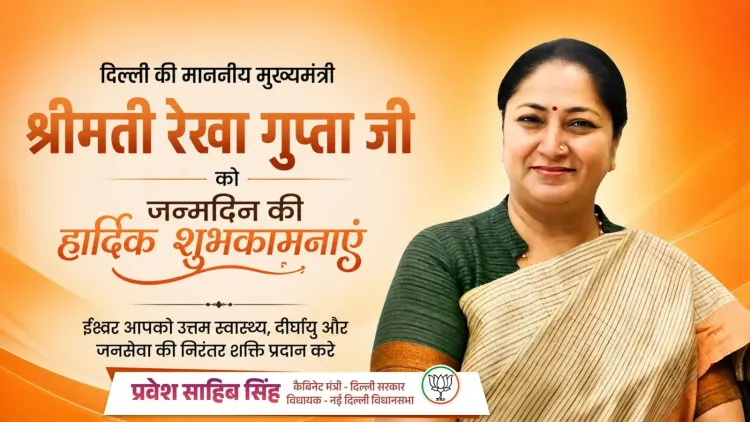
Delhi Chief Minister Rekha Gupta on 19 July 2026 publicly thanked cabinet colleague P. Sahib Singh for his goodwill, reaffirming their shared 'Viksit Delhi' vision and crediting him with giving new momentum to infrastructure and civic amenities in the capital.
Key Takeaways
CM Rekha Gupta posted on 19 July 2026 expressing gratitude to P.
Sahib Singh , her colleague in the Delhi Cabinet .
Sahib Singh 's leadership with accelerating progress on infrastructure and civic amenities in Delhi .
Both leaders share the 'Viksit Delhi' vision, aligned with the national BJP narrative of a developed India.
The BJP's urban agenda in Delhi draws on central schemes including Smart Cities Mission and AMRUT , both launched in 2015 .
Delhi's approximately 2 crore residents are the primary beneficiaries of the infrastructure push referenced in the post.
Delhi Chief Minister Rekha Gupta on Sunday, 19 July 2026, publicly acknowledged her cabinet colleague P. Sahib Singh, expressing gratitude for his goodwill and reaffirming the shared vision of a 'Viksit Delhi' — a developed Delhi — under the BJP-led Delhi government.
Context
In a post on X, CM Rekha Gupta addressed P. Sahib Singh, a fellow minister in the Delhi Cabinet, with warm acknowledgment. Translated from Hindi, she wrote: 'दिल्ली कैबिनेट में मेरे साथी श्री @p_sahibsingh जी, आपकी आत्मीय शुभकामनाओं के लिए हृदय से आभार' — 'My colleague in the Delhi Cabinet, Shri P. Sahib Singh ji, I am sincerely grateful for your heartfelt wishes.' She added that their resolve for a developed Delhi is shared, and that under his leadership, infrastructure and civic amenities have gained new momentum.
The post reflects routine intra-cabinet courtesy within the ruling dispensation, but also signals a deliberate public articulation of collective governance and team cohesion at the top of the Delhi government.
Policy Backdrop
P. Sahib Singh holds a portfolio with emphasis on infrastructure and civic development within the Delhi Cabinet. The BJP's urban development agenda in Delhi has drawn on central government frameworks, including the Smart Cities Mission (launched 2015) and AMRUT — the Atal Mission for Rejuvenation and Urban Transformation — also initiated in 2015, which together channel funds toward urban infrastructure upgrades and basic civic services.
The 'Viksit Delhi' framing aligns with the broader national narrative of 'Viksit Bharat' — a developed India — which the BJP has positioned as its long-term governance goal. State-level cabinets have increasingly adopted this vocabulary to signal alignment with the central government's vision.
Stakeholders and Impact
Delhi's approximately 2 crore residents stand as the primary stakeholders in the infrastructure and civic amenity push referenced by CM Gupta. Urban local bodies, resident welfare associations, and commuters are directly affected by decisions on roads, drainage, public transport, and sanitation — the core domains of civic infrastructure.
Public expressions of cabinet unity also carry a political signal. For a government that came to power in Delhi after years in opposition at the state level, demonstrating cohesion among ministers is part of building institutional credibility with the electorate.
What's Next
Observers will watch upcoming Delhi Cabinet meetings for concrete approvals on infrastructure projects and any budget allocations directed at civic works under P. Sahib Singh's portfolio. The pace at which 'Viksit Delhi' commitments translate into on-ground project execution will be a key measure of the cabinet's collective performance heading into future electoral cycles.
Point of View
A currency that newly-installed state governments often invest in early to project stability. The 'Viksit Delhi' framing ties local governance directly to the BJP's national brand, making infrastructure delivery a shared political stake for both the state and central leadership. Such posts also serve as a soft accountability mechanism — by praising a colleague's momentum publicly, the Chief Minister implicitly sets a benchmark for continued delivery. The pattern is consistent with how BJP-governed states have used social media to narrate governance continuity rather than merely announce policy.
NationPress
18 Oct 2026
Frequently Asked Questions
Who is P. Sahib Singh in the Delhi Cabinet?
P. Sahib Singh is a BJP leader serving as a minister in the Delhi Cabinet, with a focus on infrastructure and civic development in the capital.
What is 'Viksit Delhi'?
'Viksit Delhi' means 'Developed Delhi' and is the BJP-led Delhi government's stated governance vision, aligned with the broader national 'Viksit Bharat' (Developed India) framework championed by the party.
Why did CM Rekha Gupta thank P. Sahib Singh publicly?
CM Rekha Gupta thanked P. Sahib Singh for his goodwill wishes and acknowledged his role in accelerating infrastructure and civic amenity work in Delhi, as stated in her 19 July 2026 post on X.
What infrastructure schemes is the Delhi government using?
The Delhi government's infrastructure agenda draws on central schemes such as the Smart Cities Mission and AMRUT (Atal Mission for Rejuvenation and Urban Transformation), both launched in 2015 to upgrade urban infrastructure and basic civic services.
What should Delhi residents watch for next?
Residents should watch for Delhi Cabinet approvals on infrastructure projects and budget allocations for civic works, which will indicate how quickly the 'Viksit Delhi' commitments translate into on-ground delivery.