CM Revanth Questions IRFC Fund Freeze on Hyderabad Metro Takeover
Synopsis
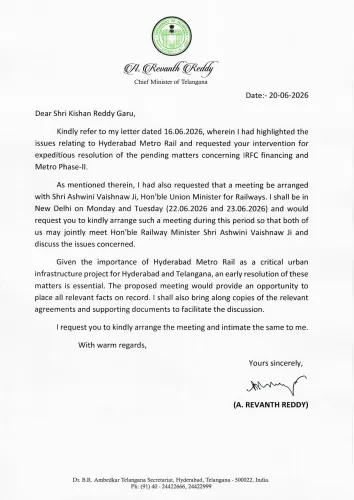
Chief Minister Revanth Anumula questioned why IRFC has not released Rs 13,500 crore due to L&T for Hyderabad Metro Phase 1 takeover, despite all agreements, guarantees, and equity payments being completed by the Telangana government. He offered to proceed with Phase 2 on 100 percent state equity if the Centre issues an NOC.
Key Takeaways
The Telangana government agreed to acquire Hyderabad Metro Phase 1 from L&T for Rs 15,000 crore against an assessed value of Rs 30,000 crore .
IRFC was to disburse Rs 13,500 crore to L&T at 4 percent interest ; funds from a Japanese institution are already in IRFC's account but payment to L&T has been withheld.
Telangana has paid Rs 84 crore in fees and Rs 1,400 crore in equity to IRFC, and provided both state and RBI counter-guarantees .
L&T had reported annual losses of Rs 350–400 crore and declined to undertake Phase 2, prompting the state takeover plan.
Hyderabad Metro's national ranking fell from second to ninth due to a decade of no expansion under the previous BRS government.
CM Revanth offered to execute Phase 2 with 100 percent state equity if the Centre grants an NOC, and urged Union Minister Kishan Reddy to intervene.
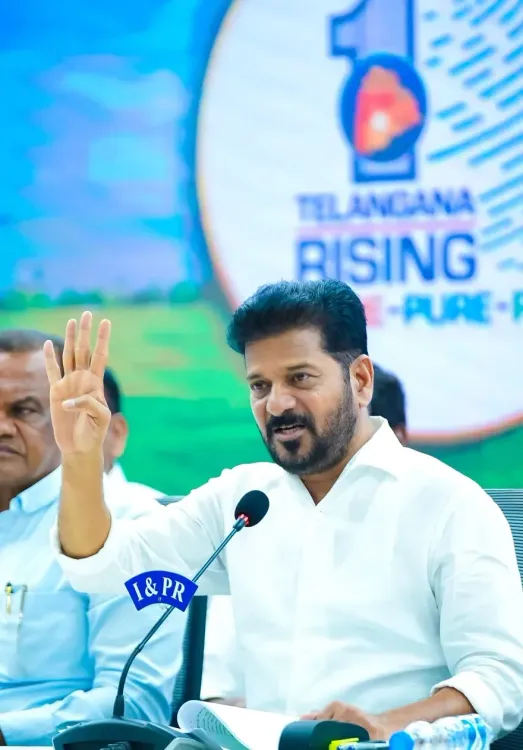
Hyderabad, June 15, 2026 — The Chief Minister's Office of Telangana announced that Chief Minister Revanth Anumula publicly questioned why the Indian Railway Finance Corporation (IRFC) has withheld funds critical to the state government's takeover of Hyderabad Metro Phase 1 from Larsen & Toubro (L&T), even after all agreements were finalised. Speaking at a press conference at Dr. B.R. Ambedkar State Secretariat on Monday, June 15, the Chief Minister said funds due to be disbursed to L&T through IRFC had not been released despite every contractual condition being met.
Context
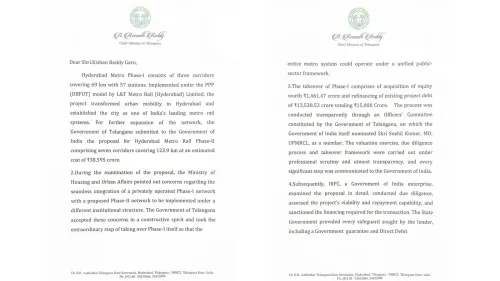
Flanked by ministers and several Members of Parliament, CM Revanth addressed the media in detail on three interlocked issues: the takeover of Hyderabad Metro Phase 1 from L&T, the financing arrangement with IRFC, and the planned Phase 2 expansion. He stated that the state government had agreed to purchase the metro — valued at Rs 30,000 crore — from L&T for Rs 15,000 crore, securing a loan of Rs 13,500 crore from IRFC at an interest rate of just 4 percent, far below the 8 to 11 percent rates the previous government paid on other project loans.
The CM noted that funds from a Japanese financial institution had already been transferred into IRFC's accounts as part of the agreed financing chain. Despite this, IRFC had not released the payment due to L&T on the scheduled date. He also confirmed that both a state government counter-guarantee and a Reserve Bank of India (RBI) counter-guarantee had been provided, and that the state had already paid Rs 84 crore as fees and Rs 1,400 crore as equity to IRFC.
Policy Backdrop
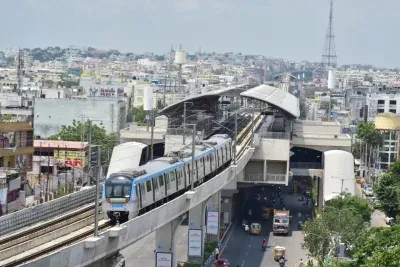
Hyderabad Metro Phase 1 was conceived during the UPA era, with tenders floated in 2009 under then-Prime Minister Manmohan Singh, UPA Chairperson Sonia Gandhi, Union Minister S. Jaipal Reddy, and then-Chief Minister Y.S. Rajasekhara Reddy. Construction was largely completed by 2020, though the Falaknuma corridor remains incomplete due to heritage structure concerns. The project's cost rose from an initial Rs 15,000 crore to Rs 22,000 crore by completion.
L&T subsequently reported annual operating losses of Rs 350–400 crore, leading it to decline Phase 2 expansion. The central government then advised the state to take over Phase 1 and pursue expansion under state ownership. The CM noted that during the decade of the previous BRS government, no steps were taken toward metro expansion, and Hyderabad Metro's national ranking dropped from second to ninth among Indian metro systems.
Stakeholders and Impact
The Hyderabad Core Urban Region (CURE) now has a population of 1.34 crore, making metro expansion a pressing public transport need. The CM argued that metro rail expansion is essential for attracting investment and positioning Hyderabad as a global city. He stated that the state is prepared to undertake Phase 2 expansion with 100 percent state government equity — without any central share — provided the central government issues a No Objection Certificate (NOC).
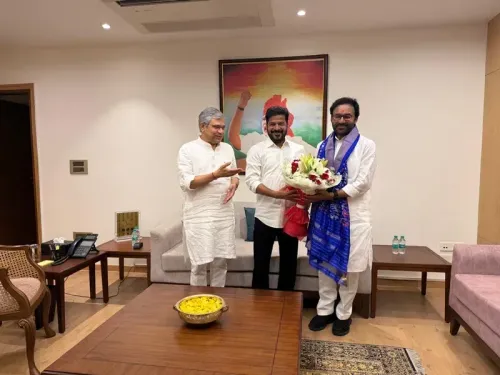
CM Revanth directly called upon Union Minister Kishan Reddy, a BJP leader and Telangana's representative in the Union Cabinet, to take responsibility and help resolve the funding impasse. He pointed out that the central government funds 50 percent of metro projects in other states and asked why Telangana is being treated differently, offering to present a PowerPoint briefing to state MPs if needed to clarify the agreements reached.
What's Next
The Telangana government has framed the immediate question as whether IRFC will release the agreed funds to complete the L&T takeover, which is a prerequisite for any Phase 2 work to begin under the Hyderabad Metro Rail Limited (HMRL) framework. The CM said the state does not wish to complicate the matter further and is seeking an amicable resolution, but made clear that Phase 2 cannot proceed until Phase 1 ownership is transferred.
Whether the Union Ministry of Housing and Urban Affairs issues an NOC for 100 percent state-funded Phase 2 expansion, or whether the Centre agrees to the standard 50 percent cost-sharing model, will determine the trajectory of Hyderabad Metro's expansion and its ability to reclaim a leading position among India's urban rail networks.
Point of View
Shifting the political burden onto the BJP-led Centre and its Telangana representative Kishan Reddy ahead of any formal dispute. By offering 100 percent state equity for Phase 2 while simultaneously demanding answers on the stalled Phase 1 payment, CM Revanth is positioning the Congress state government as a proactive actor blocked by central inaction — a familiar Congress-BJP pressure dynamic in infrastructure politics. The offer to brief state MPs with a PowerPoint presentation suggests the government is also building a parliamentary record. How the Union Ministry of Housing and Urban Affairs and IRFC respond will signal whether this is a procedural delay or a deeper centre-state standoff over Hyderabad's urban infrastructure future.
NationPress
15 Sept 2026
Frequently Asked Questions
Why has IRFC not released funds for Hyderabad Metro takeover?
CM Revanth Anumula stated that IRFC has not released the agreed Rs 13,500 crore to L&T despite all loan agreements, state and RBI counter-guarantees, and equity payments being completed. The reason for the hold has not been officially stated by IRFC or the central government.
How much is Telangana paying L&T for Hyderabad Metro Phase 1?
The Telangana government is acquiring Hyderabad Metro Phase 1 from L&T for Rs 15,000 crore , against the project's assessed value of Rs 30,000 crore , with the bulk of the payment to be routed through an IRFC loan.
What is the plan for Hyderabad Metro Phase 2 expansion?
The Telangana state government has said it is ready to undertake Phase 2 expansion with 100 percent state government equity under the HMRL framework, provided the central government issues a No Objection Certificate (NOC). Alternatively, it is seeking the Centre's standard 50 percent cost-sharing.
Why did L&T exit Hyderabad Metro operations?
L&T reported annual losses of Rs 350–400 crore on Hyderabad Metro Phase 1 operations and declined to undertake Phase 2 expansion, prompting the central government to advise the Telangana state government to take over the metro system.
What is Hyderabad's CURE population?
The Hyderabad Core Urban Region (CURE) has a population of 1.34 crore , which CM Revanth cited as a key reason why metro expansion is urgently needed for the city.