CM Revanth Orders 1st-of-Month Pay for Telangana Panchayat Staff
Synopsis
Chief Minister Revanth Anumula has ordered that Telangana's 50,000 gram panchayat employees receive salaries on the first of every month, backed by a dedicated Rs 50 crore monthly fund. The review also proposed restoring panchayat fiscal autonomy via a legislative amendment and shifting pensions to direct bank transfers.
Key Takeaways
CM Revanth Anumula directed that all 50,000 gram panchayat staff in Telangana must be paid on the first of every month , with zero tolerance for delay.
The state government will allocate a dedicated Rs 50 crore per month specifically to meet gram panchayat salary obligations.
The first-of-month salary rule covers outsourcing and contract employees across all government departments, not just panchayat staff.
A proposed amendment to Section 70(3) of the Telangana Panchayat Raj Act, 2018 would let panchayats deposit Own Source Revenue in bank accounts instead of treasury accounts, restoring financial autonomy.
Pension delivery will shift from the postal department to direct bank transfers , with eligibility verified through Voter ID, Aadhaar, and SEEEPC survey data.
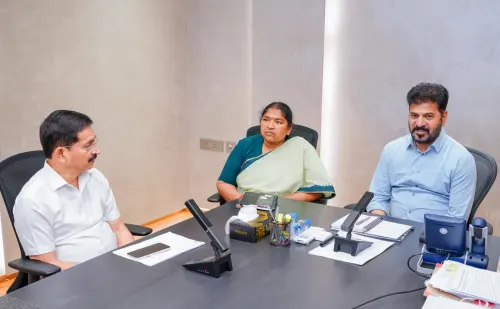
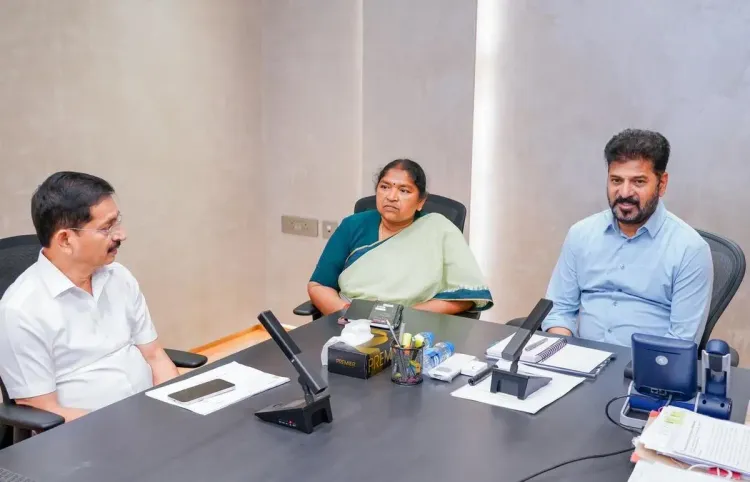
The review was attended by Minister Seethakka and MP Vem Narender Reddy alongside senior Panchayat Raj officials.
The Chief Minister's Office of Telangana announced on Tuesday, 26 May 2026 that Chief Minister Revanth Anumula has directed officials to ensure that salaries for approximately 50,000 gram panchayat employees across the state are credited on the first of every month, without exception. The directive came during a high-level review meeting on the Panchayat Raj and Rural Development Department.
Context
CM Revanth stated that panchayat staff must receive wages on the same schedule as IAS officers, drawing a pointed comparison to underscore that frontline rural workers deserve equal pay punctuality. He was unequivocal: 'సిబ్బంది జీతాలు ఒక్కరోజు ఆలస్యమైనా సహించబోమన్నారు' — 'Not even a single day's delay in staff salaries will be tolerated.' The government has committed to allocating a dedicated Rs 50 crore per month to meet panchayat salary obligations.
The order extends beyond permanent staff: the Chief Minister made clear that outsourcing and contract employees in all government departments must also receive their salaries on the first of each month, without distinction.
Policy Backdrop
A key structural reform proposed at the meeting involves amending Section 70(3) of the Telangana Panchayat Raj Act, 2018. The proposed change would allow gram panchayats to deposit their Own Source Revenue (OSR) into bank accounts rather than treasury accounts — a move aimed at restoring financial autonomy to village bodies. CM Revanth directed officials to act on this amendment, framing it as a reversal of a decision by the previous government that had curtailed panchayat fiscal independence.
The Telangana Panchayat Raj Act, 2018 established the foundational framework for village-level self-governance in the state, and Section 70(3) governs how local bodies manage their own-source revenues — making this amendment significant for decentralised governance.
Pension Reform and Stakeholder Impact
The review meeting also produced a major shift in pension delivery. CM Revanth directed that pensions currently distributed through the postal department be switched to direct bank transfers into beneficiaries' accounts, eliminating intermediaries and reducing leakage. To ensure that only eligible recipients receive pensions, he ordered that disbursals be rationalised using Voter ID, Aadhaar, and SEEEPC survey data. New pension grants are to be prioritised for those who qualify under this streamlined verification framework.
These changes directly affect gram panchayat staff and rural pensioners — two of the most economically vulnerable groups in Telangana's administrative ecosystem. Timely salaries and direct pension credits are expected to reduce financial hardship and dependency on informal credit among rural workers.
What's Next
The meeting was attended by Minister Seethakka (Panchayat Raj and Rural Development), MP Vem Narender Reddy, and senior Panchayat Raj Department officials. The immediate watch points are the tabling of the proposed amendment to Section 70(3) and the operational rollout of the direct bank transfer mechanism for pensions. If the monthly Rs 50 crore allocation is formalised in the budget cycle and the OSR amendment passes, it would mark a measurable shift in how Telangana's roughly 12,700 gram panchayats manage staff welfare and local finances — with implications for other states watching the model.
Point of View
A politically resonant move given that panchayat workers are a large, organised constituency in rural Telangana. The proposed OSR amendment directly targets a legacy policy of the previous government, framing the change as a restoration of local autonomy and offering a clear contrast narrative heading into the next electoral cycle. The pivot to direct bank transfers for pensions mirrors the Centre's DBT architecture and positions the state as aligned with national efficiency benchmarks. Collectively, these directives suggest a governance strategy that blends administrative accountability with political visibility at the village level.
NationPress
10 Oct 2026
Frequently Asked Questions
When will Telangana gram panchayat employees get their salaries on time?
CM Revanth Anumula has directed that all gram panchayat staff receive salaries on the first of every month, effective immediately as per orders issued at the 26 May 2026 review meeting.
How much money is Telangana allocating for panchayat staff salaries?
The Telangana government has committed to a dedicated allocation of Rs 50 crore per month specifically to pay gram panchayat employees on time.
What is the proposed amendment to Section 70(3) of the Telangana Panchayat Raj Act?
The proposed amendment to Section 70(3) of the Telangana Panchayat Raj Act, 2018 would allow gram panchayats to deposit their Own Source Revenue into bank accounts instead of government treasury accounts, restoring financial independence to village bodies.
How will Telangana pension distribution change under the new orders?
Pensions currently delivered through the postal department will be shifted to direct bank transfers into beneficiaries' accounts, with eligibility cross-verified using Voter ID, Aadhaar, and SEEEPC survey data.
Who attended the Telangana Panchayat Raj review meeting on 26 May 2026?
The review meeting was attended by Panchayat Raj Minister Seethakka, MP Vem Narender Reddy, and senior officials of the Panchayat Raj Department, chaired by CM Revanth Anumula.