CM Revanth Reddy Pushes BharatNet Rollout for Rural Telangana
Synopsis
Chief Minister Revanth Reddy met Union Minister Jyotiraditya Scindia via video conference on 27 May 2026 to accelerate the Amended BharatNet Programme in Telangana, seeking an early agreement, pending fund release, and ring-architecture broadband rollout covering 3,089 damaged-network villages.
Key Takeaways
CM Revanth Reddy held a video conference with Union Communications Minister Jyotiraditya Scindia on 27 May 2026 to advance the Amended BharatNet Programme in Telangana.
The CM sought an early formal agreement under the ABP and immediate release of pending central funds for the T-Fiber project .
Telangana plans to set up a Special Purpose Vehicle (SPV) to sign the agreement with the central government under the ABP framework.
The first phase will restore digital connectivity to 3,089 villages in combined districts of Nizamabad, Rangareddy, and Khammam where networks are damaged.
A ring architecture for the T-Fiber network will ensure uninterrupted broadband even if one network link fails, addressing reliability gaps in earlier deployments.
Minister Scindia responded positively, assuring full central government cooperation in achieving Telangana's rural broadband goals.
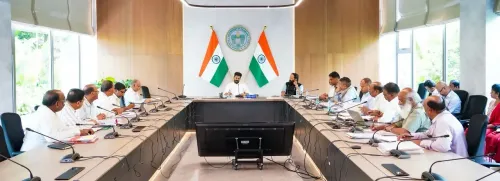
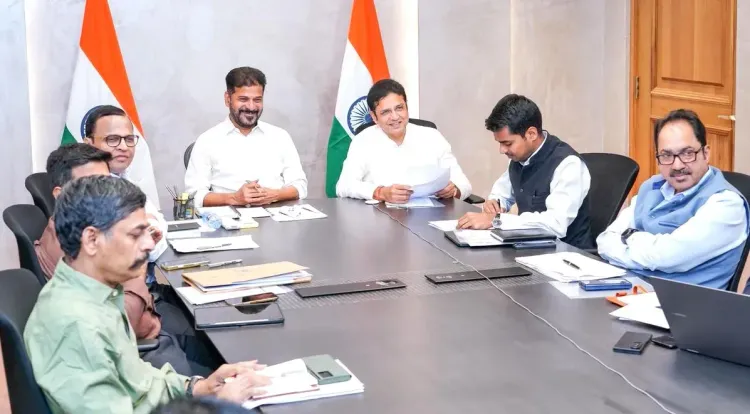
The Chief Minister's Office of Telangana announced on Wednesday, 27 May 2026 that Chief Minister Revanth Reddy held a video conference with Union Communications Minister Jyotiraditya Scindia to advance the Amended BharatNet Programme, pressing for an early agreement and release of pending funds to deliver uninterrupted high-speed broadband to rural Telangana.
Context
The video conference focused on implementing the T-Fiber project under the Amended BharatNet Programme (ABP) across Telangana's rural areas. Chief Minister Revanth Reddy, joined by Minister D. Sridhar Babu (@OffDSB), raised several key concerns with Scindia, including expediting a formal agreement and releasing pending central funds at the earliest. Scindia responded positively, assuring full central government cooperation in achieving Telangana's connectivity goals.
The CM also called for a clear policy on transferring mandal-to-gram panchayat ring network systems to the Digital Bharat Nidhi (#DigitalBharatNidhi) fund. This transfer mechanism is seen as critical to sustaining and expanding the rural fibre network's operational backbone.
Policy Backdrop
BharatNet, originally conceived as the National Optical Fibre Network and approved by the Cabinet in 2011, aims to connect all gram panchayats across India with broadband. It was subsequently integrated into the broader Digital India programme launched in 2015. The Amended BharatNet Programme represents an updated implementation framework that allows state-level models with greater flexibility.
Under the ABP, Telangana proposes to set up a Special Purpose Vehicle (SPV) to sign a formal agreement with the central government. This SPV structure would allow the state to develop a wide high-speed network tailored to rural needs — a model that reflects lessons from earlier linear-deployment shortfalls seen across multiple states in BharatNet's initial phases.
Stakeholders and Impact
The immediate priority is restoring digital connectivity to 3,089 villages in the combined districts of Nizamabad, Rangareddy, and Khammam, where existing networks have been damaged. This forms the first phase of the rollout under the Amended BharatNet framework. Rural households, village panchayats, and local businesses in these districts stand to be the direct beneficiaries.
The state's vision, as discussed in the conference, is to extend the T-Fiber (@tfiberofficial) network in a ring architecture — connecting every gram panchayat in a loop so that if one link in the network fails, traffic is automatically rerouted through an alternate path, ensuring uninterrupted service. This reliability-first design directly addresses one of the persistent criticisms of earlier BharatNet deployments, which used linear topologies vulnerable to single-point failures.
Senior officials participating in the video conference included Telangana Chief Secretary K. Ramakrishna Rao, CM Special Secretary B. Ajit Reddy, and IT Department Joint Secretary D. Anudeeep, underscoring the administrative weight the state has placed behind this initiative.
What's Next
The immediate milestones to watch are the formal constitution of Telangana's SPV and the signing of the agreement with the central government under the ABP framework. Once the agreement is in place, pending central funds are expected to be unlocked, enabling the state to begin network restoration in the 3,089 affected villages across the three districts.
Over the longer term, the ring-architecture rollout is intended to bring rural Telangana's broadband quality on par with better-connected urban and semi-urban areas in the state. The Centre's assurance of 'full cooperation' — while not yet backed by a signed agreement — signals political alignment between Hyderabad and New Delhi on closing the rural digital divide, a goal that will ultimately be tested by execution speed and fund disbursement timelines.
Point of View
Setting aside political differences for rural development optics. The emphasis on ring architecture and SPV formation signals that Telangana has learned from the first-generation BharatNet's fragile linear deployments, moving toward a more resilient, state-owned delivery model. The push to transfer ring network assets to the Digital Bharat Nidhi is a subtle but significant fiscal manoeuvre — it could shift long-term operational costs onto the central fund while retaining state control over rollout. Whether Scindia's verbal assurances translate into a signed agreement and actual fund disbursement will be the real test of this Centre-State alignment.
NationPress
10 Oct 2026
Frequently Asked Questions
What is the Amended BharatNet Programme in Telangana?
The Amended BharatNet Programme (ABP) is an updated version of the central government's BharatNet scheme, designed to provide high-speed optical fibre broadband to all gram panchayats. In Telangana, it is being implemented through the state's T-Fiber project, with the state planning to form a Special Purpose Vehicle (SPV) to execute the programme.
What did CM Revanth Reddy discuss with Jyotiraditya Scindia?
CM Revanth Reddy discussed expediting a formal agreement under the Amended BharatNet Programme, releasing pending central funds, transferring mandal-to-gram-panchayat ring network systems to the Digital Bharat Nidhi, and extending T-Fiber in a ring architecture to ensure uninterrupted rural broadband across Telangana.
What is T-Fiber and how does it relate to BharatNet?
T-Fiber is Telangana's state fibre optic network project aimed at last-mile rural connectivity. Under the Amended BharatNet Programme, T-Fiber is the implementation vehicle through which the central scheme's objectives are being pursued in Telangana, with the state seeking to expand it in a ring architecture covering every gram panchayat.
Which districts will get connectivity restored first under BharatNet in Telangana?
In the first phase, digital connectivity will be restored to 3,089 villages in the combined districts of Nizamabad, Rangareddy, and Khammam, where existing networks have been damaged.
What is ring architecture in broadband networks?
Ring architecture connects network nodes in a loop so that if one link fails, data traffic is automatically rerouted through the alternate path in the ring, ensuring uninterrupted service. Telangana plans to use this design for its T-Fiber gram panchayat network to avoid the single-point failures that affected earlier linear broadband deployments.