CM Rio Thanks Modi, Sitharaman for Advance Tax Devolution to Nagaland

Synopsis
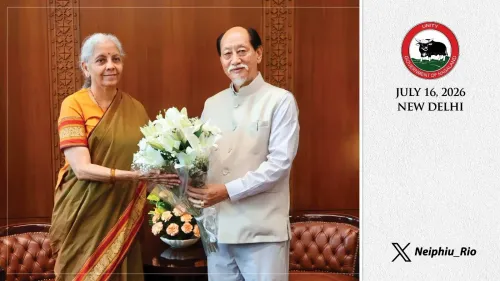
Nagaland Chief Minister Neiphiu Rio publicly thanked PM Narendra Modi and Finance Minister Nirmala Sitharaman on August 1, 2026 for releasing an advance installment of tax devolution — a transfer that is critical to the special category northeastern state's fiscal operations.
Key Takeaways
Nagaland CM Neiphiu Rio thanked PM Narendra Modi and Finance Minister Nirmala Sitharaman on August 1, 2026 for releasing an advance tax devolution installment.
Tax devolution is governed by Articles 270 and 280 of the Constitution; the 15th Finance Commission fixed the pool at 41 percent of central taxes for 2021–26 .
Nagaland holds special category state status, making it disproportionately reliant on central transfers due to limited own-tax revenue.
The Finance Ministry's practice of advance devolution releases was formalised after the 14th Finance Commission to help states manage cash flows.
The current devolution award period ends in 2026–27 , with the 16th Finance Commission set to determine the next cycle of sharing ratios.
For a state that runs largely on central transfers, an advance installment of tax devolution is not a formality — it is fuel. Nagaland Chief Minister Neiphiu Rio on Saturday, August 1, 2026, publicly thanked Prime Minister Narendra Modi and Union Finance Minister Nirmala Sitharaman for releasing an advance installment of tax devolution to the state.
Rio wrote: 'I express my sincere gratitude to Shri Narendra Modi Ji, Hon'ble Prime Minister of India, and Smt. Nirmala Sitharaman Ji, Hon'ble Union Minister for Finance, for the release of the advance installment of tax devolution to the State.'
What tax devolution means for Nagaland
Tax devolution is the constitutional mechanism through which the Centre shares its collected taxes with states — the backbone of India's fiscal federalism under Articles 270 and 280 of the Constitution. The 15th Finance Commission fixed the aggregate devolution pool at 41 percent of central taxes for the period 2021–26, with northeastern and hilly states receiving a proportionally higher per-capita share. Nagaland sits at the sharper end of that dependency. As a special category state in the northeast, it generates limited own-tax revenue — meaning central transfers, including devolution, are not supplementary income but the primary engine of state expenditure. An advance release smooths the cash-flow gap that can otherwise stall salaries, scheme disbursements, and infrastructure spending.Advance releases and the Finance Ministry's practice
The practice of releasing devolution installments in advance — ahead of the scheduled monthly cycle — was formalised after the 14th Finance Commission recommendations took effect. It gives state treasuries breathing room, particularly in the first and last quarters of a fiscal year when expenditure pressure peaks. For smaller northeastern states, even a single installment arriving early can determine whether a district hospital gets its supplies or a road project stays on schedule. With the 15th Finance Commission award period ending in 2026–27, the next cycle of negotiations for the 16th Finance Commission will reset devolution shares — making the current period one where state governments are watching every transfer closely. Rio's public acknowledgement signals both gratitude and, implicitly, the weight these releases carry for Nagaland's fiscal calendar. When a chief minister takes to social media to thank the Centre for a routine transfer, it underscores just how central — and how consequential — federal fiscal flows remain for India's northeastern states.Point of View
Yet their advance release carries genuine operational significance for small-revenue states like Nagaland. The timing, at the cusp of the 15th Finance Commission's final year, adds a subtle dimension: state governments are keenly aware that devolution shares will be renegotiated soon, and maintaining visible, cordial Centre-state optics is politically prudent. The post also reinforces the NDPP government's posture of cooperative federalism with the BJP-led Centre, a relationship that has defined Nagaland's political alignment since 2018.
NationPress
1 Aug 2026
Frequently Asked Questions
What is tax devolution in India?
Tax devolution is the constitutionally mandated sharing of central government tax revenues with states, governed by Articles 270 and 280. The Finance Commission determines the percentage share; the 15th Finance Commission set it at 41 percent for 2021–26.
Why did Nagaland CM Rio thank PM Modi and Nirmala Sitharaman?
CM Neiphiu Rio expressed gratitude for the release of an advance installment of tax devolution to Nagaland, a transfer critical to the state's fiscal operations given its limited own-tax revenue base.
What is Nagaland's special category state status?
Nagaland is classified as a special category state, entitling it to a higher per-capita share of central transfers and grants. This status reflects the state's difficult terrain, low economic base, and strategic northeastern location.
What is an advance installment of tax devolution?
The Finance Ministry periodically releases devolution ahead of the standard monthly schedule to help states manage cash-flow gaps, a practice formalised after the 14th Finance Commission recommendations. It ensures states can fund salaries and schemes without delay.
What is the 16th Finance Commission and why does it matter for Nagaland?
The 16th Finance Commission will determine devolution shares and grants for the period starting 2026–27. For states like Nagaland that depend heavily on central transfers, the new award will directly shape their budget capacity for the next five years.