CM Sai Approves VB-G Ram Ji Yojana, Guarantees 125 Days of Rural Jobs
Synopsis
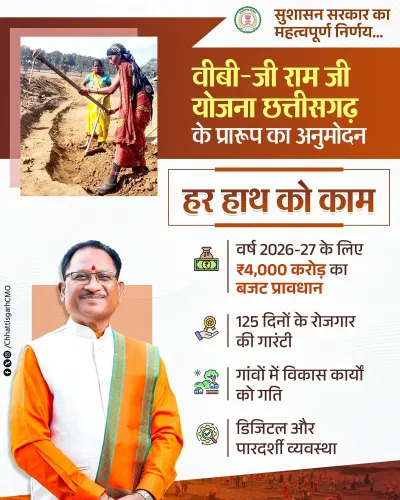
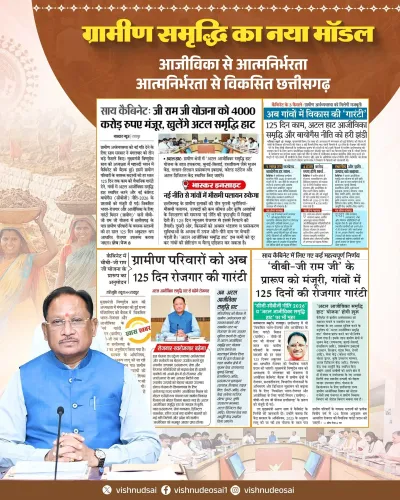
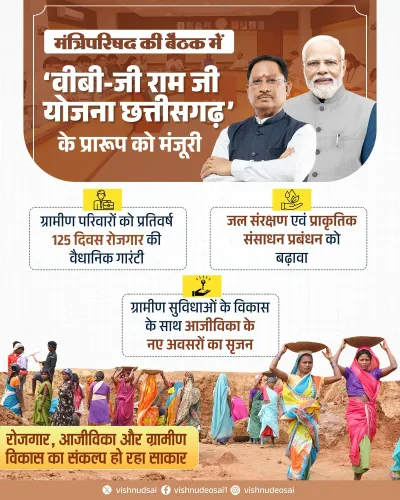
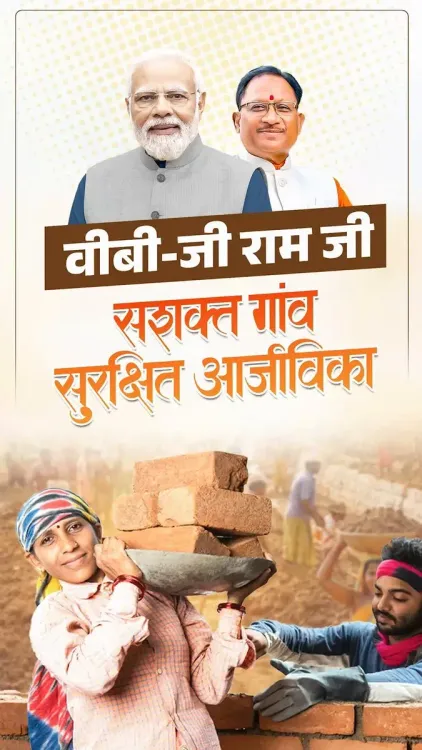
Chhattisgarh CM Vishnu Deo Sai has approved the draft of the VB-G Ram Ji Yojana, a state scheme guaranteeing eligible rural households 125 days of employment per year — 25 days more than the central MGNREGA guarantee — aimed at strengthening village economies and building self-reliant communities.
Key Takeaways
Chhattisgarh CM Vishnu Deo Sai approved the draft framework of the VB-G Ram Ji Yojana on 24 June 2026 .
The scheme guarantees eligible rural households 125 days of wage employment per year, exceeding MGNREGA's central guarantee of 100 days .
The stated objectives are livelihood empowerment, strengthening the rural economy, and building self-reliant villages.
The scheme supplements — rather than replaces — the central MGNREGA framework enacted in 2005 .
Budgetary allocations, eligibility norms, and phased rollout details are yet to be announced.
CM Sai has been in office since December 2023 following the BJP's victory in the Chhattisgarh assembly elections.
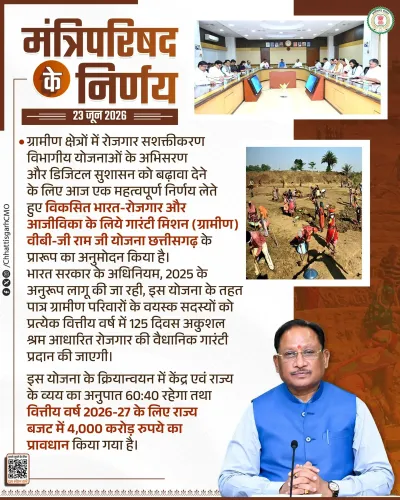
Chhattisgarh Chief Minister Vishnu Deo Sai on Wednesday, 24 June 2026 announced that his government has approved the draft framework of the 'VB-G Ram Ji Yojana, Chhattisgarh', a state-level rural employment scheme that promises eligible rural households a guaranteed 125 days of wage employment every year — surpassing the 100-day ceiling under the central MGNREGA framework.
Context
Posting on X, CM Sai described the cabinet-level approval as a step toward 'aajivika sashaktikaran' (livelihood empowerment) in villages. Translating his post, he wrote: 'New energy for rural development, a new guarantee for employment... by approving the draft of the VB-G Ram Ji Yojana, our government has taken an important initiative in the direction of livelihood empowerment in villages.' He added that the scheme would strengthen the rural economy and accelerate the building of 'aatmanirbhar gaon' (self-reliant villages).
The announcement came with a video attachment, suggesting the government intends to communicate the scheme directly to rural audiences across the state.
Policy Backdrop
The Mahatma Gandhi National Rural Employment Guarantee Act (MGNREGA), enacted in 2005, is a central law that legally guarantees up to 100 days of wage employment annually to rural households across India. The VB-G Ram Ji Yojana appears designed to supplement this floor by adding 25 additional days, bringing the total guaranteed employment to 125 days per year for eligible families in Chhattisgarh.
Indian states have periodically introduced such top-up schemes to address seasonal unemployment gaps that MGNREGA alone does not cover. BJP-governed states have frequently framed such measures within the Atmanirbhar Bharat and sushasan (good governance) agendas that have been central to the party's policy narrative since 2014. CM Sai, who took office in December 2023 after the party's victory in the state assembly elections, has positioned the scheme as a signature governance commitment of his administration.
Stakeholders and Impact
The primary beneficiaries are eligible rural families across Chhattisgarh's villages, particularly those dependent on seasonal agricultural labour and daily-wage work. An additional 25 days of guaranteed employment can meaningfully supplement household incomes during lean agricultural periods, reducing distress migration to urban centres.
Village-level institutions, gram panchayats, and state rural development machinery will likely be the implementing agencies, though the specific operational guidelines, eligibility norms, and wage rates are yet to be made public. The approval of the praroop (draft framework) signals policy intent; the detailed rollout architecture is expected to follow.
What's Next
The immediate priority for the Chhattisgarh government will be finalising budgetary allocations sufficient to fund the incremental 25 days of employment beyond MGNREGA's central funding. Watchers will look for the notification of eligibility criteria, the phased rollout schedule across the state's development blocks, and the wage structure to assess how the scheme compares with MGNREGA rates.
If implemented at scale, the VB-G Ram Ji Yojana could become a model that other BJP-ruled states reference as they seek to differentiate their rural welfare offerings ahead of future electoral cycles — and a key plank in CM Sai's governance record heading into the next state assembly election.
Point of View
Signalling state-level ownership of rural welfare at a time when BJP governments across India are keen to demonstrate grassroots delivery. By framing the extra 25 days as a 'new guarantee,' the government is adopting the language of rights-based entitlement — a terrain historically associated with opposition welfare politics — and recasting it within the sushasan and Atmanirbhar Bharat vocabulary. The scheme's real test will lie in implementation: whether budgetary allocations are adequate and whether the delivery machinery can absorb the additional workload without the delays and wage-payment backlogs that have historically plagued MGNREGA in several states. If it scales credibly, it could serve as a replicable template for BJP-ruled states looking to sharpen their rural development narrative ahead of assembly elections.
NationPress
24 Jun 2026
Frequently Asked Questions
What is the VB-G Ram Ji Yojana in Chhattisgarh?
The VB-G Ram Ji Yojana is a state-level rural employment scheme approved by the Chhattisgarh government under CM Vishnu Deo Sai that guarantees eligible rural households 125 days of wage employment per year, supplementing the central MGNREGA guarantee of 100 days.
How is the VB-G Ram Ji Yojana different from MGNREGA?
While MGNREGA guarantees up to 100 days of wage employment annually under a central law, the VB-G Ram Ji Yojana is a Chhattisgarh state scheme that adds 25 more days, bringing the total to 125 days for eligible rural families in the state.
Who will benefit from the VB-G Ram Ji Yojana?
Eligible rural families across Chhattisgarh are the intended beneficiaries. The specific eligibility criteria and operational guidelines are yet to be notified by the state government.
When was the VB-G Ram Ji Yojana approved?
Chhattisgarh CM Vishnu Deo Sai announced the approval of the scheme's draft framework on 24 June 2026.
What is the goal of the VB-G Ram Ji Yojana?
The scheme aims to strengthen the rural economy, provide livelihood empowerment to village households, and support the development of self-reliant villages, in line with the Atmanirbhar Bharat vision.