Chhattisgarh Cabinet Launches VB-G Ram Ji Yojana for Rural Jobs
Synopsis
The Chhattisgarh Council of Ministers on 23 June 2026 approved the VB-G Ram Ji Yojana, a rural employment and livelihood guarantee mission that converges departmental schemes and promotes digital governance under the Viksit Bharat@2047 framework.
Key Takeaways
The Chhattisgarh Council of Ministers approved the VB-G Ram Ji Yojana Chhattisgarh on 23 June 2026 .
The scheme's full name is Viksit Bharat - Rozgar aur Aajivika ke liye Guarantee Mission (Gramin) , targeting rural employment and livelihood.
Key pillars include employment generation, empowerment, convergence of departmental schemes, and digital governance .
The mission is aligned with the national Viksit Bharat@2047 framework.
Primary beneficiaries are rural households , with village panchayats as expected implementation units.
Specific funding, eligibility criteria, and integration with MGNREGA are yet to be detailed publicly.
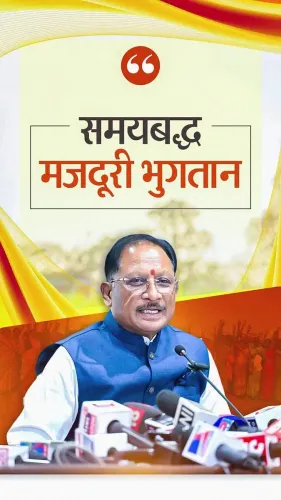
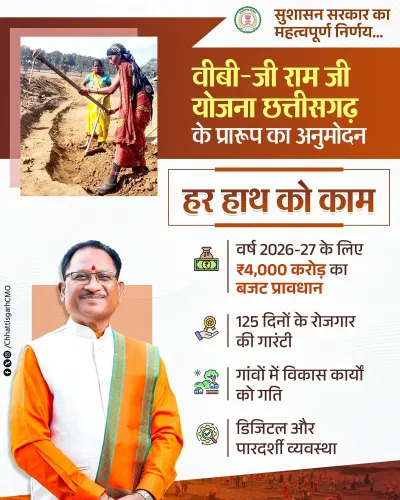
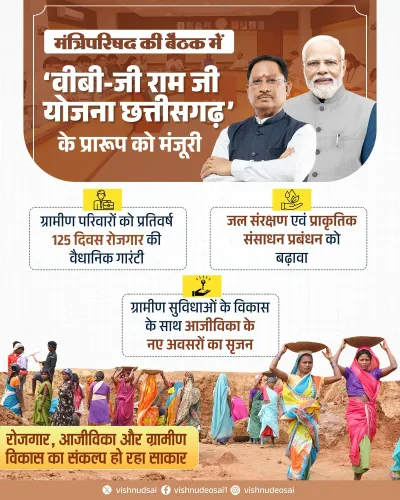
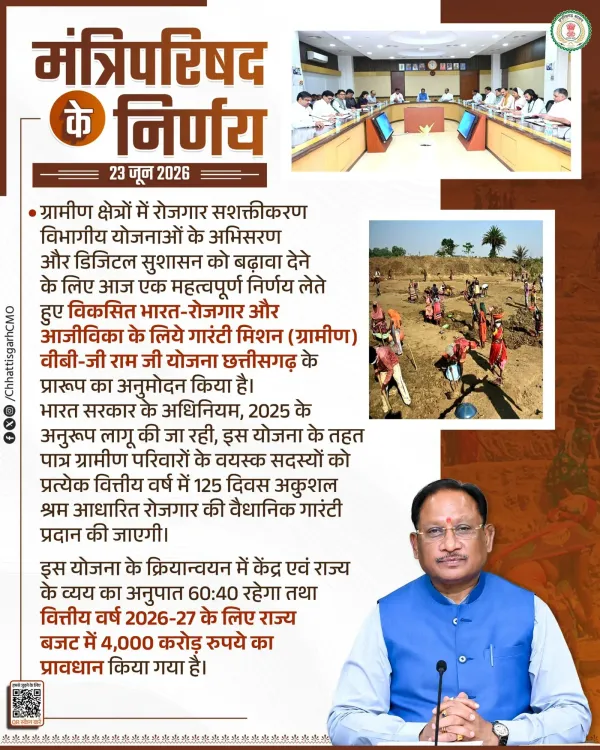
The Chief Minister's Office of Chhattisgarh announced on Tuesday, 23 June 2026 that the state's Council of Ministers has approved a landmark rural employment scheme, the Viksit Bharat - Rozgar aur Aajivika ke liye Guarantee Mission (Gramin), formally titled the VB-G Ram Ji Yojana Chhattisgarh, aimed at expanding employment, empowerment, and digital governance in rural areas.
Context
The cabinet decision, shared by the Chief Minister's Office on its official X account, states that the mission is designed to promote employment, empowerment, convergence of departmental schemes, and digital good governance in rural Chhattisgarh. The scheme's name draws from the national Viksit Bharat framework, signalling alignment with the Government of India's broader ambition to build a developed economy by 2047. The post translates as: 'The Council of Ministers, in an important decision today, has approved the Viksit Bharat - Employment and Livelihood Guarantee Mission (Rural): VB-G Ram Ji Yojana Chhattisgarh, to promote employment, empowerment, convergence of departmental schemes, and digital governance in rural areas.'
Policy Backdrop
Rural employment guarantee as a policy instrument has deep roots in India. The Mahatma Gandhi National Rural Employment Guarantee Act (MGNREGA), enacted in 2005, established the principle of 100 days of guaranteed wage employment for rural households across the country, and remains the backbone of rural livelihood support. State governments have increasingly built upon this foundation by launching convergence missions that bundle multiple central and state schemes under a single delivery architecture, often with digital tracking and grievance mechanisms.
Chhattisgarh's VB-G Ram Ji Yojana follows this pattern, explicitly incorporating digital governance as a pillar alongside employment generation. The scheme's framing under the Viksit Bharat@2047 umbrella reflects a wider national trend of states anchoring their social welfare programmes to the Centre's long-term development vision, enabling potential convergence of funding streams and administrative oversight.
Stakeholders and Impact
Rural households across Chhattisgarh stand as the primary beneficiaries of the scheme, with village panchayats expected to serve as key implementation nodes at the grassroots level. The emphasis on convergence of departmental schemes suggests that existing programmes across agriculture, skill development, and social welfare may be brought under a unified mission framework, potentially reducing duplication and improving last-mile delivery. The digital governance component could enable real-time monitoring of beneficiary enrolment and wage disbursement, addressing longstanding concerns about leakages in rural welfare delivery.
What's Next
Observers will watch closely for the release of detailed implementation guidelines, including eligibility criteria, the number of guaranteed employment days, and the specific departmental schemes to be converged under the mission. State budget allocations for the VB-G Ram Ji Yojana and the mechanism for integration with MGNREGA and other centrally sponsored rural schemes will be critical indicators of the programme's scale and ambition. The Chhattisgarh government's ability to operationalise the digital backbone of the scheme at the panchayat level will determine whether the mission delivers on its governance reform promise.
Point of View
The government is likely seeking both political alignment and potential access to centrally pooled resources. The emphasis on digital governance is notable — it reflects a broader shift among state governments toward accountability infrastructure, not just benefit delivery. The real test will be whether the scheme's convergence architecture translates into measurable outcomes for rural households or remains a repackaging of existing programmes.
NationPress
22 Sept 2026
Frequently Asked Questions
What is the VB-G Ram Ji Yojana Chhattisgarh?
The VB-G Ram Ji Yojana Chhattisgarh, formally called the Viksit Bharat - Rozgar aur Aajivika ke liye Guarantee Mission (Gramin), is a state-level rural employment and livelihood guarantee scheme approved by the Chhattisgarh Council of Ministers on 23 June 2026.
What is the aim of the VB-G Ram Ji Yojana?
The scheme aims to promote employment, empowerment, convergence of departmental schemes, and digital governance in rural areas of Chhattisgarh.
Who will benefit from the VB-G Ram Ji Yojana Chhattisgarh?
Rural households across Chhattisgarh are the primary beneficiaries, with village panchayats expected to serve as key implementation units at the grassroots level.
How is the VB-G Ram Ji Yojana different from MGNREGA?
While MGNREGA is a central law guaranteeing 100 days of wage employment, the VB-G Ram Ji Yojana is a state-level mission that seeks to converge multiple departmental schemes and add a digital governance layer; detailed integration with MGNREGA has not yet been publicly announced.
What is the Viksit Bharat framework that the scheme is linked to?
Viksit Bharat is a national initiative of the Government of India aimed at transforming India into a developed economy by 2047, with emphasis on employment, governance reforms, and inclusive growth.