CM Sai Backs Viksit Bharat-Ji Ram Ji Yojana for Rural Jobs

Synopsis
Chhattisgarh CM Vishnu Deo Sai on 7 July 2026 spotlighted the Viksit Bharat-Ji Ram Ji Yojana, which promises 125 days of rural employment — 25 more than the MGNREGA baseline — to strengthen village-level livelihoods under the BJP's double-engine governance model.
Key Takeaways
Vishnu Deo Sai , Chief Minister of Chhattisgarh , publicly promoted the Viksit Bharat-Ji Ram Ji Yojana on 7 July 2026 .
The scheme guarantees 125 days of rural wage employment per household, exceeding MGNREGA's central guarantee of 100 days .
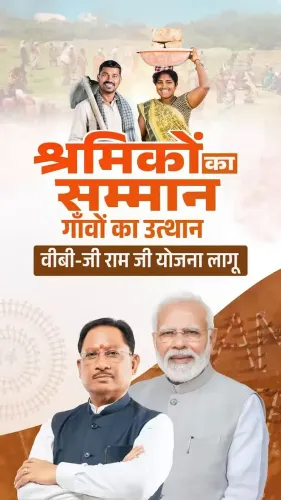
CM Sai framed it as a 'double-engine government' initiative aligning state delivery with the national Viksit Bharat vision for 2047 .
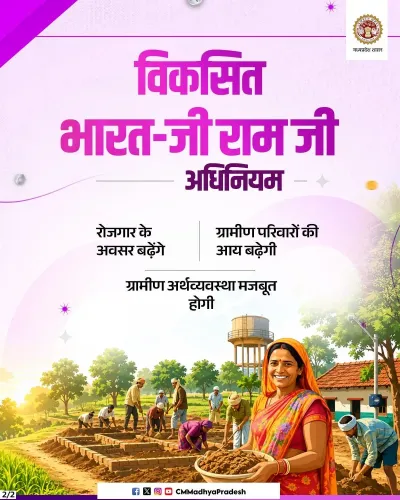
The scheme aims to provide dignified livelihoods to rural families within their own villages , targeting distress migration.
District-level rollout data and funding details are yet to be officially confirmed and will be closely watched.
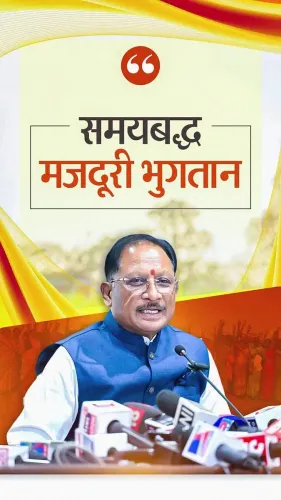
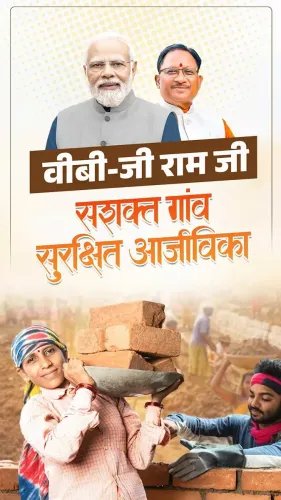
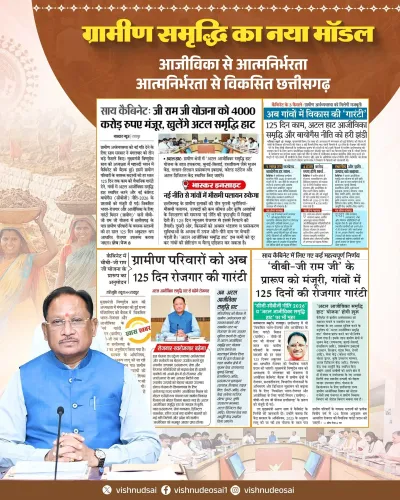
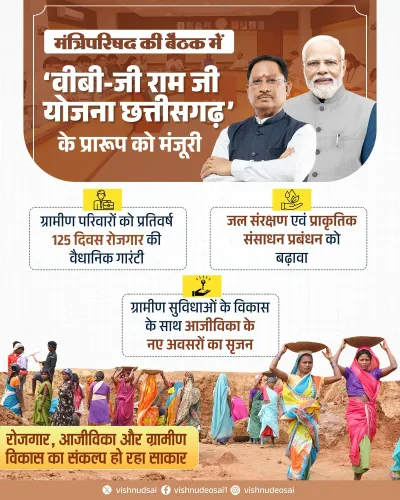
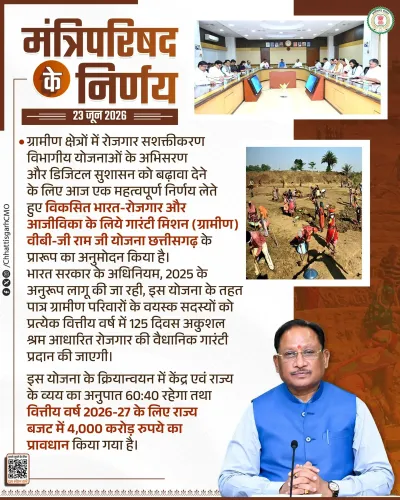
Chhattisgarh Chief Minister Vishnu Deo Sai on Tuesday, 7 July 2026 highlighted the state government's Viksit Bharat-Ji Ram Ji Yojana, describing it as a key initiative to strengthen the rural economy by guaranteeing 125 days of employment to rural families across the state.
In his post, CM Sai wrote: 'हर हाथ को काम, हर परिवार को सम्मान' ('Work for every hand, dignity for every family'), framing the scheme as giving rural households a 'dignified livelihood and a better future right in their own villages.'
Context
The Viksit Bharat-Ji Ram Ji Yojana is positioned by the Bharatiya Janata Party-led state government as an extension of the broader national vision of a developed India by 2047. CM Sai described it as a product of the 'double-engine government' — a phrase BJP uses to describe concurrent rule at the central and state levels, arguing it enables faster and more coordinated scheme delivery.
The scheme's central promise — 125 days of guaranteed rural wage employment — goes beyond the 100-day guarantee enshrined in the central Mahatma Gandhi National Rural Employment Guarantee Act (MGNREGA) of 2005. The additional 25 days would, if borne by the state, represent a meaningful top-up to the existing federal framework.
Policy Backdrop
MGNREGA, enacted in 2005, remains India's largest rural employment safety net, legally guaranteeing at least 100 days of wage work per household per year. Several Indian states have over the years supplemented this floor with additional days funded through state budgets, seeking to address seasonal unemployment and rural distress more aggressively.
Chhattisgarh, a central Indian state with a large tribal and agrarian population, has consistently seen rural employment and livelihood programmes as a political and administrative priority. The BJP government, which returned to power in Chhattisgarh after the 2023 assembly elections, has sought to align state welfare delivery with the central government's Viksit Bharat branding.
Stakeholders and Impact
The scheme directly targets rural families in Chhattisgarh, particularly those dependent on agricultural wages and daily labour. By guaranteeing employment within the village itself, the initiative aims to reduce distress migration to urban centres — a persistent challenge in states with high tribal and rural populations.
If implemented at scale, the additional 25 days of employment over the MGNREGA baseline could meaningfully supplement household incomes for lakhs of families in the state's rural districts. Gram panchayats and district administrations are the primary delivery mechanism for such schemes.
What's Next
Attention will now turn to the district-level rollout of the Viksit Bharat-Ji Ram Ji Yojana, including operational guidelines, wage rates, and the source of supplementary funding — details that are expected to emerge through official state government notifications and the next Chhattisgarh assembly session. The scheme's actual reach and implementation fidelity will determine whether it delivers on the promise of 'सम्मानजनक आजीविका' ('dignified livelihood') that CM Sai has publicly committed to.
Point of View
Directly linking Chhattisgarh's governance to the Centre's Viksit Bharat 2047 framework. The 125-day employment promise — 25 days above the MGNREGA floor — is a politically significant signal in a state where tribal and agrarian voters are a decisive constituency. However, the scheme's credibility will hinge on verifiable rollout data and transparent funding disclosures, which remain outstanding. This pattern of state-level MGNREGA supplementation is increasingly common among BJP-ruled states, suggesting a coordinated federal strategy to outflank the opposition on rural welfare terrain.
NationPress
6 Oct 2026
Frequently Asked Questions
What is the Viksit Bharat-Ji Ram Ji Yojana in Chhattisgarh?
The Viksit Bharat-Ji Ram Ji Yojana is a Chhattisgarh state government rural employment scheme that guarantees 125 days of wage work to rural households, exceeding the 100-day central MGNREGA guarantee by 25 days. It is aimed at providing dignified livelihoods to village families within their own communities.
How is the Viksit Bharat-Ji Ram Ji Yojana different from MGNREGA?
MGNREGA, the central law enacted in 2005, guarantees a minimum of 100 days of rural employment per household. The Viksit Bharat-Ji Ram Ji Yojana extends this to 125 days, with the additional 25 days expected to be funded through state resources.
Who announced the Viksit Bharat-Ji Ram Ji Yojana?
Chhattisgarh Chief Minister Vishnu Deo Sai highlighted the scheme on 7 July 2026 via a post on X, describing it as a key initiative of the BJP's double-engine government to strengthen the rural economy.
What does 'double-engine government' mean in the context of this scheme?
The BJP uses 'double-engine government' to describe states where both the central and state governments are BJP-led, arguing this alignment enables faster and more coordinated delivery of welfare schemes like the Viksit Bharat-Ji Ram Ji Yojana.
Who benefits from the Viksit Bharat-Ji Ram Ji Yojana?
Rural families in Chhattisgarh, particularly those dependent on agricultural wages and daily labour, are the primary beneficiaries. The scheme is designed to reduce distress migration by ensuring employment is available within the village itself.