MP CM Office Backs 'Viksit Bharat-Ji Ram Ji Act' for Rural Jobs
Synopsis
The Chief Minister's Office of Madhya Pradesh has announced the 'Viksit Bharat-Ji Ram Ji Act', a state legislative measure aimed at expanding rural employment opportunities, aligning with the Centre's Viksit Bharat 2047 vision. Details on funding and implementation are awaited.
Key Takeaways
The Chief Minister's Office of Madhya Pradesh announced the 'Viksit Bharat-Ji Ram Ji Adhiniyam' on 15 July 2026 .
The act is explicitly aimed at increasing employment opportunities in rural areas of Madhya Pradesh.
The measure is branded under the national Viksit Bharat framework, which targets India's development by 2047 .
Primary stakeholders include rural workers and village panchayats across the state.
The act is expected to complement existing central schemes such as MGNREGA , which guarantees 100 days of rural wage employment.
Specific funding, eligibility rules, and implementation guidelines are yet to be formally announced.
The Chief Minister's Office of Madhya Pradesh announced on Wednesday, 15 July 2026, that the state is moving to expand rural employment opportunities through a measure titled the 'Viksit Bharat-Ji Ram Ji Adhiniyam' (Viksit Bharat-Ji Ram Ji Act), explicitly linking the initiative to the national Viksit Bharat development vision.
Context
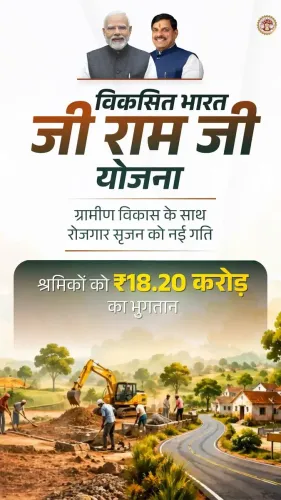
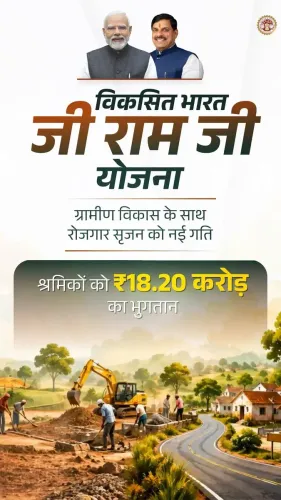
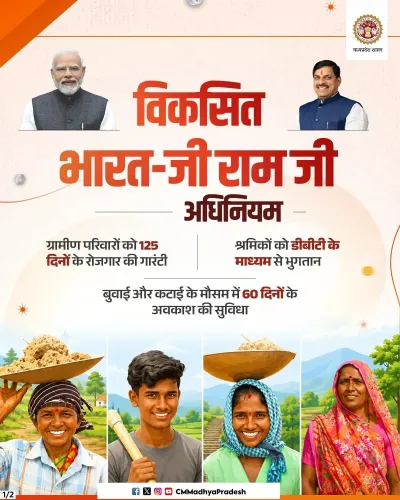
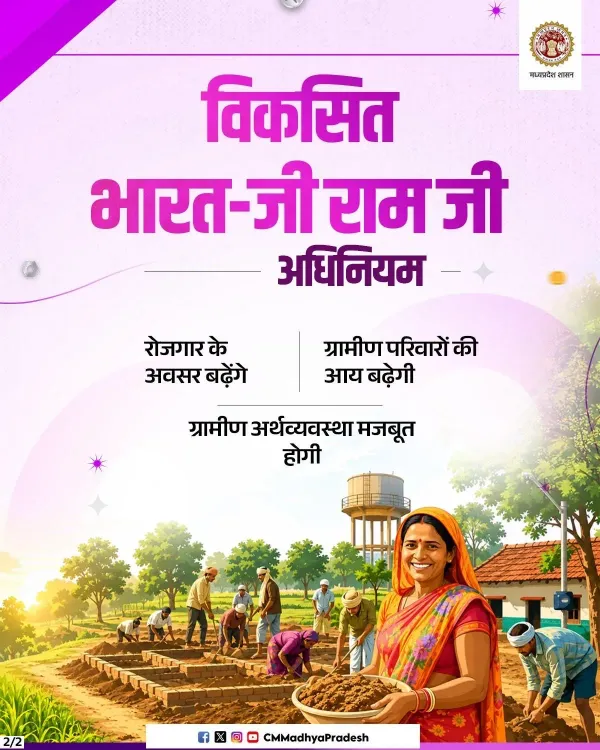
The post, shared from the official @CMMadhyaPradesh handle, states: 'विकसित भारत-जी राम जी अधिनियम' ('Viksit Bharat-Ji Ram Ji Act') — ग्रामीण क्षेत्रों में बढ़ेंगे रोजगार के अवसर ('Employment opportunities will increase in rural areas'). The announcement frames the act as a direct instrument for rural livelihood expansion within Madhya Pradesh.
The name of the act signals a deliberate alignment with the Centre's Viksit Bharat mission, the Government of India's overarching goal of transforming the country into a fully developed nation by 2047. By embedding that branding into state legislation, the Madhya Pradesh government is positioning this measure within the national development framework.
Policy Backdrop
Rural employment legislation in India has a long lineage. The Mahatma Gandhi National Rural Employment Guarantee Act (MGNREGA), passed in 2005, established a statutory right to at least 100 days of wage employment per year for rural households and remains the backbone of rural work guarantees in the country.
Successive central and state governments have layered additional schemes and legislative tools on top of MGNREGA to address gaps in coverage, skill development, and livelihood diversification. Madhya Pradesh has historically supplemented central rural employment programmes with state-specific initiatives, and the new act appears to follow that pattern while invoking the Viksit Bharat umbrella.
Stakeholders and Impact
The primary beneficiaries of the proposed act are rural workers across Madhya Pradesh, a state with a large agrarian population spread across its districts. Village panchayats are expected to play a key role in implementation, as they do under MGNREGA, serving as the local administrative units through which rural employment schemes are typically channelled.
Broader rural communities stand to benefit if the act succeeds in generating sustained non-farm employment, reducing seasonal migration and improving household incomes in the state's rural belt.
What's Next
The details of the act — including its funding structure, eligibility criteria, wage provisions, and convergence with existing central schemes such as MGNREGA — are expected to emerge through state assembly debates or formal budget announcements. Observers will watch for whether the legislation introduces new categories of guaranteed work, extends coverage beyond existing schemes, or creates dedicated rural employment funds at the state level.
The announcement marks an early signal of Madhya Pradesh's legislative intent; the policy's real impact will depend on implementation rules, budgetary allocations, and coordination between state departments and local governance bodies.
Point of View
Tying state legislative action to the ruling alliance's flagship national narrative ahead of future electoral cycles. By legislating rather than merely announcing a scheme, the state signals a degree of institutional commitment that goes beyond budgetary line items. The move also reflects a broader pattern among BJP-governed states of using nomenclature and branding to reinforce alignment with the Centre's development agenda. Whether the act delivers substantive gains for rural workers will ultimately depend on the fiscal muscle and administrative machinery deployed behind it.
NationPress
13 Oct 2026
Frequently Asked Questions
What is the Viksit Bharat-Ji Ram Ji Adhiniyam in Madhya Pradesh?
The Viksit Bharat-Ji Ram Ji Adhiniyam is a state legislative measure announced by the Chief Minister's Office of Madhya Pradesh on 15 July 2026, aimed at increasing employment opportunities in rural areas of the state.
How does the new MP rural employment act relate to MGNREGA?
The new act is expected to complement MGNREGA, the central law that guarantees 100 days of wage employment to rural households. Madhya Pradesh has historically supplemented central rural employment schemes with state-specific measures, and this act follows that pattern.
What is the Viksit Bharat vision the act is linked to?
Viksit Bharat is the Government of India's goal to transform India into a fully developed nation by 2047, covering employment, infrastructure, and human development. The Madhya Pradesh act explicitly aligns itself with this national framework.
Who will benefit from the Viksit Bharat-Ji Ram Ji Adhiniyam?
The primary beneficiaries are rural workers in Madhya Pradesh and village panchayats, which are expected to serve as local implementation bodies for the act.
When will the details of the MP rural jobs act be available?
Specific details including funding, eligibility, and implementation rules are expected to be disclosed through state assembly debates or formal budget announcements following the initial announcement on 15 July 2026.