CM Sai Honours Jashpur's Bihan Women as Drone Pilots
Synopsis
Chief Minister Vishnu Deo Sai awarded drone pilot certificates to four Bihan self-help group women from Jashpur on 5 November 2026, framing the initiative as a bridge between agricultural mechanisation and rural women's economic empowerment in Chhattisgarh.
Key Takeaways
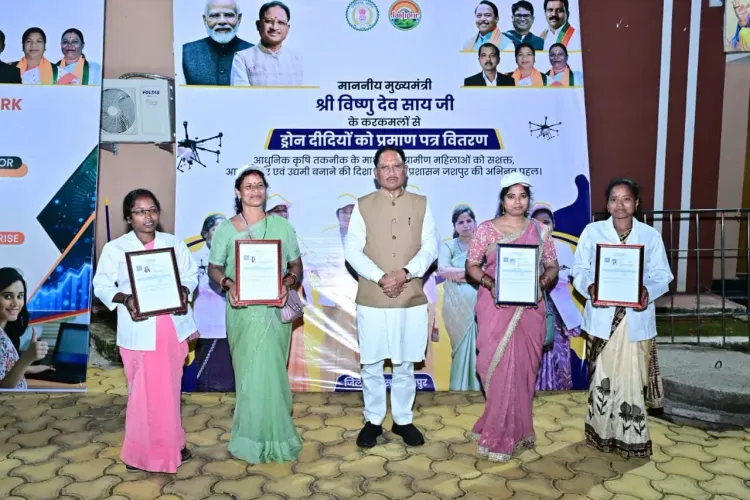
CM Vishnu Deo Sai presented drone pilot completion certificates to four Bihan women from Jashpur at the Bagiya camp office on 5 November 2026 .
The Bihan Mission , Chhattisgarh's women self-help group livelihood programme, is expanding into drone-based agricultural skill training.
Jashpur , a tribal-majority district in northern Chhattisgarh, is among the early sites for this technology-meets-empowerment push.
Certified women can offer drone crop-spraying services as self-employment, creating new income streams in the rural economy.
The initiative aligns with the Government of India's drone agriculture subsidies under the Sub-Mission on Agricultural Mechanization introduced in 2021-22 .
Multiple Indian states are running similar programmes linking rural women's self-help groups with certified drone operations for precision farming.
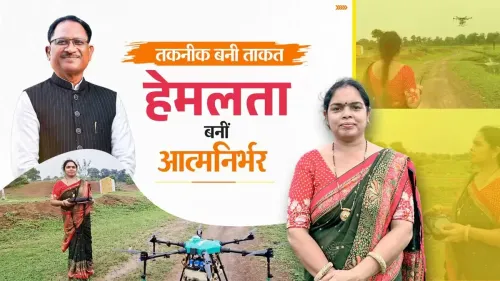
Four women from Jashpur district's Bihan self-help groups have crossed a milestone that would have seemed improbable just years ago — they are now certified drone pilots. Chief Minister Vishnu Deo Sai personally handed them their completion certificates at the camp office in Bagiya during his Jashpur visit on 5 November 2026, placing the moment at the intersection of agricultural modernisation and rural women's empowerment.
What four Bihan 'didis' just proved in Jashpur
Speaking at the ceremony, CM Sai said the state government is actively pushing modern technology and mechanisation into the farm sector. 'ड्रोन तकनीक से कृषि कार्य अधिक सरल, समयबद्ध और प्रभावी होंगे' — 'Drone technology will make farm work simpler, time-bound and more effective,' he said. The practical upside is tangible: a drone can spray pesticides or fertilisers across a large area in a fraction of the time it takes manual labour, cutting both cost and drudgery for farmers.
Jashpur is a predominantly tribal district in northern Chhattisgarh where agriculture drives most livelihoods. Training women here — not in a city lab but at the district level — signals a deliberate push to make technology adoption local rather than aspirational.
Bihan Mission's expanding role in skill development
The Bihan Mission was designed to build livelihoods for women self-help groups across Chhattisgarh, moving beyond microfinance into skill-linked income. Drone pilot certification represents one of its more visible technological upgrades, connecting rural women directly to India's broader push for precision agriculture. The Government of India introduced drone subsidies and operational guidelines under the Sub-Mission on Agricultural Mechanization from 2021-22 onwards, and states have been encouraged to integrate this into existing rural livelihood schemes.
CM Sai framed the programme explicitly as an employment engine: trained women can offer drone-based crop-spraying services as self-employment, strengthening their participation in the rural economy. 'New avenues of employment and self-employment will open for women, and they will be able to strengthen their contribution to the rural economy,' he added.
A pattern spreading across Indian states
Chhattisgarh is not alone. Several states have begun certifying rural women from self-help groups as drone operators, using the overlap between agricultural mechanisation policy and women's livelihood missions to create a new category of skilled rural worker. What makes the Bihan programme noteworthy is its reach into tribal-majority districts where both farm productivity challenges and women's economic marginalisation tend to be sharper.
The question now is velocity — how quickly Chhattisgarh scales this beyond the first certified cohort and whether state budget allocations follow to build drone training infrastructure across more districts.
Four women in Jashpur just demonstrated what that future looks like. The government's next job is to make them the rule, not the exception.
Point of View
The optics are deliberate: tribal-district women as tech-enabled entrepreneurs sits squarely in the 'Viksit Bharat' narrative ahead of future electoral cycles. The deeper policy bet, however, is whether a certified pilot translates into a revenue-earning operator — which requires not just training but a sustained market for drone spraying services and state support for equipment access.
NationPress
5 Nov 2026
Frequently Asked Questions
What is the Bihan Mission in Chhattisgarh?
The Bihan Mission is a Chhattisgarh government programme that supports women self-help groups with livelihood opportunities, skill development and economic participation, moving beyond microfinance into training for income-generating activities.
What did CM Vishnu Deo Sai do in Jashpur on 5 November 2026?
CM Vishnu Deo Sai visited Jashpur and awarded drone pilot completion certificates to four Bihan women at the Bagiya camp office, congratulating them and outlining the state's agricultural mechanisation vision.
How does drone technology help farmers in Chhattisgarh?
Drones allow faster, more precise spraying of pesticides and fertilisers across large farm areas, saving time and manual labour — a significant benefit for farmers in agriculture-dependent districts like Jashpur.
Can Bihan women earn income as drone pilots?
Yes. Certified Bihan drone pilots can offer crop-spraying services to local farmers as self-employment, creating a new income stream and deepening their participation in the rural economy.
Is Chhattisgarh the only state training rural women as drone pilots?
No. Several Indian states have begun training women from self-help groups as certified drone operators under agricultural mechanisation and rural livelihood missions, with Chhattisgarh's Bihan programme following this broader national pattern.