CM Sai Backs Shala Praveshotsav as Chhattisgarh's Education Drive
Synopsis
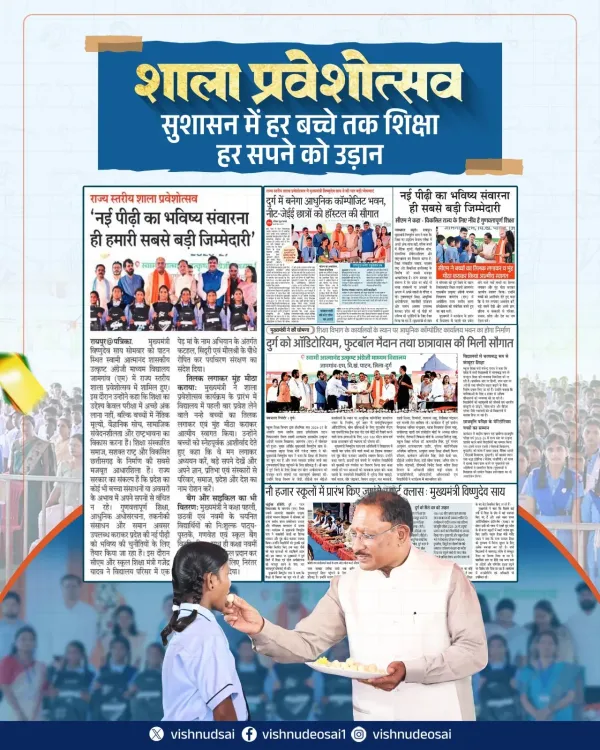
Chhattisgarh Chief Minister Vishnu Deo Sai marked Shala Praveshotsav on 21 July 2026, calling education the strongest foundation of a prosperous state and pledging quality schooling and equal opportunity for every child as his government's highest priority.
Key Takeaways
CM Vishnu Deo Sai posted on 21 July 2026 reaffirming education as Chhattisgarh's top development priority.
Shala Praveshotsav is an annual school enrollment festival aimed at driving universal access to education across the state.
The initiative is underpinned by the Right to Education Act, 2009 , which mandates free schooling for children aged 6 to 14 .
The Samagra Shiksha Abhiyan (2018) provides federal funding for school infrastructure and enrollment efforts in Chhattisgarh .
Rural, tribal, and first-generation learners are the primary target group of the enrollment campaign.
District-wise enrollment outcomes and the next state budget's education outlay will be key indicators of follow-through.
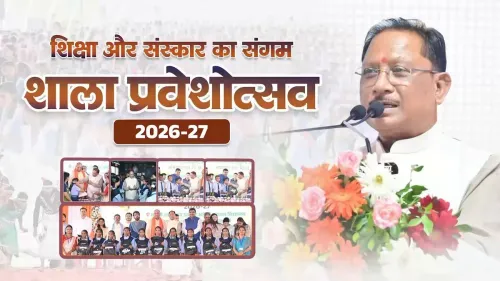
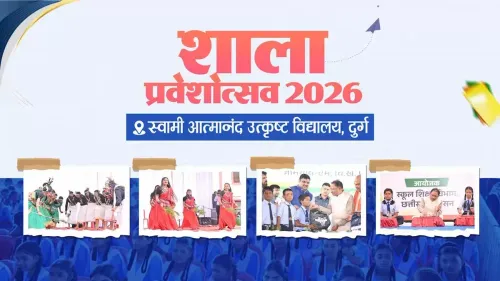
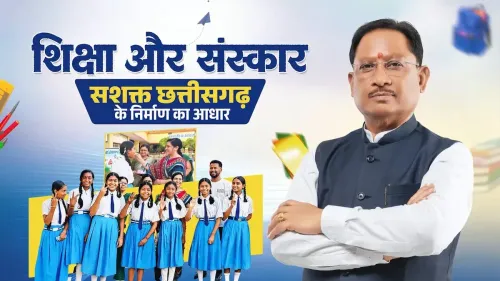
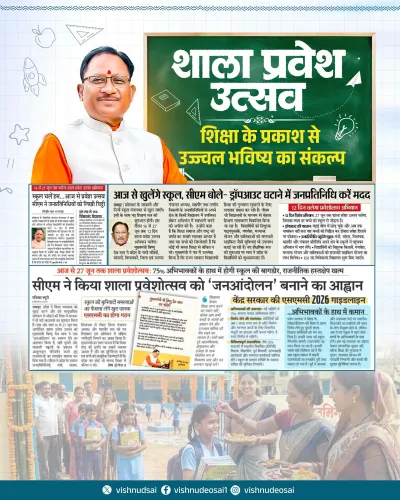
Chhattisgarh Chief Minister Vishnu Deo Sai on Tuesday, 21 July 2026 reaffirmed his government's commitment to universal quality education, calling Shala Praveshotsav — the state's annual school enrollment festival — a collective pledge for the bright future of every child in the state.
Posting in Hindi on X, CM Sai stated: 'Shiksha hi samridh Chhattisgarh ki sabse mazboot neev hai' ['Education is the strongest foundation of a prosperous Chhattisgarh']. He described Shala Praveshotsav not merely as a school admission exercise, but as a 'sankalp' — a solemn resolve — for the luminous future of every young child. Ensuring that each child receives quality education, better opportunities, and an equal chance to develop their talent, he wrote, is the government's 'highest priority.'
Context
Shala Praveshotsav is an annual state-level enrollment festival observed across Chhattisgarh at the start of the academic year to drive universal school access and celebrate the entry of new students into the formal education system. The event brings together local administrators, teachers, and community members to welcome children — particularly first-generation learners from rural and tribal households — into classrooms.
CM Sai, who assumed office in December 2023 as the BJP government returned to power in the state, has consistently positioned education as a central development pillar of his administration.
Policy Backdrop
The enrollment drive draws its legal foundation from the Right to Education Act, 2009, which mandates free and compulsory schooling for children aged 6 to 14 across India, including Chhattisgarh. The act obligates state governments to ensure every child in this age group is enrolled and retained in school.
At the national level, the Samagra Shiksha Abhiyan, launched in 2018 by merging earlier centrally sponsored schemes, provides states with financial and infrastructural support to improve school quality and boost enrollment figures. Chhattisgarh has been a beneficiary of this umbrella programme, channelling funds toward classroom construction, teacher training, and mid-day meal coverage. The government's emphasis on foundational literacy also aligns with the goals of the National Education Policy (NEP) 2020, which prioritises early childhood learning and universal basic education.
Stakeholders and Impact
The primary beneficiaries of Shala Praveshotsav are school-going children, particularly those from rural, tribal, and economically marginalised families in Chhattisgarh, a state with significant Scheduled Tribe and Scheduled Caste populations spread across districts such as Bastar, Surguja, and Raipur. For many rural parents, the festival serves as a visible government signal that enrolling children — including girls — is a state priority, not merely a bureaucratic requirement.
Teachers and local school management committees are central to the event's execution, as they coordinate community outreach and admission drives. A successful enrollment season directly influences the state's literacy metrics and its standing under centrally monitored education indices.
What's Next
Attention will now turn to district-wise enrollment data expected to be published in the weeks following the festival, which will indicate whether the campaign translated into measurable gains in school attendance and new admissions. Education observers and opposition legislators are likely to scrutinise these figures alongside the allocation for the education sector in Chhattisgarh's next state budget. The government's ability to move beyond ceremonial enrollment drives toward sustained improvements in learning outcomes and teacher deployment will determine the longer-term impact of its stated education-first agenda.
Point of View
The messaging seeks to emotionally invest communities, particularly in rural and tribal belts, in the education agenda. This fits a broader national BJP pattern of using ceremonial education events to reinforce welfare-state credentials ahead of local body elections and budget cycles. The real test, however, lies in post-festival enrollment data and whether learning outcome indicators in Chhattisgarh improve in subsequent national assessments.
NationPress
20 Oct 2026
Frequently Asked Questions
What is Shala Praveshotsav in Chhattisgarh?
Shala Praveshotsav is an annual school enrollment festival held in Chhattisgarh at the start of the academic year to promote universal access to education and formally welcome new students into government schools, especially in rural and tribal areas.
What did CM Vishnu Deo Sai say about education on 21 July 2026?
CM Vishnu Deo Sai said education is the strongest foundation of a prosperous Chhattisgarh and described Shala Praveshotsav as a collective pledge for every child's bright future, calling quality education and equal opportunity the government's highest priority.
What is the Right to Education Act and how does it apply to Chhattisgarh?
The Right to Education Act, 2009 mandates free and compulsory schooling for all children aged 6 to 14 across India. Chhattisgarh, like all states, is legally bound to ensure every child in this age group is enrolled and retained in school.
What is Samagra Shiksha Abhiyan and does Chhattisgarh benefit from it?
Samagra Shiksha Abhiyan is a centrally sponsored scheme launched in 2018 that merged earlier education programmes to improve school infrastructure, teacher quality, and enrollment. Chhattisgarh receives funding under this scheme to support its education initiatives.
When did Vishnu Deo Sai become Chief Minister of Chhattisgarh?
Vishnu Deo Sai assumed office as Chief Minister of Chhattisgarh in December 2023 after the BJP won the state assembly elections.