CM Sai Pledges Equal Opportunity for Chhattisgarh Youth
Synopsis
Chhattisgarh Chief Minister Vishnu Deo Sai on 6 June 2026 reaffirmed his government's pledge to provide equal education and skill development opportunities for children from poor and deprived families, calling merit-recognition the hallmark of good governance.
Key Takeaways
CM Vishnu Deo Sai posted on 6 June 2026 reaffirming commitment to equal opportunity for all children in Chhattisgarh .
The post frames suśāsan (good governance) as synonymous with honouring and nurturing talent.
Children from poor and deprived families are the stated focus, with quality education, skill development, and self-reliance as the three pillars.
The message aligns with national frameworks including NEP 2020 and the Skill India Mission (2015) .
Sai has served as Chief Minister since December 2023 , with human capital development a consistent theme of his administration.
State budget allocations for scholarships and school infrastructure will be the next concrete test of these commitments.
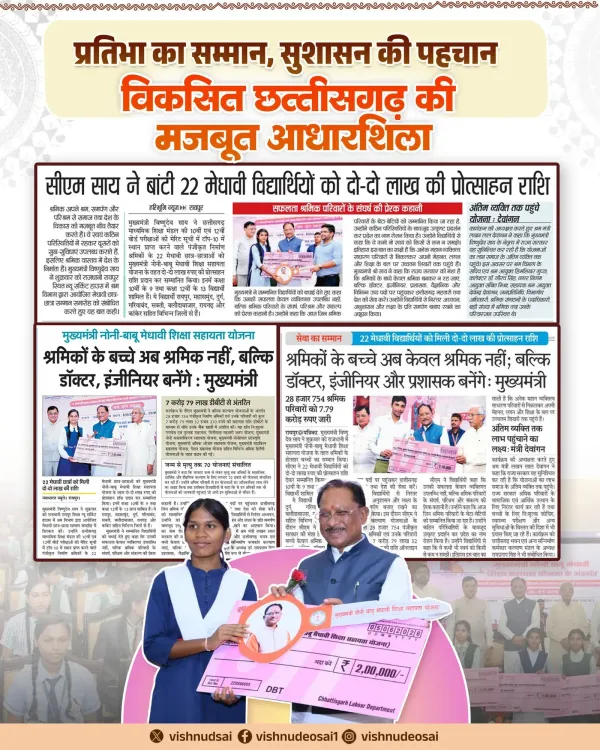
Chhattisgarh Chief Minister Vishnu Deo Sai on Saturday, 6 June 2026, reaffirmed his government's commitment to building a state where every child — regardless of economic background — receives equal opportunity to develop their talent and realise their aspirations. The post, shared on X, frames merit-recognition as a defining hallmark of what the Chief Minister calls a suśāsan sarkār (good governance government).
Context
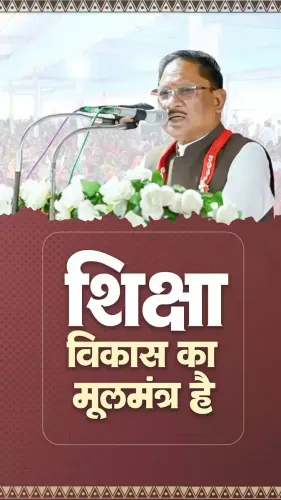
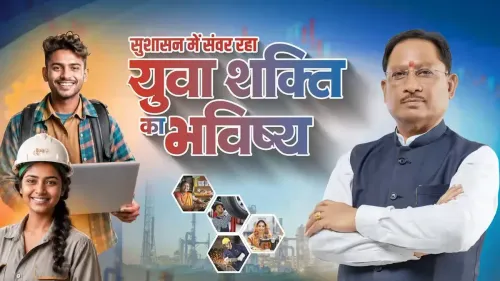
In the post, CM Sai wrote: 'Pratibhā kā sammān, suśāsan sarkār kī pahchān' — 'Honouring talent is the identity of a good governance government.' He stated that his administration is resolved to build a Chhattisgarh where every son and daughter gets equal opportunity to sharpen their abilities, turn dreams into reality, and reach new heights. The message specifically highlights children from poor and deprived families, pledging to connect them with quality education, skill development, and self-reliance as the foundation of a brighter future.
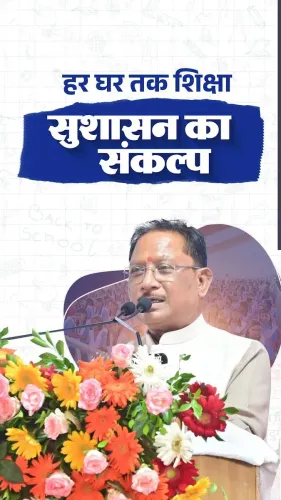
The Chief Minister concluded with a broader social argument: 'When talent gets opportunity, not just one individual but the entire society and state moves forward.' The post was accompanied by one image and was published in Hindi.
Policy Backdrop
Vishnu Deo Sai assumed office as Chief Minister of Chhattisgarh in December 2023 after the BJP returned to power in the state. Since then, the government has consistently positioned suśāsan — good governance — as its central brand, with human capital development cited as a pillar of that agenda. Chhattisgarh has a substantial tribal and rural population, and access to quality education has long been a structural policy challenge in the state.
The post's emphasis on equity in education aligns with the national National Education Policy 2020, which calls for overhauling school and higher education with a focus on quality and inclusion. It also resonates with the Skill India Mission, launched in 2015, which expanded vocational training and employability pathways for youth from disadvantaged backgrounds. The Right to Education Act, 2009 had earlier mandated free and compulsory schooling for children aged 6 to 14 across the country, providing a legal baseline that state governments are expected to build upon.
Stakeholders and Impact
The primary beneficiaries named in the post are children from poor and deprived families — a demographic that constitutes a significant share of Chhattisgarh's population, particularly in its rural and forested districts. For these households, barriers to quality schooling and vocational training remain real, making state-level commitment to bridging those gaps consequential.
The broader framing — that investing in individual talent yields collective progress for society and the state — is a message directed at multiple audiences: students and families seeking upward mobility, educators and administrators responsible for delivery, and voters who assess governance performance. Similar messaging has been deployed by other BJP-governed states linking education access for poorer households to inclusive growth narratives.
What's Next
Observers will look to Chhattisgarh's upcoming state budget allocations as a concrete test of these commitments — specifically, outlays for scholarships, school infrastructure, and vocational training centres in underserved districts. Progress in implementing NEP 2020 provisions at the school level within the state will also be a key indicator of whether the governance rhetoric translates into measurable outcomes for the children the Chief Minister has highlighted.
Point of View
The message attempts to neutralise a traditional opposition argument that the party governs for elites. The framing mirrors a wider BJP playbook visible across states: linking national schemes like NEP 2020 and Skill India to local governance credibility. The real test, however, will come when state budget figures and enrolment or skilling data are available to verify whether the rhetoric has been matched by resource allocation.
NationPress
21 Oct 2026
Frequently Asked Questions
Who is Vishnu Deo Sai and what is his role?
Vishnu Deo Sai is a senior BJP leader who has served as Chief Minister of Chhattisgarh since December 2023 , when the party returned to power in the state.
What did CM Sai say about education in Chhattisgarh?
CM Sai stated that his government is committed to giving every child — especially those from poor and deprived families — equal access to quality education, skill development, and self-reliance, describing this as the foundation of a brighter future.
What is 'suśāsan sarkār' as used by CM Sai?
Suśāsan sarkār translates to 'good governance government' in English. CM Sai uses the phrase as a defining identity for his administration in Chhattisgarh , linking it to policies on education, talent development, and inclusive growth.
How does this relate to NEP 2020 and Skill India?
CM Sai's emphasis on quality education and skill development for disadvantaged youth aligns with the national National Education Policy 2020 and the Skill India Mission (2015) , both of which prioritise equity and vocational training for youth from poorer backgrounds.
What should citizens watch for next regarding Chhattisgarh education policy?
Key indicators to watch include Chhattisgarh's upcoming state budget allocations for scholarships and school infrastructure, as well as the state's progress in implementing NEP 2020 provisions in underserved rural and tribal districts.