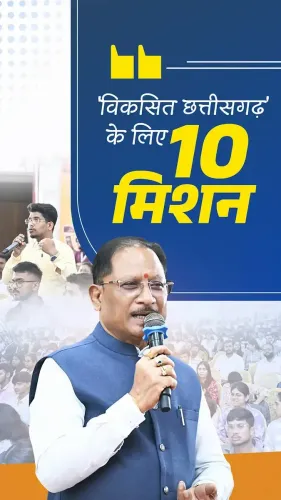
CM Sai Cites IMF 7% Growth Forecast for India in 2026-27
Synopsis
Chhattisgarh CM Vishnu Deo Sai cited IMF projections of 7% GDP growth for India in 2026 and 2027 — more than double the global average of 3.1% — linking the figures to PM Modi's Viksit Bharat @ 2047 vision and India's accelerating global economic influence.
Key Takeaways
The IMF has projected 7% GDP growth for India in both 2026 and 2027 , according to Chhattisgarh CM Vishnu Deo Sai's post on October 13, 2026 .
The projected global growth rate for 2026 stands at just 3.1% — less than half of India's forecast pace.
CM Sai framed the figures as evidence of PM Narendra Modi's economic leadership bearing results on the world stage.
The projections are directly linked to the Viksit Bharat @ 2047 vision, which targets transforming India into a fully developed economy by the centenary of independence.
India has consistently received the highest growth forecasts among major economies in successive IMF outlooks, reflecting a broader pattern of structural outperformance.
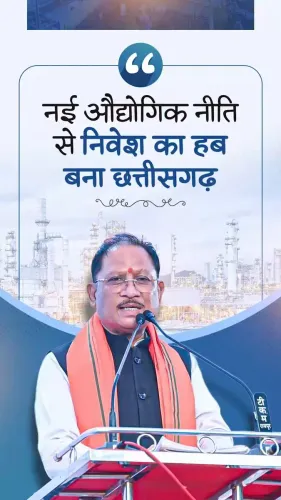
While the global economy braces for a sluggish 3.1% growth rate in 2026, India is on track to nearly double that pace — and Chhattisgarh Chief Minister Vishnu Deo Sai wants every Indian to know it. On Tuesday, October 13, 2026, Sai took to X to highlight the International Monetary Fund's (IMF) projection of 7% GDP growth for India in both 2026 and 2027, framing it as proof that Prime Minister Narendra Modi's economic vision is paying off on the world stage.
India at 7%, the World at 3.1%: The Gap That Tells the Story
The numbers Sai flags are striking by any measure. An IMF forecast of 7% growth for India against a global average of just 3.1% would place the country in a category of its own among large economies — growing at more than twice the world's pace. Sai posted in Hindi, writing that 'नया भारत वैश्विक अनिश्चितताओं के बावजूद आर्थिक प्रगति के नए कीर्तिमान स्थापित कर रहा है' — 'New India is setting new records of economic progress despite global uncertainties.' That phrase, 'global uncertainties', is doing real work here: it is a direct acknowledgement that the external environment is tough, which makes the projected growth gap all the more pointed.
India has consistently attracted the highest growth projections among major economies in successive IMF World Economic Outlook cycles. That trend, if it holds through the 2026–27 window, would reinforce the structural argument that domestic reforms — rather than just a benign global cycle — are driving the outperformance.
Viksit Bharat @ 2047: The Milestone This Number Feeds Into
Sai explicitly links the IMF figure to Viksit Bharat @ 2047, the flagship national vision Prime Minister Modi publicly articulated in 2022 to transform India into a fully developed economy by the centenary of its independence. The logic is direct: sustained high growth over two-plus decades is the arithmetic bridge between India today and the 2047 target. Every year the country clocks 7% is a year closer to that goal; every year it falls short widens the gap.
For a state-level leader like Sai to amplify a macroeconomic IMF projection is itself a signal of how thoroughly the Viksit Bharat narrative has been woven into BJP's multi-tier political communication. National economic milestones are no longer just the Centre's talking points — they are part of every chief minister's stump.
What Global Investors and Policymakers Are Watching
The next IMF World Economic Outlook release and any mid-term review of the central government's economic targets will be the immediate checkpoints. For global investors, a sustained 7% trajectory would cement India's position as the world's fastest-growing major economy — a status that carries real weight in capital-allocation decisions. For domestic policymakers, the pressure is to keep the reform pipeline moving so the forecast becomes the floor, not the ceiling.
Point of View
A sustained IMF endorsement of India's trajectory matters more than any domestic political framing; for opposition parties, the growth-inequality gap remains their counter-argument. The real test of the Viksit Bharat timeline will be visible in the next two or three IMF review cycles and the government's own mid-term fiscal roadmap.
NationPress
13 Oct 2026
Frequently Asked Questions
What is the IMF's GDP growth forecast for India in 2026 and 2027?
The IMF has projected India's GDP growth rate at 7% for both 2026 and 2027 , according to Chhattisgarh Chief Minister Vishnu Deo Sai's post on October 13, 2026.
What is the IMF's global growth forecast for 2026?
The IMF estimates global GDP growth at 3.1% for 2026 , making India's projected 7% more than double the world average.
What is Viksit Bharat @ 2047?
Viksit Bharat @ 2047 is the Indian government's long-term vision, articulated by PM Narendra Modi in 2022 , to transform India into a fully developed nation by the centenary of its independence in 2047.
Why did Chhattisgarh CM Vishnu Deo Sai post about the IMF forecast?
CM Sai used the IMF's high growth projection for India to reinforce the national narrative around PM Modi's economic leadership and the Viksit Bharat @ 2047 goal, situating state-level BJP communication within the broader growth story.
Is India the fastest-growing major economy according to the IMF?
India has consistently received the highest growth forecasts among major economies in successive IMF outlooks. A projected 7% growth against a global average of 3.1% would maintain that status for 2026–27 .