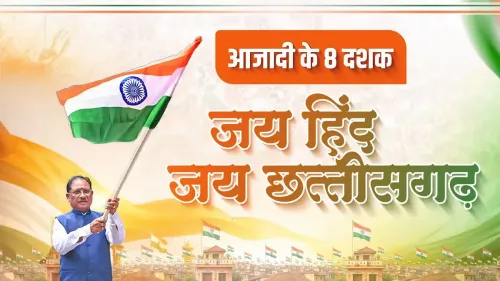
CM Vishnu Deo Sai Marks 26 Years of Chhattisgarh Statehood
Synopsis
On Chhattisgarh's 26th statehood anniversary, Chief Minister Vishnu Deo Sai positioned the mineral-rich, tribal-majority state as India's next major growth engine, blending cultural heritage with industrial ambition in a pointed foundation-day message.
Key Takeaways
Chhattisgarh marked 26 years of statehood on 1 November 2000 , carved from Madhya Pradesh to address regional development demands.
CM Vishnu Deo Sai posted on X on 21 November 2026 , framing the state as India's 'leading growth engine.' The Chief Minister explicitly linked tribal strength ( janjatiya saamarthya ) with the state's industrial and economic ambitions.
Chhattisgarh's economy is anchored by significant mineral wealth including coal, iron ore, and bauxite, alongside steel and power sectors.
Sai, a tribal leader from Jashpur , has made the integration of cultural identity and economic development a hallmark of his administration since late 2023 .
Twenty-six years after a new state was carved out of Madhya Pradesh's heartland, Chhattisgarh Chief Minister Vishnu Deo Sai is making a pointed declaration: the state's richest chapter is still being written. On Saturday, 21 November 2026, the Chief Minister took to X to frame Chhattisgarh's journey not as a story of arrival, but of acceleration.
Posting in Hindi, CM Sai wrote that Chhattisgarh is today 'writing a new saga of development and prosperity' — one that holds its janjatiya saamarthya (tribal strength), cultural heritage, and proud traditions at its core. 'On the strength of vast natural resources, industrial potential, and the power of our hardworking people,' he said, 'our state is rapidly moving in the direction of becoming the country's leading growth engine.'
A State Born From Regional Aspirations
Chhattisgarh was notched onto India's map on 1 November 2000, when it was separated from Madhya Pradesh to meet long-standing demands for regional representation and focused development. The new state inherited one of the country's most significant mineral belts — coal, iron ore, bauxite, and limestone run through its geology — alongside a substantial tribal population whose cultural identity has become central to the state's official self-image.
That combination of resource wealth and demographic distinctiveness has shaped every administration since. The pattern is familiar across India's bifurcated states: local pride and natural endowments are routinely fused into a development narrative. What shifts is the ambition of the claim being made.
Tribal Identity and Industrial Ambition — Chhattisgarh's Dual Bet
What makes CM Sai's framing notable is its deliberate pairing of cultural preservation with economic velocity. Placing janjatiya saamarthya — tribal capability — in the same breath as industrial growth is a political and policy signal. Vishnu Deo Sai, himself from the Jashpur district and a prominent tribal leader within the BJP, has consistently positioned tribal communities not merely as beneficiaries of development but as its engine.
Chhattisgarh's industrial sector — anchored by steel plants, power generation, and mining operations — represents one of the state's most significant contributions to national output. Future state budgets and investment summits will be the clearest test of whether the 'growth engine' claim translates from rhetoric into measurable GDP momentum.
The 26-Year Milestone as a Political Marker
Statehood anniversaries in India's younger states carry particular political weight. For a government that came to power in late 2023, reaching the 26th foundation year offers a moment to both acknowledge the arc of history and set a tone for the administration's remaining tenure. CM Sai's post does exactly that — anchoring the present government's ambitions within a 26-year development journey while projecting forward.
The state that once struggled to establish basic infrastructure and administrative identity is now being framed as a national growth pole. Whether the next budget cycle and industrial investment figures validate that claim will tell the fuller story.
Point of View
The shift from 'nascent and neglected' to 'national growth pole' is an ambitious reframe that will face scrutiny in the next investment cycle. The real test is whether industrial announcements and budget allocations in the coming year match the rhetorical velocity of the statehood anniversary message.
NationPress
21 Nov 2026
Frequently Asked Questions
When was Chhattisgarh formed as a separate state?
Chhattisgarh was established as a separate state on 1 November 2000 , carved out of Madhya Pradesh to address regional development aspirations and cultural representation.
Who is the current Chief Minister of Chhattisgarh?
Vishnu Deo Sai is the Chief Minister of Chhattisgarh. He assumed office following the BJP's victory in the 2023 state assembly elections and is a prominent tribal leader from Jashpur district.
What natural resources does Chhattisgarh have?
Chhattisgarh is rich in coal, iron ore, bauxite, and limestone , making it one of India's most significant mineral-bearing states and a major contributor to national steel and power output.
What did CM Vishnu Deo Sai say about Chhattisgarh's development?
On 21 November 2026 , CM Sai posted that Chhattisgarh is 'writing a new saga of development and prosperity,' calling it India's emerging 'leading growth engine' driven by natural resources, industrial potential, and tribal strength.
What is the tribal population significance in Chhattisgarh?
Chhattisgarh has a substantial tribal population whose cultural identity has been central to state policy. CM Sai, himself a tribal leader, has made janjatiya saamarthya (tribal capability) a cornerstone of the state's development narrative.