CM Vishnu Deo Sai marks Chhattisgarh's 26th Foundation Day

Synopsis
On Chhattisgarh's 26th Foundation Day, CM Vishnu Deo Sai honoured former PM Atal Bihari Vajpayee as the architect of statehood, pledged continued good governance, and called on citizens to strengthen the Chhattisgarh Anjor Vision 2047 under PM Modi's Viksit Bharat framework.
Key Takeaways
Chhattisgarh completed 26 years of statehood on 1 November 2026 , marking the occasion as Rajyotsav .
CM Vishnu Deo Sai paid tribute to Bharat Ratna Atal Bihari Vajpayee , crediting him with the foresight that created the state on 1 November 2000 .
The state was formed by the trifurcation of Madhya Pradesh under Vajpayee's government, alongside Jharkhand and Uttarakhand .
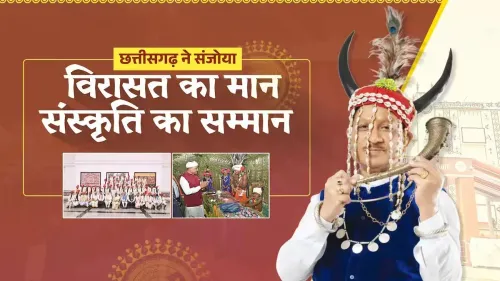
CM Sai invoked the state's cultural identity — as the sacred land of Mata Kaushalya and a hub of tribal heritage — as central to its development identity.
The message renewed commitment to 'Chhattisgarh Anjor Vision 2047' , the state government's long-term development roadmap aligned with PM Modi's Viksit Bharat goals.
The 'Jai Johar' salutation underscored the administration's outreach to the state's significant tribal population.
Twenty-six years ago, on 1 November 2000, a new state was carved out of the heart of India — and today, Chhattisgarh Chief Minister Vishnu Deo Sai marked that founding moment with a tribute to the man who made it possible and a renewed pledge to build the state its founders always imagined.
In a post on X on the occasion of Rajyotsav (State Foundation Day), CM Sai opened with the traditional salutation 'Jai Johar! Jai Chhattisgarh Mahtari!' — 'Victory to the salute! Victory to Mother Chhattisgarh!' — before invoking the state's deep cultural identity: its reverence as the nanihal (maternal home) of Lord Shri Ram, the sacred land of Mata Kaushalya, and its living traditions of tribal pride and folk heritage.
The man behind the state: Vajpayee's legacy remembered
At the centre of CM Sai's message was a pointed tribute to the late Bharat Ratna Atal Bihari Vajpayee, the former Prime Minister whose government gave formal shape to Chhattisgarh's statehood. Vajpayee's administration executed one of independent India's most consequential administrative restructurings on 1 November 2000 — the simultaneous trifurcation of Madhya Pradesh, Uttar Pradesh, and Bihar to create three new states: Chhattisgarh, Uttarakhand, and Jharkhand.
BJP governments in all three states have consistently framed their development ambitions as the fulfilment of Vajpayee's original vision — and today's message is squarely in that tradition. CM Sai described his administration as a 'sushasan sarkar' (good-governance government) working continuously toward a 'Viksit-Samridh Chhattisgarh' — a 'developed and prosperous Chhattisgarh' — in the spirit of what Vajpayee dreamed.
Anjor Vision 2047 and the Modi framework
The Chief Minister also anchored the state's long-term ambitions to Prime Minister Narendra Modi's broader Viksit Bharat framework, calling on every citizen of the state to collectively strengthen the resolve behind 'Chhattisgarh Anjor Vision 2047' — the state government's own roadmap aligned to India's centenary independence goal. Anjor means 'light' in Chhattisgarhi, and the choice of the word signals an intent to position the state's tribal and cultural identity at the heart of its development story, not as a footnote to it.
The state's 26-year journey has taken it from a resource-rich but infrastructure-thin geography to a state with growing industrial presence, significant forest cover, and one of India's largest tribal populations — a demographic that successive governments have pledged to bring to the centre of mainstream development planning.
What the 26th year actually means
Foundation Day messages from chief ministers are, by nature, ceremonial — but the specific language CM Sai chose signals real political intent. The dual invocation of Vajpayee (the state's architect) and Modi (the current national leader) stitches together a continuity narrative that is central to BJP's brand in the state. It says, in effect: the party that built this state is the same party that will fulfil its promise by 2047.
For Chhattisgarh's tribal communities — who constitute roughly a third of the state's population — the 'Jai Johar' salutation is not incidental. It is a gesture of cultural recognition, a signal that governance in the state must speak the language of its people before it speaks the language of policy.
The 26th Rajyotsav is not a round number, not a jubilee. But the vision document it is being tied to — Anjor 2047 — marks exactly 21 years to go. The clock, as CM Sai frames it, is already running.
Point of View
Giving local governance a larger ideological canvas. The prominent use of 'Jai Johar' and the reference to tribal heritage signal that the BJP government is competing on cultural fluency, not just welfare delivery, in a state where tribal voters are decisive. As state elections cycle approaches the mid-point of the current government's term, the Rajyotsav message doubles as a confidence report — and a benchmark against which Anjor 2047 milestones will eventually be measured.
NationPress
1 Nov 2026
Frequently Asked Questions
When was Chhattisgarh formed as a separate state?
Chhattisgarh was formed on 1 November 2000 , when it was carved out of Madhya Pradesh during former Prime Minister Atal Bihari Vajpayee's tenure. Jharkhand and Uttarakhand were created simultaneously in the same restructuring exercise.
What is Chhattisgarh Anjor Vision 2047?
Chhattisgarh Anjor Vision 2047 is the state government's long-term development roadmap aimed at making the state developed and prosperous by 2047 , aligned with PM Narendra Modi's national Viksit Bharat framework. Anjor means 'light' in Chhattisgarhi.
Why is Atal Bihari Vajpayee remembered on Chhattisgarh Foundation Day?
Former PM Atal Bihari Vajpayee is credited as the architect of Chhattisgarh's statehood — his government passed the legislation that created the state on 1 November 2000 . CM Vishnu Deo Sai invoked his memory on the 26th Rajyotsav as the founding inspiration for the state's development goals.
What does 'Jai Johar' mean in Chhattisgarh?
'Jai Johar' is a traditional salutation rooted in the tribal cultures of Chhattisgarh and the broader central Indian region, used as a greeting of respect and solidarity. Its use by CM Sai signals cultural recognition of the state's significant tribal communities.
What is the significance of Chhattisgarh being called the nanihal of Lord Ram?
Chhattisgarh is traditionally identified as the nanihal (maternal homeland) of Lord Shri Ram , with Mata Kaushalya — Ram's mother — believed to have been from the region. This cultural and religious identity is a recurring motif in the state's political and governance discourse.