CM Sai Hails India's First Hydrogen Train Launch on Jind-Sonipat Route
Synopsis
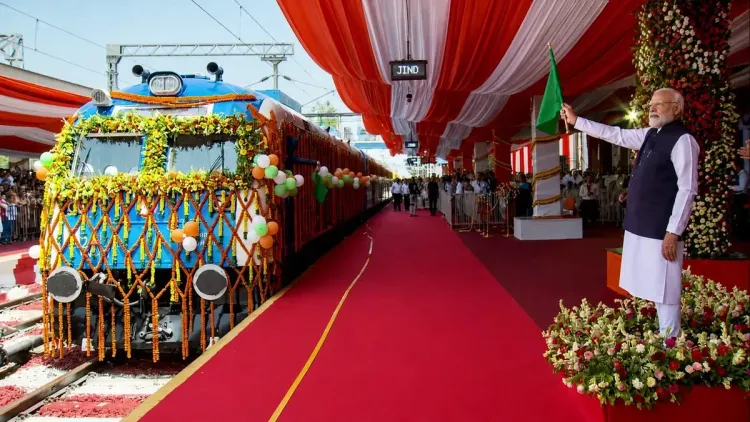
Chhattisgarh Chief Minister Vishnu Deo Sai praised PM Narendra Modi on 17 July 2026 for launching India's first hydrogen-powered train on the Jind–Sonipat corridor in Haryana, calling it a milestone for green transport and the Atmanirbhar Bharat vision.
Key Takeaways
India's first hydrogen-powered train was launched on the Jind–Sonipat rail corridor in Haryana .
Chhattisgarh CM Vishnu Deo Sai congratulated PM Narendra Modi on 17 July 2026 , calling it a historic achievement.
The launch aligns with the National Green Hydrogen Mission , which carries a Rs 19,744 crore outlay approved in 2023 .
Indian Railways has targeted net-zero emissions by 2030 , with hydrogen traction as a key pillar.
The pilot is expected to inform expansion of hydrogen train services to additional corridors across the national network.
The initiative supports India's broader net-zero by 2070 climate commitment and the Atmanirbhar Bharat self-reliance agenda.
Chhattisgarh Chief Minister Vishnu Deo Sai on Friday, 17 July 2026, congratulated Prime Minister Narendra Modi on the launch of India's first hydrogen-powered train on the Jind–Sonipat corridor in Haryana, calling it a landmark step toward a green and future-ready transport system.
Posting on X, CM Sai wrote: 'यशस्वी प्रधानमंत्री श्री नरेंद्र मोदी जी के दूरदर्शी नेतृत्व में भारत स्वच्छ ऊर्जा और आधुनिक परिवहन के क्षेत्र में निरंतर नई ऊंचाइयों को छू रहा है' — ('Under the visionary leadership of Prime Minister Narendra Modi, India is continuously touching new heights in the field of clean energy and modern transport'). He described the hydrogen train's inauguration as 'an important step toward a green, clean and future-oriented transport system' and said the achievement would give 'new energy to the resolve of a self-reliant and developed India.'
Context
Indian Railways has been pursuing decarbonisation as a core pillar of its modernisation agenda, with hydrogen fuel-cell trains identified as a priority technology in its net-zero roadmap targeting 2030. The Jind–Sonipat rail corridor in Haryana was selected as the demonstration route for the country's first such service, making it a closely watched milestone in India's clean-transport transition.
The launch draws on years of coordinated planning between the central government and Indian Railways, signalling a shift from pilot proposals to operational deployment of hydrogen traction technology on the national network.
Policy Backdrop
The hydrogen train initiative sits squarely within the National Green Hydrogen Mission, approved by the central government in 2023 with an outlay of Rs 19,744 crore. The mission targets domestic production, storage and end-use of green hydrogen across transport and industrial sectors, positioning India as a global hub for the technology.
Indian Railways incorporated hydrogen fuel-cell trains into its budget announcements for 2022–23, and the Jind–Sonipat pilot represents the first tangible on-track realisation of that commitment. The broader push aligns with India's pledge to reach net-zero emissions by 2070, combining electrification, biofuels and hydrogen across the transport sector.
Stakeholders and Impact
Commuters on the Jind–Sonipat route stand to benefit directly from cleaner, quieter rolling stock, while the domestic green hydrogen industry gains a high-visibility use-case that could accelerate investment in electrolyser and refuelling infrastructure. Haryana's rail passengers are among the earliest beneficiaries of what the government frames as a nationally scalable model.
For the broader Atmanirbhar Bharat agenda, the hydrogen train pilot demonstrates indigenous capability in an emerging technology domain, reinforcing central-state messaging on self-reliance. CM Sai's statement from Chhattisgarh reflects the BJP's coordinated effort to amplify the milestone across state governments.
What's Next
Attention will now turn to whether the National Green Hydrogen Mission can support rapid extension of hydrogen train trials to additional corridors, and whether refuelling and electrolyser infrastructure can be commissioned at scale. Indian Railways has set ambitious targets, and the success of the Jind–Sonipat demonstration will be a key benchmark for that expansion.
If the pilot proves operationally reliable, it could accelerate procurement decisions for hydrogen rolling stock on other routes, cementing India's position as one of the few countries to operationalise hydrogen traction on a national rail network.
Point of View
A distinction that carries real political weight for the BJP ahead of future state cycles. CM Sai's congratulatory post is part of a wider pattern of BJP-governed states amplifying central infrastructure milestones to reinforce the party's development narrative. The Rs 19,744 crore National Green Hydrogen Mission now has a flagship transport symbol, which could sharpen public understanding of an otherwise abstract policy. Whether the pilot can scale quickly enough to meet Indian Railways' 2030 net-zero targets remains the central test of this momentum.
NationPress
16 Oct 2026
Frequently Asked Questions
Where was India's first hydrogen train launched?
India's first hydrogen-powered train was launched on the Jind–Sonipat rail corridor in Haryana , selected as the demonstration route for the country's hydrogen traction pilot.
What is the National Green Hydrogen Mission?
The National Green Hydrogen Mission is a central government scheme approved in 2023 with an outlay of Rs 19,744 crore to promote domestic production, storage and use of green hydrogen across transport and industry.
Why did CM Vishnu Deo Sai comment on the hydrogen train?
Chhattisgarh Chief Minister Vishnu Deo Sai posted on X to congratulate PM Narendra Modi on the launch, describing it as a milestone for green transport and the Atmanirbhar Bharat vision.
What is Indian Railways' net-zero target?
Indian Railways has set a target to achieve net-zero carbon emissions by 2030 , with hydrogen fuel-cell trains, electrification and biofuels forming the key pillars of that roadmap.
What does the hydrogen train pilot mean for India's climate goals?
The Jind–Sonipat hydrogen train pilot supports India's pledge to reach net-zero emissions by 2070 and provides a scalable model for decarbonising rail transport, a sector that carries hundreds of millions of passengers annually.