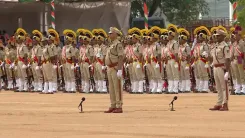
CM Sai Hails Naxal-Free India Pledge on Independence Day
Synopsis
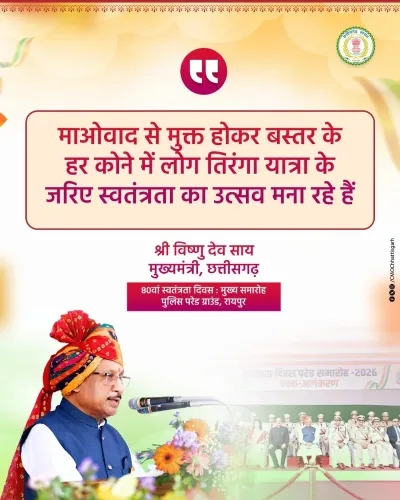
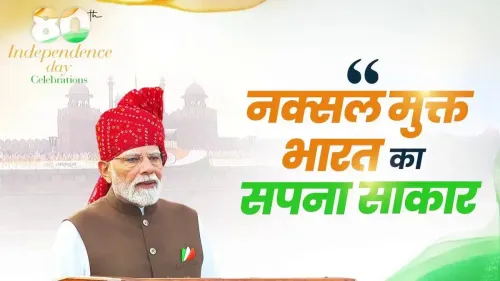
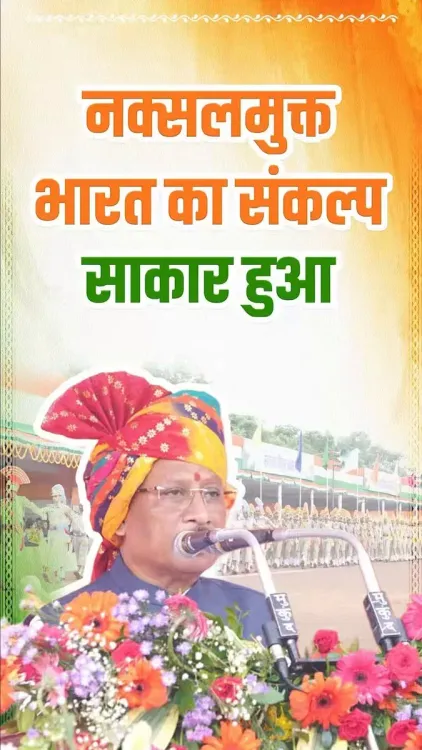
On Independence Day 2026, Chhattisgarh Chief Minister Vishnu Deo Sai declared that India's resolve to eliminate Naxalism has been fulfilled under PM Modi's leadership, saluting the sacrifice of security personnel who fought in the Red Corridor.
Key Takeaways
CM Vishnu Deo Sai declared on August 15, 2026 that the goal of a Naxal-free India has been achieved.
He credited Prime Minister Narendra Modi's leadership for the milestone and paid tribute to martyred security personnel.
Chhattisgarh — including districts like Bastar , Sukma , and Dantewada — has historically been India's most Naxal-affected state.
The SAMADHAN strategy , launched in 2017 by the Ministry of Home Affairs, combined security operations with development and rehabilitation programmes.
The government's claim is a political declaration; formal verification through MHA district-level notifications remains the benchmark to watch.
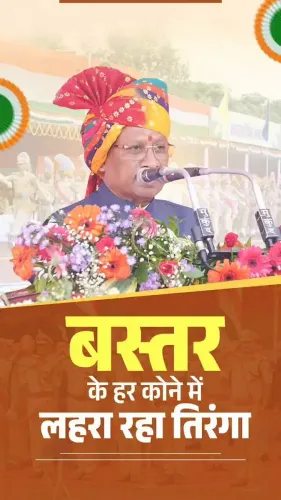
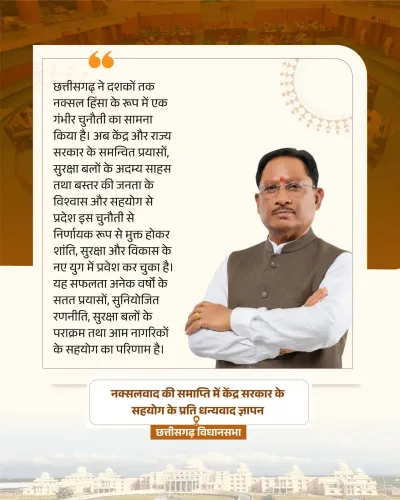
On Independence Day, August 15, 2026, Chhattisgarh Chief Minister Vishnu Deo Sai declared that the resolve to make India free of Naxalism has been fulfilled — a claim that lands with particular weight coming from the leader of the state that has borne the heaviest cost of left-wing extremism for decades.
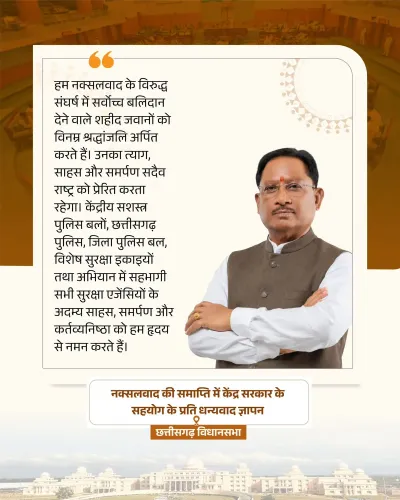
Posting from the Chief Minister's Office of Chhattisgarh, CM Sai credited Prime Minister Narendra Modi's 'courageous leadership' for the milestone, and called on the nation to bow before the bravery and sacrifice of the security personnel who 'uprooted left-wing extremism from its roots' — वामपंथी उग्रवाद को जड़ से उखाड़ फेंकने वाले हमारे वीर जवानों के पराक्रम तथा उनकी शहादत को नमन ('we salute the valour and martyrdom of our brave soldiers who eradicated left-wing extremism from its roots').
The Red Corridor's Long Shadow Over Chhattisgarh
Chhattisgarh — particularly its southern districts of Bastar, Sukma, and Dantewada — has historically been the epicentre of Naxalite violence in India's so-called Red Corridor. Security forces, tribal communities, and civilian administrators paid a steep price through decades of ambushes, improvised explosive device attacks, and displacement. The state's forests became contested ground between the state and Maoist insurgents who claimed to fight for the rights of marginalised tribal populations.
For successive governments in New Delhi and Raipur, Naxalism represented the most persistent internal security challenge on Indian soil — more enduring, in many ways, than cross-border threats, because it was rooted in socioeconomic grievances that military action alone could not resolve.
The SAMADHAN Strategy and Years of Coordinated Pressure
The shift in momentum accelerated after 2017, when the Ministry of Home Affairs formalised the SAMADHAN strategy — an acronym-driven framework combining security operations, development investment, and rehabilitation programmes for surrendered cadres. Central paramilitary forces worked alongside state police in coordinated grid-based operations, while welfare schemes extended roads, schools, and banking access into areas previously under Maoist sway.
CM Sai, appointed in December 2023, has consistently framed the anti-Naxal campaign as a defining achievement of the BJP government at both the state and central levels. His Independence Day statement represents the strongest official claim yet — that the mission is not merely progressing, but complete.
Martyrs at the Centre of the Tribute
What gives the post its emotional core is not the political declaration but the tribute to fallen soldiers. Hundreds of security personnel lost their lives in Chhattisgarh's forests over the course of this insurgency — CRPF jawans, state police officers, and district force personnel. CM Sai's message places their sacrifice at the centre of this Independence Day, framing the claimed victory not as a government achievement but as a debt owed to the dead.
That framing — honouring martyrs on a national holiday — is a deliberate and resonant choice. It connects the anti-Naxal campaign to the broader patriotic register of August 15, and signals that the government intends this moment to be remembered as a turning point in India's internal security history.
Whether official notifications — such as the removal of districts from the Ministry of Home Affairs affected-district list — follow this political declaration will determine how the claim is ultimately measured. The soldiers' families, and the tribal communities of Bastar, will be watching.
Point of View
The messaging is strategically pitched above electoral optics. However, the gap between a political announcement and formal administrative delisting of affected districts will be the real test of whether this moment marks a genuine inflection point or an aspirational milestone. The statement also reinforces the BJP's national security narrative ahead of any future electoral cycle, positioning the anti-Naxal campaign alongside surgical strikes and Article 370 as signature security achievements.
NationPress
15 Aug 2026
Frequently Asked Questions
Has India officially been declared Naxal-free in 2026?
Chhattisgarh Chief Minister Vishnu Deo Sai declared on Independence Day 2026 that the Naxal-free India pledge has been fulfilled, but a formal official declaration would require the Ministry of Home Affairs to remove districts from its affected-area list.
What is the SAMADHAN strategy against Naxalism?
SAMADHAN is a multi-pronged framework introduced by the Ministry of Home Affairs in 2017 that combines coordinated security operations, infrastructure development in affected areas, and rehabilitation programmes for Naxalite cadres who surrender.
Which districts of Chhattisgarh were most affected by Naxalism?
Bastar, Sukma, and Dantewada in southern Chhattisgarh were historically the most affected districts, forming the core of India's so-called Red Corridor where Maoist insurgents were most active.
Who is Vishnu Deo Sai and when did he become Chhattisgarh CM?
Vishnu Deo Sai is a BJP leader who was appointed Chief Minister of Chhattisgarh in December 2023 after the BJP's victory in the state assembly elections.
What role did security forces play in ending Naxalism in Chhattisgarh?
Central paramilitary forces and state police conducted years of coordinated grid-based operations in Chhattisgarh's forests, with hundreds of personnel losing their lives — the sacrifice CM Sai specifically honoured in his Independence Day message.