CM Sai joins Dokada Jagannath Rath Yatra, plays Gajapati role
Synopsis
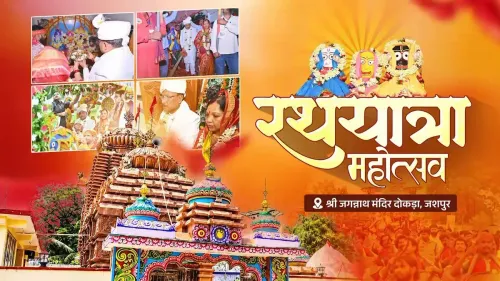
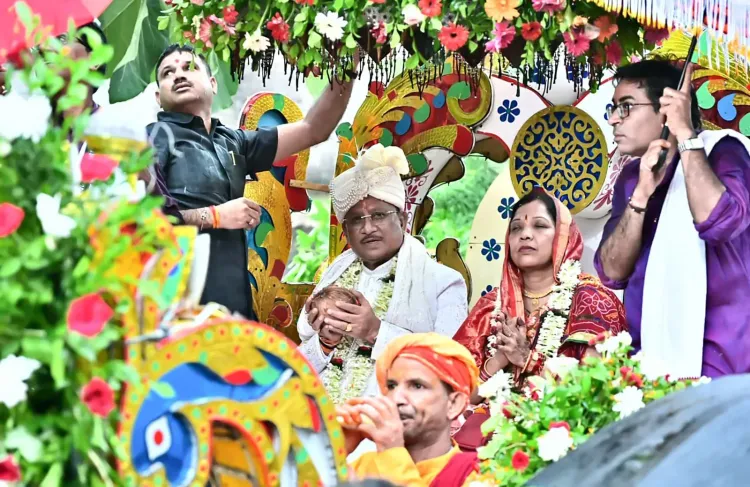
Chhattisgarh Chief Minister Vishnu Deo Sai joined the 84-year-old Shri Jagannath Rath Yatra at Dokada in Jashpur on 16 July 2026, performing the ceremonial Gajapati Maharaj role alongside his wife and invoking blessings for the state.
Key Takeaways
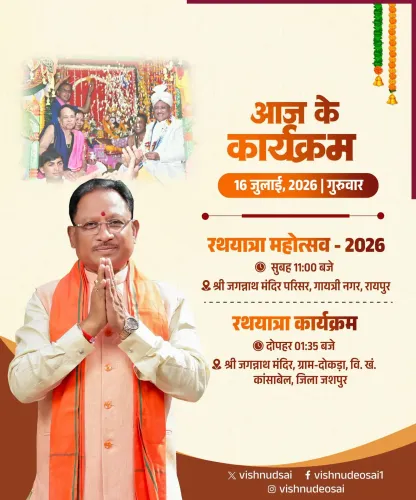
CM Vishnu Deo Sai attended the Dokada Jagannath Rath Yatra in Jashpur district on 16 July 2026 , accompanied by his wife.
He performed the symbolic role of Gajapati Maharaj , a ceremonial duty historically linked to the king of Puri during the Jagannath Rath Yatra.
The Dokada Rath Yatra was founded in 1942 and has been observed continuously since, making it over eight decades old.
Jashpur is a northern Chhattisgarh district with a mixed tribal and non-tribal population where the event holds deep community significance.
The Chief Minister described the yatra as a symbol of seva, sadbhaav aur lokmangal — service, goodwill, and public welfare — rooted in Sanatan tradition.
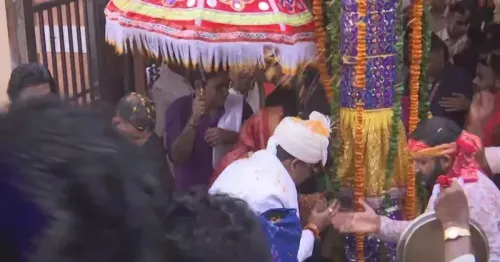
Chhattisgarh Chief Minister Vishnu Deo Sai participated in the Shri Jagannath Rath Yatra at Dokada in Jashpur district on 16 July 2026, accompanied by his wife, and performed the ceremonial role of Gajapati Maharaj during the procession.
Context
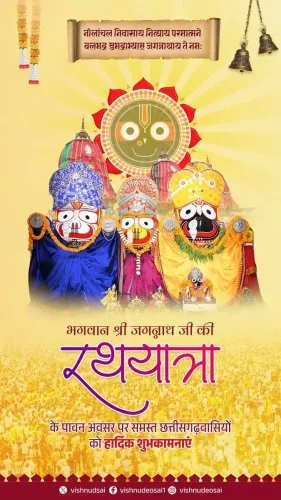
Posting in Hindi and Sanskrit on X, CM Sai shared a Sanskrit verse — 'rathan sprishtvaa premnaa viralarath yaatrasurabhitam, Jagannathan natvaa charamachirasaukhyam bhavatu me' — which translates roughly as: 'Having touched the chariot with devotion and bowed before Jagannath, may lasting joy be mine.' He described the occasion as a privilege, noting he attended 'sapattnik' (with his wife) and fulfilled the symbolic role of Gajapati Maharaj, the title historically associated with the king of Puri who performs ritual sweeping duties during the main Rath Yatra in Odisha.
The Dokada Jagannath Rath Yatra, held in Jashpur in northern Chhattisgarh, was described by the Chief Minister as a decades-old tradition that has grown into a powerful symbol of public faith, cultural consciousness, and social harmony. He called on Mahaprabhu Shri Jagannath Swami's blessings to remain with Chhattisgarh always, closing with the invocation 'Jai Jagannath!'
Policy Backdrop
The Dokada Rath Yatra was established in 1942, making it over eight decades old. It replicates core elements of the celebrated Puri Rath Yatra of Odisha and has been maintained as a continuous local cultural observance in Jashpur district, a region with a substantial tribal population.
The Gajapati Maharaj role that CM Sai assumed is a ceremonially significant one: in Puri, the reigning king traditionally performs the ritual of sweeping the chariot path before the procession moves. A state's chief minister assuming an equivalent local role underscores the event's cultural weight and the administration's recognition of it as part of the region's living heritage.
Stakeholders and Impact
For residents of Jashpur and the broader tribal and non-tribal communities of northern Chhattisgarh, the Dokada Yatra represents a convergence of devotional practice and community identity. CM Sai framed the event as an expression of seva, sadbhaav aur lokmangal — service, goodwill, and public welfare — values he linked to what he called 'Sanatan Sanskriti' (the eternal civilisational tradition).
State-level participation by constitutional functionaries in such ritual roles has become a recurring feature of political engagement in several BJP-governed states, positioning cultural continuity as a shared heritage that bridges community lines in demographically diverse regions.
What's Next
The Dokada Jagannath Rath Yatra is expected to continue as an annual observance, and the Chief Minister's high-profile participation may draw wider attention to the event in subsequent years. Any proposals from Chhattisgarh's culture or tourism departments to formally recognise or support the tradition would be a natural follow-up to watch. CM Sai's post signals that the state administration views such grassroots cultural events as integral to its public engagement strategy across the state's diverse districts.
Point of View
Where tribal communities form a significant demographic, framing a local Jagannath tradition as a symbol of 'social harmony' carries both cultural and political resonance. The choice of an 84-year-old grassroots observance, rather than a newly created event, lends the participation an air of authentic heritage endorsement. This approach reflects a broader arc in which cultural engagement is treated as an extension of governance, particularly in states with diverse religious and ethnic compositions.
NationPress
15 Oct 2026
Frequently Asked Questions
What is the Dokada Jagannath Rath Yatra in Chhattisgarh?
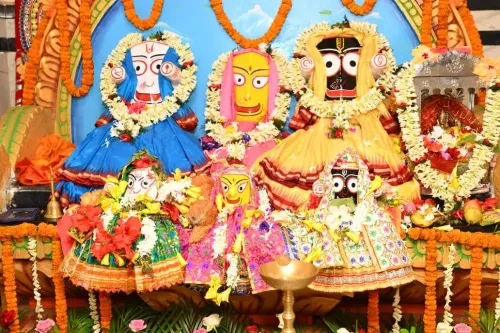
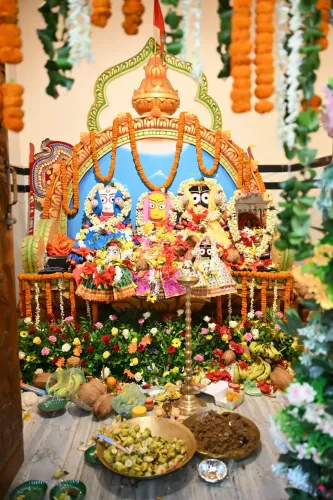
The Dokada Jagannath Rath Yatra is a local religious procession held in Dokada village in Jashpur district of Chhattisgarh. It was established in 1942 and replicates elements of the famous Puri Rath Yatra, serving as a symbol of faith and social harmony in the region.
What role did CM Vishnu Deo Sai play at the Rath Yatra?
CM Vishnu Deo Sai performed the role of Gajapati Maharaj at the Dokada Rath Yatra on 16 July 2026. This is a ceremonial role historically associated with the king of Puri, who traditionally performs ritual duties at the start of the Jagannath procession.
Where is Jashpur district located?
Jashpur is a district in the northern part of Chhattisgarh, bordering Jharkhand and Odisha. It has a substantial tribal population and is known for its forested terrain and cultural diversity.
When did the Dokada Rath Yatra begin?
The Dokada Jagannath Rath Yatra was started in 1942, making it over 80 years old. It has been maintained as a continuous annual observance and is one of the older local Jagannath traditions in Chhattisgarh.
What is the significance of the Gajapati Maharaj role in Rath Yatra?
The Gajapati Maharaj is the historic title of the king of Puri in Odisha, who performs the ritual of sweeping the chariot path — known as Chhera Pahanra — before the Jagannath procession begins. When a chief minister assumes this role at a local yatra, it signals both devotion and ceremonial recognition of the tradition.