CM Sai Launches 'Seva Setu' for 500+ Govt Services in Chhattisgarh
Synopsis
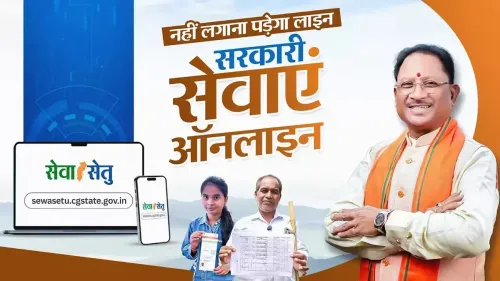
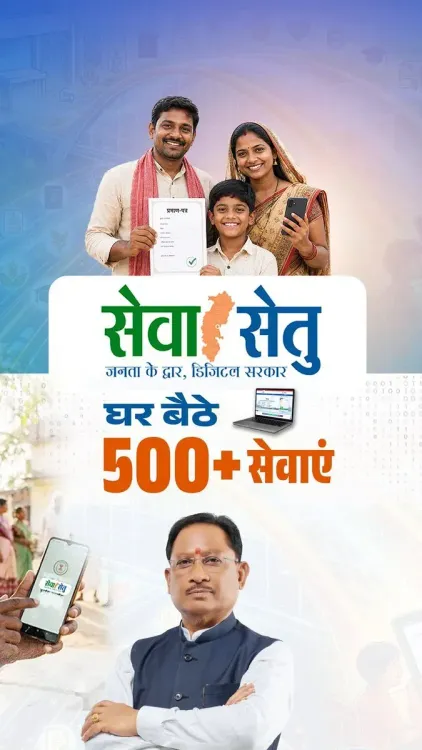
Chhattisgarh Chief Minister Vishnu Deo Sai on 14 July 2026 announced 'Seva Setu', a unified digital portal consolidating over 500 services from 36 state departments, enabling citizens to access government services from home with transparency and fixed timelines.
Key Takeaways
Chhattisgarh CM Vishnu Deo Sai announced the launch of Seva Setu on 14 July 2026 .
The platform brings together more than 500 government services from 36 departments onto a single digital interface.
Citizens can access services from home, eliminating the need to visit government offices in person.
The initiative aligns with India's national Digital India programme and state-level Right to Services frameworks.
Chhattisgarh's large tribal and rural population stands to benefit most if last-mile connectivity gaps are addressed.
Integration with central portals such as UMANG and expansion to additional departments will be key milestones to watch.
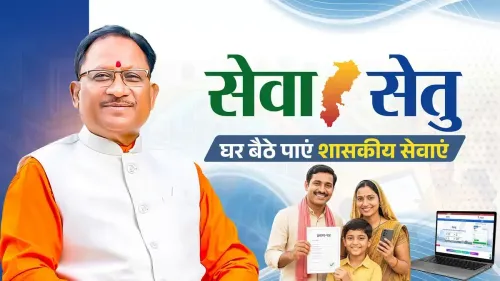
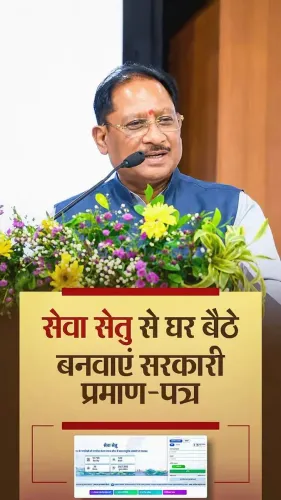
Chhattisgarh Chief Minister Vishnu Deo Sai announced on Tuesday, 14 July 2026 the launch of 'Seva Setu', a unified digital platform designed to deliver government services to citizens transparently and within fixed timelines, without requiring them to visit government offices.
In his post, Chief Minister Sai stated: 'जनता तक शासकीय सेवाओं की सहज, पारदर्शी एवं समयबद्ध पहुंच सुनिश्चित करने के लिए हमारी सरकार ने सेवा सेतु की शुरुआत की है' — meaning, 'To ensure easy, transparent, and time-bound access to government services for the public, our government has launched Seva Setu.' He added that the platform consolidates services from 36 departments, offering more than 500 services on a single interface so that citizens can avail them from home.
Context
The Sai government, which came to power in Chhattisgarh after the November–December 2023 assembly elections, has positioned technology-driven governance as a central pillar of its administration. Seva Setu is framed as a 'bridge' — the literal meaning of 'setu' in Hindi — between the state machinery and ordinary citizens. The announcement underlines a push to reduce bureaucratic friction, especially for residents in rural and tribal belts where physical access to government offices is difficult.
Policy Backdrop
Seva Setu fits within the broader arc of India's Digital India programme, launched in 2015, which mandated states to shift public services onto electronic platforms and meet Right to Services timelines. Indian states have progressively built single-window portals that integrate departmental databases, reducing the need for citizens to navigate multiple offices or intermediaries. BJP-governed states have particularly accelerated such technology-led reforms following the 2023 round of state elections, often branding them as extensions of the national Digital India vision.
Consolidating services from 36 departments onto one platform represents a significant integration exercise, typically requiring harmonisation of legacy databases, identity verification through Aadhaar, and interoperability with central platforms such as UMANG. The stated goal of time-bound delivery aligns with statutory Right to Services frameworks that several states, including Chhattisgarh, have enacted to hold departments accountable for service delays.
Stakeholders and Impact
Chhattisgarh has a large tribal population — roughly 32 percent of its residents belong to Scheduled Tribes — and significant rural geography where distance to district or block offices can run into tens of kilometres. A home-delivery model for government services could reduce both travel costs and the role of informal intermediaries who often charge fees to facilitate paperwork. The platform's effectiveness for these communities will, however, depend heavily on last-mile internet connectivity and digital literacy outreach.
For the 36 participating departments, Seva Setu introduces accountability pressure: once services are listed on a unified platform with defined timelines, delays become more visible to both citizens and the administration. Urban residents and small businesses seeking certificates, licences, or welfare entitlements stand to benefit immediately from the single-window approach.
What's Next
Attention will now turn to the pace of enrolment and actual service delivery metrics — how many applications are filed, processed, and resolved within stipulated timeframes. Integration with central government portals and expansion to additional departments will be key indicators of the platform's ambition. The state government's ability to extend Seva Setu's reach into tribal blocks and remote districts will be the real test of its promise to leave no citizen behind in the shift to digital governance.
Point of View
A pattern consistent with BJP state governments seeking to translate national Digital India branding into state-level wins. Consolidating 500-plus services under one roof is an administratively ambitious target — the harder challenge lies in backend integration and ensuring rural and tribal citizens, who face structural barriers to internet access, are not left as bystanders to a platform built for the connected. If delivery metrics are made public and tracked rigorously, Seva Setu could set a benchmark; if they are not, it risks becoming another well-announced portal that underperforms at the last mile. The initiative will be watched as a test of whether technology-led governance rhetoric in Chhattisgarh translates into measurable reductions in service delays and citizen grievances.
NationPress
14 Jul 2026
Frequently Asked Questions
What is Seva Setu in Chhattisgarh?
Seva Setu is a unified digital platform launched by the Chhattisgarh government under Chief Minister Vishnu Deo Sai that consolidates over 500 government services from 36 departments on a single interface, allowing citizens to access them from home without visiting offices.
How many services are available on Chhattisgarh's Seva Setu portal?
According to Chief Minister Vishnu Deo Sai's announcement on 14 July 2026, Seva Setu offers more than 500 services drawn from 36 state government departments.
Who launched Seva Setu in Chhattisgarh?
Seva Setu was launched by Chhattisgarh Chief Minister Vishnu Deo Sai, a BJP leader who has been in office since December 2023.
How is Seva Setu related to Digital India?
Seva Setu is a state-level implementation consistent with India's national Digital India programme, which since 2015 has pushed states to deliver government services electronically and meet statutory Right to Services timelines.
Will Seva Setu help tribal and rural citizens in Chhattisgarh?
The platform is designed to reduce the need to travel to government offices, which is particularly relevant for Chhattisgarh's large tribal population — about 32 percent of residents — though its reach will depend on internet connectivity and digital literacy in remote areas.