Joshi flags Tier-II/III cities leading rooftop solar surge
Synopsis
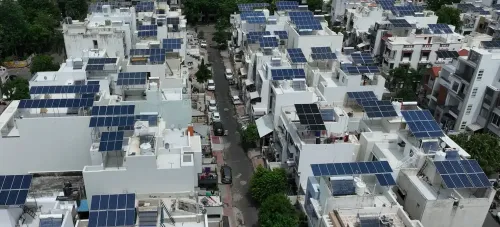
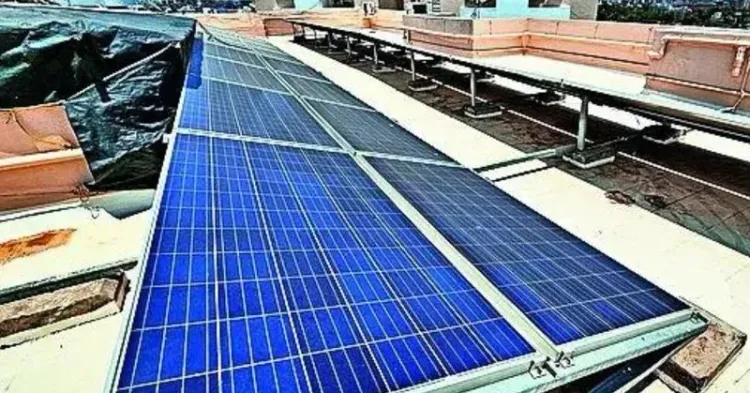
Union Minister Pralhad Joshi on 14 July 2026 highlighted that Tier-II and Tier-III cities are driving India's rooftop solar revolution under PM Surya Ghar: Muft Bijli Yojana, with Gujarat leading states and Lucknow topping all districts nationally.
Key Takeaways
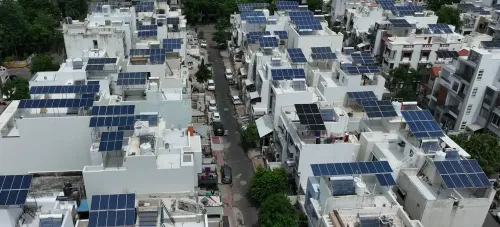
Union Minister Pralhad Joshi on 14 July 2026 flagged Tier-II and Tier-III cities as the new engine of India's rooftop solar adoption.
Gujarat leads all states in rooftop solar installations, followed by Maharashtra and Uttar Pradesh .
Lucknow has been identified as the country's top-performing district under the scheme.
The PM Surya Ghar: Muft Bijli Yojana carries an outlay of Rs 75,021 crore and targets one crore households , offering up to 300 units of free electricity monthly .
The minister framed clean energy adoption as both a welfare measure — cutting household electricity bills — and a contribution to India's 500 GW non-fossil target by 2030 .
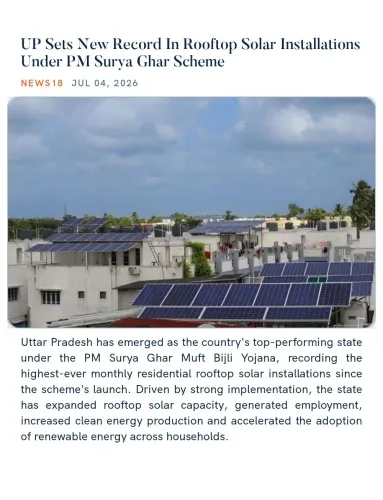
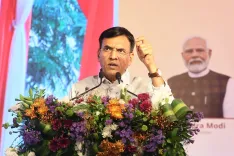
Union Minister of New and Renewable Energy Pralhad Joshi on Tuesday, 14 July 2026 highlighted the rapid grassroots expansion of rooftop solar adoption across India, noting that smaller Tier-II and Tier-III cities are outpacing metros under the PM Surya Ghar: Muft Bijli Yojana. The minister pointed to Gujarat as the national leader in rooftop solar installations, followed by Maharashtra and Uttar Pradesh, with Lucknow emerging as the country's top-performing district.
Context
Joshi wrote that India's 'clean energy transition is now being powered from the grassroots,' describing the trend as 'heartening.' He credited Prime Minister Narendra Modi's leadership for ensuring that 'benefits of sustainable development are reaching every corner of the country, making clean energy a true people's movement.' The post underscores the government's framing of solar energy as a welfare measure — reducing household electricity bills — alongside its environmental and energy-security dimensions.
The minister's remarks come as rooftop solar registrations under the scheme have visibly spread beyond India's major urban centres, with smaller cities and districts recording strong uptake driven by central subsidies, falling panel costs, and state-level net-metering policies.
Policy Backdrop
The PM Surya Ghar: Muft Bijli Yojana was announced in the Union Budget 2024-25 with a total outlay of Rs 75,021 crore, targeting installation of rooftop solar systems on one crore households across India. Eligible households can receive up to 300 units of free electricity per month through the subsidy-linked scheme.
The Ministry of New and Renewable Energy, which Joshi heads alongside the Consumer Affairs portfolio, serves as the nodal body coordinating subsidies, state agency partnerships, and installation targets. The push for distributed rooftop generation is part of India's broader goal of achieving 500 GW of non-fossil fuel capacity by 2030 and reaching net-zero emissions by 2070. Rooftop solar also helps reduce transmission losses inherent in large utility-scale parks located far from consumption centres.
India's solar policy lineage stretches back to the National Solar Mission of 2010 and was given international momentum through the International Solar Alliance, co-founded by India and France in 2015 to mobilise global investment in solar infrastructure.
Stakeholders and Impact
The primary beneficiaries are households in Tier-II and Tier-III cities — a demographic that has historically had limited access to clean energy incentives designed around urban infrastructure. Lower electricity bills directly translate to disposable income gains for middle- and lower-middle-income families, while state electricity distribution companies (discoms) benefit from reduced peak-load pressure on the grid.
Gujarat's consistent leadership in rooftop solar is attributed to early state-level policy support and industrial incentives that created a mature installation ecosystem. The rise of Lucknow as the top district nationally signals that Uttar Pradesh — one of India's most populous and power-deficit states — is making measurable progress in decentralised energy access, with implications for both energy security and household welfare in the Hindi heartland.
What's Next
The government's mid-term progress against the one-crore household installation target will be a key metric to watch through 2026-27. State budget cycles in the coming months could see additional incentives or streamlined rooftop approval processes, particularly in states seeking to replicate Gujarat's model. Sustained momentum in smaller cities will be critical to demonstrating that India's clean energy transition is genuinely distributed — and not concentrated in a handful of industrial or metropolitan clusters.
Point of View
Geographically broad results — not just in industrial states but in the populous Hindi heartland, where Lucknow's top ranking carries electoral resonance ahead of state cycles. By foregrounding Tier-II and Tier-III cities, the ministry is repositioning clean energy from an elite or industrial policy to a mass-welfare narrative, which strengthens the scheme's political durability. The Gujarat-first framing also reinforces a familiar BJP governance template: showcase a home-state model, then present it as a national blueprint. The broader arc here is India's strategic pivot from utility-scale solar parks to distributed rooftop generation as the faster path to both the 500 GW target and household energy security.
NationPress
14 Jul 2026
Frequently Asked Questions
What is PM Surya Ghar Muft Bijli Yojana?
PM Surya Ghar: Muft Bijli Yojana is a central government scheme launched in 2024 to subsidise rooftop solar installations on one crore Indian households, providing eligible families up to 300 units of free electricity every month. The scheme has a total outlay of Rs 75,021 crore.
Which state leads in rooftop solar adoption in India in 2026?
Gujarat leads all Indian states in rooftop solar adoption under the PM Surya Ghar scheme, according to Union Minister Pralhad Joshi's post on 14 July 2026, followed by Maharashtra and Uttar Pradesh.
Which district is the top performer in rooftop solar in India?
Lucknow, the capital district of Uttar Pradesh, has emerged as India's top-performing district in rooftop solar adoption under the PM Surya Ghar: Muft Bijli Yojana, as highlighted by Minister Pralhad Joshi.
Why are Tier-II and Tier-III cities leading in rooftop solar?
Smaller cities are gaining ground in rooftop solar adoption because central subsidies under PM Surya Ghar, combined with state-level net-metering rules and falling solar panel costs, have made installations financially attractive for middle-income households outside major metros.
What is India's renewable energy target by 2030?
India aims to achieve 500 GW of non-fossil fuel electricity capacity by 2030. The expansion of rooftop solar through schemes like PM Surya Ghar is a key component of this target, alongside large utility-scale solar and wind parks.