CM Dhami: Uttarakhand hits 40,000 rooftop solar target early
Synopsis
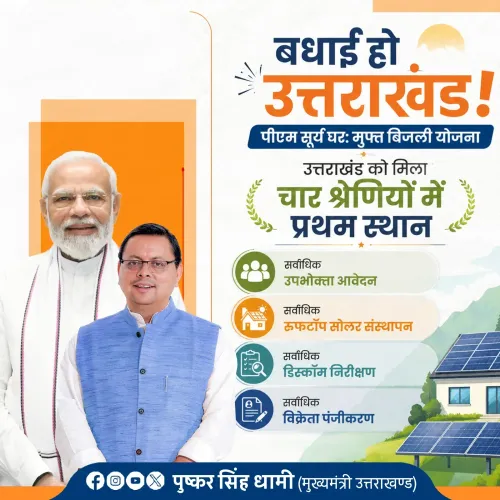
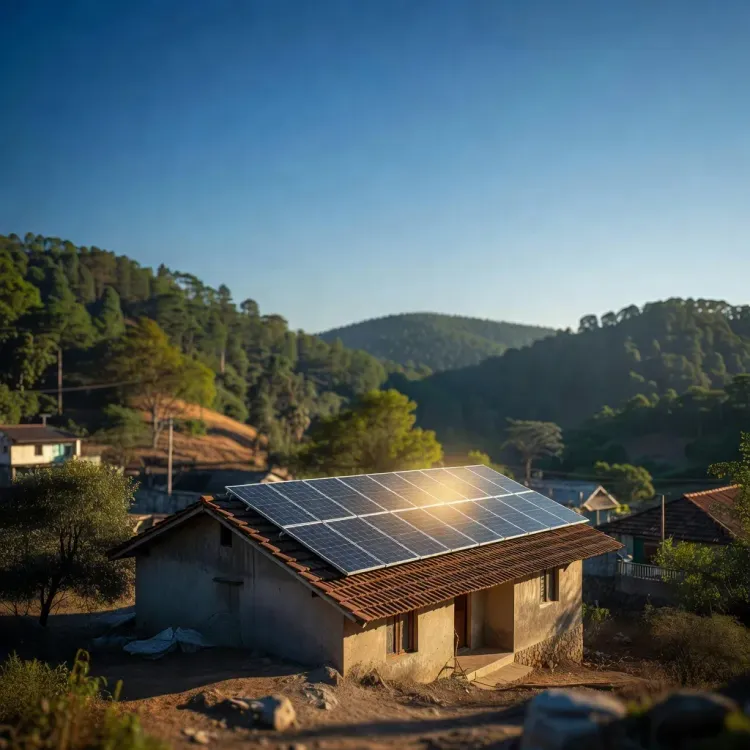
Uttarakhand CM Pushkar Singh Dhami announced the state has surpassed its initial target of 40,000 rooftop solar installations under PM Surya Ghar: Muft Bijli Yojana ahead of schedule, recording a nearly 10-fold rise in solar capacity to approximately 290 MW since 2024.
Key Takeaways
Uttarakhand achieved its initial target of 40,000 residential rooftop solar installations under PM Surya Ghar: Muft Bijli Yojana ahead of schedule.
The state recorded approximately a 10-fold increase in solar energy capacity in roughly two years since 2024 .
Total residential rooftop solar capacity installed stands at approximately 290 MW .
CM Pushkar Singh Dhami attributed the milestone to PM Narendra Modi 's vision and the central scheme's effective implementation.
The achievement positions Uttarakhand as an active early implementer of the central rooftop solar scheme among Indian states.
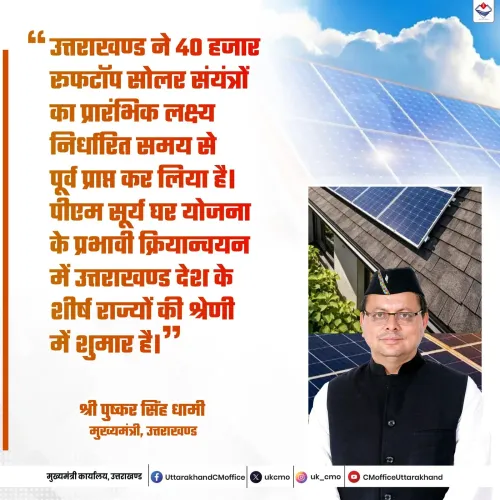
Uttarakhand Chief Minister Pushkar Singh Dhami announced on Friday, 29 May 2026 that the state has achieved its initial target of 40,000 residential rooftop solar installations under the central PM Surya Ghar: Muft Bijli Yojana ahead of schedule, crediting the milestone to Prime Minister Narendra Modi's vision for clean energy.
In his post on X, CM Dhami wrote: 'पीएम सूर्य घर: मुफ्त बिजली योजना के प्रभावी क्रियान्वयन के तहत राज्य ने 40 हजार रूफटॉप सोलर संयंत्रों का अपना प्रारंभिक लक्ष्य निर्धारित समय से पूर्व प्राप्त कर लिया है' — ['Under the effective implementation of PM Surya Ghar: Muft Bijli Yojana, the state has achieved its initial target of 40,000 rooftop solar plants ahead of the set timeline.']. He further stated that in just two years since 2024, the state has recorded nearly a 10-fold increase in solar energy capacity, with approximately 290 MW of residential rooftop solar capacity now installed.
Context
PM Surya Ghar: Muft Bijli Yojana is a central government scheme that provides subsidies to households for rooftop solar installations and offers free electricity units as an incentive. It was rolled out to accelerate decentralised residential solar adoption across India. Uttarakhand, a BJP-governed Himalayan state, has positioned itself as an early and active implementer of the scheme.
Chief Minister Dhami framed the achievement within a broader national narrative, describing PM Modi's leadership as 'visionary' (दूरदर्शी नेतृत्व) in driving the country toward clean and renewable energy. He said the state government is working 'rapidly' under Modi's inspiration and guidance to promote solar energy production.
Policy Backdrop
India's solar push has deep policy roots. The Jawaharlal Nehru National Solar Mission, launched in 2010, first set the framework for grid-connected solar scaling. At COP26 in 2021, the government raised ambitions significantly, committing to 500 GW of non-fossil fuel capacity by 2030 and net-zero emissions by 2070. India also co-founded the International Solar Alliance in 2015 to mobilise global investment in solar deployment.
Rooftop solar has emerged as a critical decentralised pillar of this strategy, shifting generation closer to consumption points and reducing pressure on state electricity distribution companies (discoms). The PM Surya Ghar scheme operationalises this approach at the household level, with states competing to report accelerated installation rates.
Stakeholders and Impact
Uttarakhand households are the primary beneficiaries, gaining access to subsidised solar installations and reduced electricity bills. The state's discoms stand to benefit from reduced peak-load pressure, while the rooftop solar installation industry sees expanded demand. For a state historically dependent on hydropower and fossil-fuel imports, the shift toward distributed solar also carries energy-security implications.
The claim of a 10-fold increase in solar capacity in roughly two years — reaching approximately 290 MW of residential rooftop capacity — signals a sharp acceleration in adoption, though the absolute base from which growth is measured remains modest in the context of India's overall renewable portfolio.
What's Next
With the initial target of 40,000 installations surpassed ahead of schedule, attention will turn to whether Uttarakhand revises its rooftop solar targets upward in upcoming annual energy plans. The state's performance could serve as a benchmark for other hill states implementing the scheme under similar geographic and grid constraints.
Nationally, parliamentary and budget deliberations on further subsidy outlays for PM Surya Ghar will shape how aggressively states can expand in the next phase. Uttarakhand's early-completion milestone adds to the political case for sustained central funding.
Point of View
If verified, would represent one of the sharper acceleration curves among hill states, lending credibility to the state's 'green development' branding. The move also fits a broader pattern of BJP-governed states using PM Surya Ghar milestones to demonstrate delivery on Modi's renewable energy commitments. Whether the state translates this early momentum into revised, more ambitious targets will be the real test of institutional follow-through.
NationPress
14 Oct 2026
Frequently Asked Questions
What is PM Surya Ghar Muft Bijli Yojana?
PM Surya Ghar: Muft Bijli Yojana is a central government scheme that subsidises rooftop solar panel installations for households and provides free electricity units, aimed at accelerating residential solar adoption across India.
How many rooftop solar plants has Uttarakhand installed under the scheme?
Uttarakhand has installed approximately 40,000 residential rooftop solar plants under PM Surya Ghar: Muft Bijli Yojana, achieving this initial target ahead of schedule, with a total installed capacity of around 290 MW .
How much has Uttarakhand's solar capacity grown since 2024?
According to CM Dhami's announcement, Uttarakhand recorded nearly a 10-fold increase in solar energy capacity between 2024 and 2026 , reaching approximately 290 MW of residential rooftop solar capacity.
What is Uttarakhand's role in India's renewable energy goals?
Uttarakhand is a BJP-governed Himalayan state actively implementing central solar schemes to reduce dependence on hydro and fossil fuel imports, contributing to India's national target of 500 GW non-fossil fuel capacity by 2030 .
What did CM Dhami say about Uttarakhand's solar progress?
CM Dhami stated that under PM Modi's inspiration, Uttarakhand's government is working rapidly to promote solar energy production, and the state has surpassed its initial rooftop solar installation target ahead of the set timeline.