CM Dhami's Uttarakhand tops PM Surya Ghar scheme in four categories
Synopsis
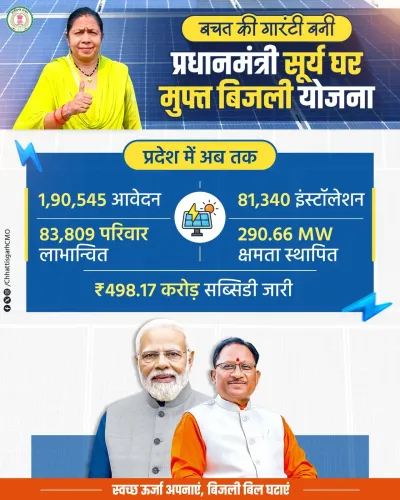
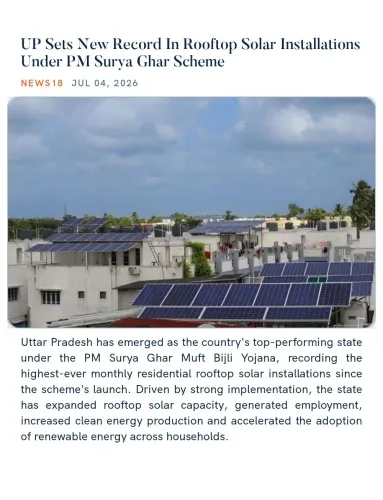
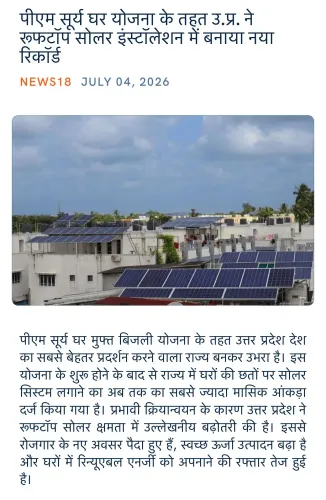
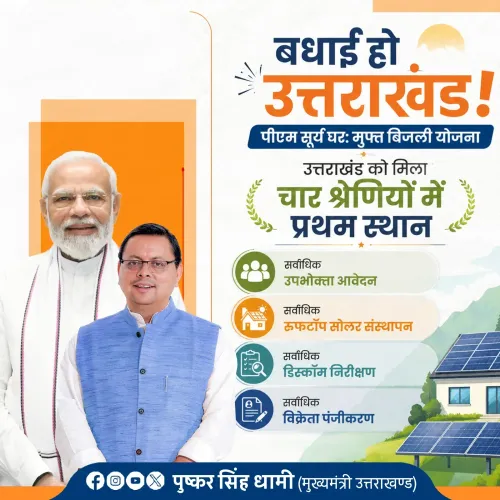
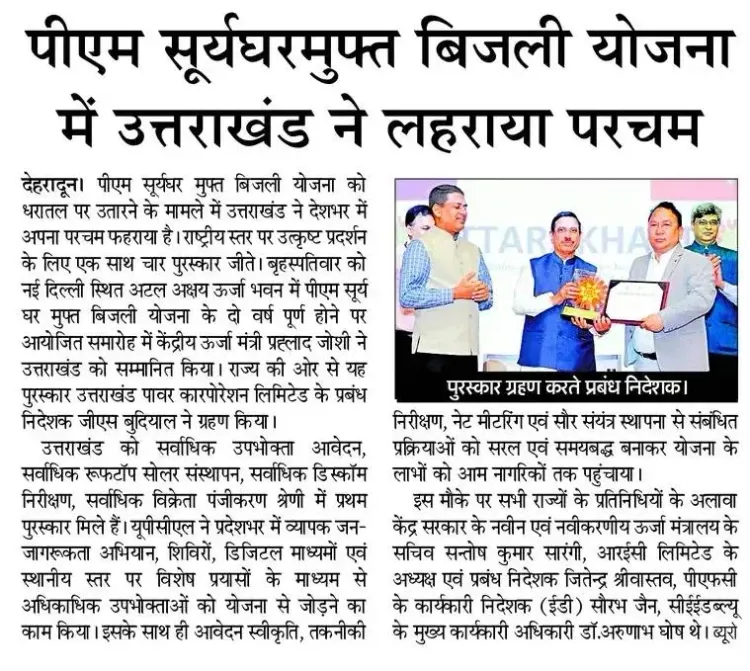
Uttarakhand has claimed first place in four national categories under the PM Surya Ghar: Muft Bijli Yojana rooftop solar scheme, with the state's Chief Minister's Office attributing the performance to CM Pushkar Singh Dhami's leadership. The central scheme aims to deliver free electricity to one crore households.
Key Takeaways
Uttarakhand's Chief Minister's Office announced the state secured first place in four categories under the PM Surya Ghar: Muft Bijli Yojana national rankings.
The achievement was announced on June 5, 2026 and attributed to Chief Minister Pushkar Singh Dhami's leadership.
PM Surya Ghar: Muft Bijli Yojana was launched in February 2024 to provide up to 300 units of free monthly electricity to one crore households via rooftop solar installations.
The scheme is administered by the Ministry of New and Renewable Energy and creates competitive performance tracking among states.
Uttarakhand's performance aligns with the state's existing hydropower base and its push for green growth in the Himalayan region.
India targets 500 GW of non-fossil fuel capacity by 2030 , with distributed solar schemes central to that goal.
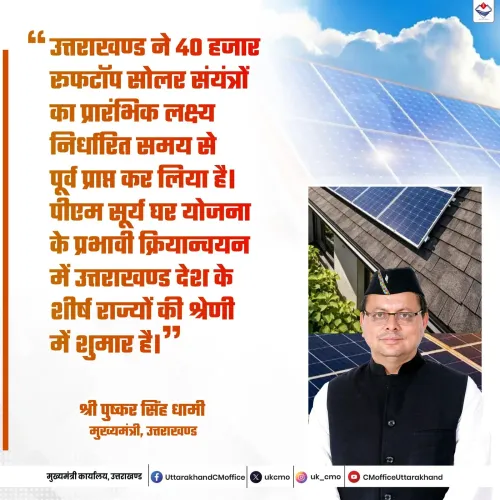
The Chief Minister's Office of Uttarakhand announced on Friday, June 5, 2026, that the state has secured first place nationally across four major categories under the PM Surya Ghar: Muft Bijli Yojana, crediting the achievement to the leadership of Chief Minister Pushkar Singh Dhami.
The official post stated: 'Mukhyamantri Shri Pushkar Singh Dhami ke kushal netritva mein Uttarakhand ne PM Surya Ghar: Muft Bijli Yojana mein deshbhar mein lahraaya parcham' — meaning, 'Under the able leadership of Chief Minister Pushkar Singh Dhami, Uttarakhand has hoisted its flag across the country in the PM Surya Ghar: Muft Bijli Yojana, securing first place in four major categories.'
Context
The PM Surya Ghar: Muft Bijli Yojana is a central government initiative launched in February 2024 with the goal of providing up to 300 units of free electricity per month to one crore households through subsidised rooftop solar installations. The scheme is administered by the Ministry of New and Renewable Energy and has set off a competitive dynamic among state governments eager to demonstrate implementation efficiency. Uttarakhand's claim of topping four categories places it among the frontrunners in this national race.
Policy Backdrop
Uttarakhand is a Himalayan state with an established base in hydropower generation and has in recent years positioned itself as a hub for green energy alongside its tourism economy. The state's existing renewable energy infrastructure and administrative machinery appear to have supported faster uptake of the rooftop solar scheme. Chief Minister Dhami, who has headed the state's BJP government since 2021, has repeatedly cited central scheme implementation as a pillar of his administration's development agenda.
India's broader clean energy ambition — a target of 500 GW of non-fossil fuel capacity by 2030 and net-zero emissions by 2070 — depends heavily on distributed generation programmes like PM Surya Ghar. The scheme's design links central subsidies to state-level performance, making rankings a politically significant metric for ruling governments.
Stakeholders and Impact
The primary beneficiaries are residential households in Uttarakhand who gain access to subsidised solar installations and reduced electricity bills. Solar equipment installers and local contractors also stand to benefit from increased demand driven by state-pushed enrolment. For the state government, the national ranking serves as a visible indicator of administrative delivery capacity ahead of future electoral cycles.
The scheme's competitive federal structure means that Uttarakhand's performance data will be tracked by the Ministry of New and Renewable Energy in subsequent quarterly reviews, potentially influencing additional central allocations or recognition for the state.
What's Next
Observers will watch for the Ministry of New and Renewable Energy's official quarterly release of installation and beneficiary data to independently confirm the rankings cited by the Chief Minister's Office. Any follow-on state budget announcements or policy decisions by the Dhami government to expand rooftop solar subsidies beyond the central scheme's framework will be a key signal of whether Uttarakhand intends to sustain this momentum. A strong showing in national scheme rankings could also bolster the state's case for higher central allocations in the next planning cycle.
Point of View
Translating a centrally funded scheme into a state-level governance narrative. In India's competitive federal landscape, scheme performance rankings have become a proxy for administrative credibility, and BJP-ruled states have been particularly aggressive in publicising such milestones. The announcement fits a broader pattern of hill states leveraging their renewable energy geography — hydropower legacy, high solar irradiance in certain zones, and smaller beneficiary populations — to outperform larger states on per-capita metrics. Whether the ranking translates into sustained household-level impact will depend on the Ministry of New and Renewable Energy's independent data validation in coming quarters.
NationPress
20 Oct 2026
Frequently Asked Questions
What is PM Surya Ghar Muft Bijli Yojana?
PM Surya Ghar: Muft Bijli Yojana is a central government scheme launched in February 2024 to install subsidised rooftop solar panels for one crore Indian households, providing up to 300 units of free electricity per month.
Why has Uttarakhand ranked first in PM Surya Ghar scheme?
The Uttarakhand Chief Minister's Office credited CM Pushkar Singh Dhami's leadership for the state securing first place in four major categories under the scheme. The state's existing renewable energy infrastructure and focused implementation are cited as contributing factors.
Which ministry oversees PM Surya Ghar Muft Bijli Yojana?
The Ministry of New and Renewable Energy is the nodal Union ministry responsible for implementing and tracking the PM Surya Ghar: Muft Bijli Yojana across all states and union territories.
How does PM Surya Ghar scheme benefit households?
Eligible households receive subsidised rooftop solar installations that can generate enough power to cover up to 300 units of electricity per month at no cost, significantly reducing or eliminating their monthly electricity bills.
What is India's renewable energy target by 2030?
India has set a target of achieving 500 GW of non-fossil fuel electricity capacity by 2030, with rooftop solar schemes like PM Surya Ghar forming a key part of the distributed generation strategy to meet that goal.