CM Sai Launches 'Sughghar Chhattisgarh' Welfare Drive
Synopsis
Chhattisgarh CM Vishnu Deo Sai has launched the 'Sughghar Chhattisgarh' campaign to saturate 31 welfare schemes across 23 districts in Raipur, Bilaspur, Durg, and Sarguja divisions, using real-time monitoring and inter-departmental convergence to ensure no eligible beneficiary is excluded.
Key Takeaways
CM Vishnu Deo Sai announced the 'Sughghar Chhattisgarh' campaign on June 19, 2026 , targeting full saturation of welfare scheme delivery.
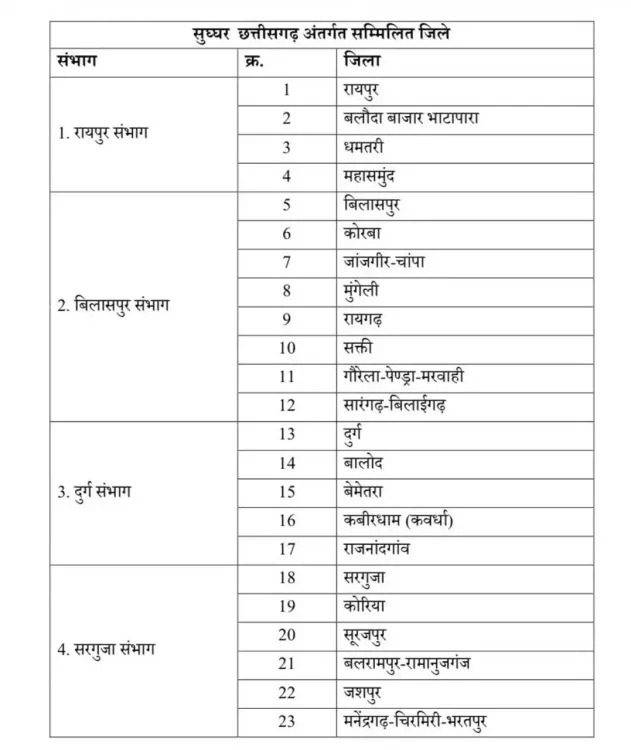
The campaign covers 31 welfare schemes across 23 districts in the Raipur, Bilaspur, Durg, and Sarguja divisions.
It builds on the Niyad Nellanar Yojana , the state's existing last-mile welfare delivery model.
Technology-based real-time monitoring and inter-departmental convergence are the core delivery mechanisms.
The stated goal is that no eligible beneficiary remains excluded from any of the 31 schemes.
The Sarguja division , covering tribal-dominated northern districts, is among the key target areas.
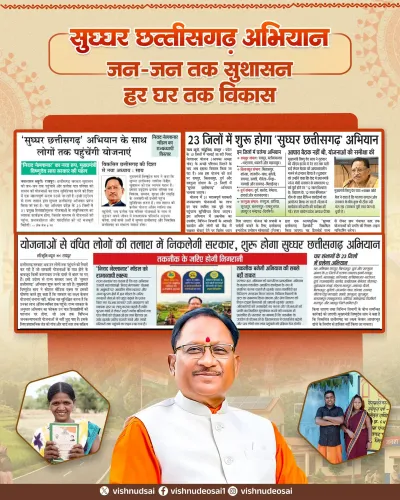
Chhattisgarh Chief Minister Vishnu Deo Sai on Friday, June 19, 2026, announced the launch of the 'Sughghar Chhattisgarh' campaign, a state-wide initiative aimed at ensuring saturation delivery of 31 welfare schemes across 23 districts in four administrative divisions, so that no eligible beneficiary is left out.
Context
Posting in Hindi on X, CM Sai stated that the foundation of a developed Chhattisgarh is not merely infrastructure, but the effective reach of government schemes to every family — 'विकसित छत्तीसगढ़ के निर्माण का आधार केवल अधोसंरचना नहीं, बल्कि हर परिवार तक शासन की योजनाओं की प्रभावी पहुँच है' ('The foundation of building a developed Chhattisgarh is not just infrastructure, but the effective reach of governance schemes to every family'). The campaign, he said, builds directly on the success of the Niyad Nellanar Yojana, a prior last-mile welfare delivery scheme, and extends its model to a larger geography.
The four divisions covered are Raipur, Bilaspur, Durg, and Sarguja. The Sarguja division, in particular, encompasses tribal-dominated northern districts of the state that have historically faced challenges in welfare access.
Policy Backdrop
The BJP government in Chhattisgarh, formed after the 2023 assembly elections, has consistently prioritised scheme saturation and convergence of central and state welfare programmes as a governance signature. The Niyad Nellanar Yojana was an early expression of this approach, focusing on reaching the last beneficiary in remote and tribal areas.
The Sughghar Chhattisgarh campaign takes that model further by introducing technology-based real-time monitoring, inter-departmental convergence, and an accountable delivery mechanism. This aligns with a broader national trend — seen in initiatives like the Aspirational Districts Programme — where state governments use dashboards and measurable targets to track welfare delivery outcomes.
CM Sai described the goal as establishing 'a new system of service delivery' through technology and departmental coordination, with the explicit aim that every eligible beneficiary receives their entitled benefits without gaps.
Stakeholders and Impact
The primary beneficiaries are rural and tribal households across the 23 districts in the four named divisions. By targeting saturation — meaning 100 per cent coverage of eligible beneficiaries — the campaign seeks to close gaps that typically arise from poor awareness, documentation barriers, or administrative lapses at the last mile.
Welfare scheme beneficiaries in Sarguja division, which covers some of the state's most remote tribal communities, stand to gain significantly if the convergence and monitoring mechanisms function as intended. Inter-departmental coordination, cited explicitly by the Chief Minister, is critical to avoiding the siloed delivery that has historically weakened scheme outcomes in central India.
What's Next
The immediate measure of the campaign's success will be progress reports on saturation levels for each of the 31 schemes across the covered districts. Real-time monitoring, as announced, should generate trackable data that will allow both administrators and the public to assess coverage. If the pilot across these four divisions demonstrates measurable saturation, the model could be extended to the remaining districts and divisions of Chhattisgarh. The campaign represents a test of whether technology-enabled convergence can bridge the persistent gap between scheme enrolment and actual benefit delivery in a state with significant rural and tribal populations.
Point of View
CM Sai is building institutional continuity rather than launching a standalone initiative, which lends it more administrative credibility. The emphasis on real-time monitoring and departmental convergence reflects a national pattern of technology-enabled accountability, but the actual test will lie in implementation fidelity in remote tribal districts like those in Sarguja. If saturation data is made publicly accessible, the campaign could set a transparency benchmark for welfare delivery in central Indian states.
NationPress
19 Sept 2026
Frequently Asked Questions
What is the Sughghar Chhattisgarh campaign?
'Sughghar Chhattisgarh' is a state government campaign launched by Chief Minister Vishnu Deo Sai to ensure 100 per cent saturation of 31 welfare schemes across 23 districts in the Raipur, Bilaspur, Durg, and Sarguja divisions, so that no eligible beneficiary is left out.
What is the Niyad Nellanar Yojana and how is it related?
The Niyad Nellanar Yojana is a Chhattisgarh welfare delivery scheme focused on reaching last-mile beneficiaries, particularly in remote and tribal areas. The Sughghar Chhattisgarh campaign explicitly builds on its model and extends it to a broader set of districts and schemes.
Which districts and divisions are covered under Sughghar Chhattisgarh?
The campaign covers 23 districts across four administrative divisions: Raipur, Bilaspur, Durg, and Sarguja. The Sarguja division includes tribal-dominated northern districts of the state.
How will the Sughghar Chhattisgarh campaign be monitored?
CM Sai has stated that the campaign will use technology-based real-time monitoring along with inter-departmental convergence and an accountable delivery mechanism to track whether eligible beneficiaries are receiving their entitled benefits.
How many schemes are covered under the Sughghar Chhattisgarh campaign?
The campaign targets saturation delivery of 31 welfare schemes across the covered districts and divisions, aiming to ensure every eligible family receives the benefits they are entitled to.