CM Sai meets Jharkhand Finance Minister at Mahanadi Bhawan
Synopsis
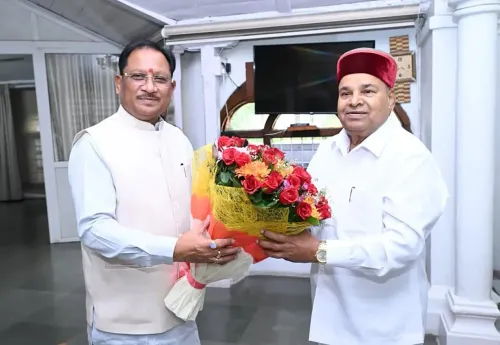
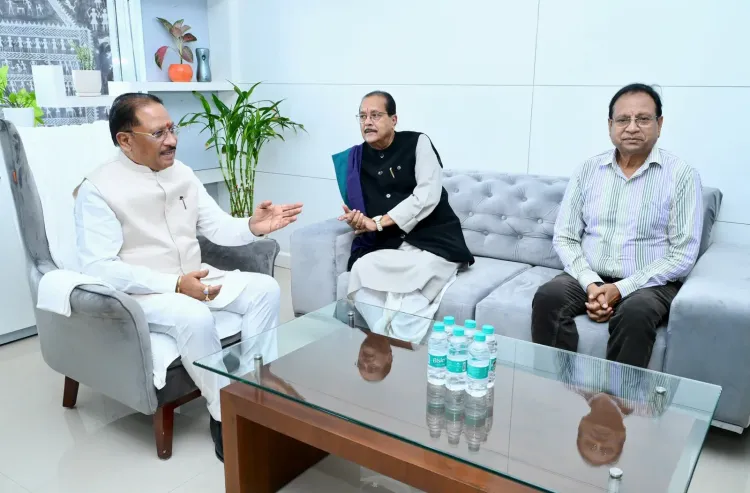
Chhattisgarh Chief Minister Vishnu Deo Sai met Jharkhand Finance Minister Radhakrishna Kishore at Mahanadi Bhawan in Raipur on 7 July 2026. The two leaders emphasised shared tribal heritage, cultural ties, and the historic proximity between Jashpur and Jharkhand, signalling intent to deepen cooperation on border-area development and welfare delivery.
Key Takeaways
CM Vishnu Deo Sai hosted Jharkhand Finance Minister Radhakrishna Kishore at Mahanadi Bhawan, Raipur on 7 July 2026 .
Both leaders highlighted shared tribal heritage , cultural traditions, and deep social bonds between the two states.
Jashpur district in northern Chhattisgarh was specifically noted for its long-standing familial and cultural ties with Jharkhand.
The meeting was cross-party: CM Sai leads a BJP government while Kishore serves in the JMM-led Jharkhand government.
Both states were formed in November 2000 and share a border with overlapping tribal demographics and development challenges.
The engagement is expected to strengthen cooperation on border-area infrastructure , welfare scheme delivery, and cultural exchange.
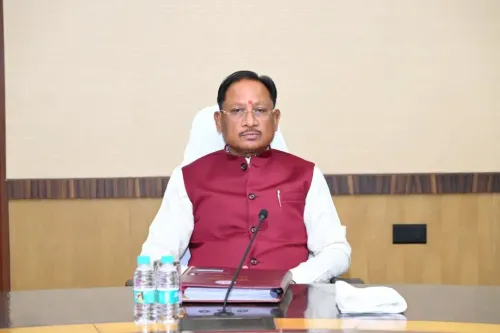
Chhattisgarh Chief Minister Vishnu Deo Sai met Jharkhand Finance Minister Radhakrishna Kishore at Mahanadi Bhawan in Raipur on Tuesday, 7 July 2026, in a cordial bilateral engagement focused on strengthening ties between the two neighbouring states. The meeting highlighted shared tribal heritage, cultural traditions, and the deep social bonds that connect the two states along their common border.
Context
Posting on X after the meeting, CM Sai described it as an 'aatmiya bhent' (warm, personal meeting), noting that Chhattisgarh and Jharkhand are bound not merely as neighbouring states but by 'sajha janjaatiya virasat, samriddh saanskritik paramparaon aur aatmiya saamajik sambandhon' — shared tribal heritage, rich cultural traditions, and close social ties. He specifically called out the long-standing familial and cultural proximity between Jashpur district in northern Chhattisgarh and the adjoining areas of Jharkhand, a bond that predates the formation of both states.
Chhattisgarh and Jharkhand were both carved out as separate states in November 2000 — from Madhya Pradesh and Bihar respectively — leaving a shared border and overlapping demographic and administrative challenges that have required ongoing inter-state coordination ever since.
Policy Backdrop
Both states carry among the highest concentrations of Scheduled Tribe populations in India, and their border districts share common concerns: delivery of forest rights, rural infrastructure, welfare scheme implementation, and historically, the challenge of left-wing extremism. Jashpur, the district CM Sai singled out, sits at the northern tip of Chhattisgarh and has deep demographic and cultural continuity with Jharkhand's southern belt, with families routinely straddling the administrative boundary.
Bilateral engagements between contiguous tribal-belt states have grown under the broader framework of cooperative federalism, with states increasingly coordinating on schemes for forest-dwelling communities, migration corridors, and border infrastructure. CM Sai, who took office in December 2023 with a stated emphasis on tribal welfare and connectivity, has positioned such outreach as central to his administration's inter-governmental approach.
Stakeholders and Impact
The communities most directly affected by closer Chhattisgarh–Jharkhand coordination are the tribal and border-district residents of districts such as Jashpur on the Chhattisgarh side and their Jharkhand counterparts. Better administrative alignment can translate into smoother access to welfare entitlements, reduced duplication in scheme delivery, and improved border-area infrastructure. Cultural exchange programmes, if formalised, would also benefit artisan and indigenous communities whose traditions span both states.
On the political side, the meeting is notable for its cross-party character: CM Sai leads a BJP government in Chhattisgarh, while Finance Minister Kishore serves in the JMM-led government in Jharkhand — signalling that administrative cooperation on shared development priorities can proceed independently of party affiliations.
What's Next
CM Sai expressed confidence that the dialogue would 'dono raajyon ke beech samvaad, sahyog aur anubhavon ka aadaan-pradaan' — the exchange of dialogue, cooperation, and experiences between the two states — would further strengthen joint efforts for the development of border regions and public welfare. Formal outcomes such as joint working groups on border infrastructure or cultural exchange programmes could be announced in upcoming state budget sessions or at regional coordination forums. The meeting sets a constructive precedent for how states with shared tribal demographics and contiguous geographies can institutionalise cooperative mechanisms beyond routine administrative contact.
Point of View
Whose government has made tribal outreach a signature priority since December 2023, this meeting reinforces a regional statecraft approach that builds goodwill beyond Chhattisgarh's borders. The emphasis on Jashpur — a district with historic cross-border cultural links — also signals that any eventual joint initiatives are likely to be grounded in genuine demographic realities rather than ceremonial diplomacy.
NationPress
7 Jul 2026
Frequently Asked Questions
Why did Chhattisgarh CM Vishnu Deo Sai meet Jharkhand Finance Minister Radhakrishna Kishore?
The meeting at Mahanadi Bhawan on 7 July 2026 was aimed at strengthening bilateral ties between Chhattisgarh and Jharkhand, with a focus on shared tribal heritage, cultural traditions, and cooperation on border-district development and welfare delivery.
What is the significance of Jashpur in Chhattisgarh-Jharkhand relations?
Jashpur is a northern Chhattisgarh district that borders Jharkhand and has long-standing familial and cultural ties with communities across the border, making it a focal point for any bilateral cooperation on tribal welfare and border-area development.
Are Chhattisgarh and Jharkhand governed by the same party?
No. Chhattisgarh is governed by the BJP under Chief Minister Vishnu Deo Sai, while Jharkhand is governed by a JMM-led coalition. The July 2026 meeting demonstrates that administrative cooperation can proceed across party lines on shared development priorities.
When were Chhattisgarh and Jharkhand formed?
Both states were created in November 2000 — Chhattisgarh was carved out of Madhya Pradesh and Jharkhand out of Bihar — leaving a shared border and overlapping administrative and demographic challenges.
What could come out of the Chhattisgarh-Jharkhand bilateral meeting?
Possible outcomes include joint working groups on border infrastructure, cultural exchange programmes, and better coordination on tribal welfare scheme delivery, which may be formalised in upcoming state budget sessions or regional coordination forums.