CM Sai pays tribute to Bharat Ratna Bhupen Hazarika on death anniversary
Synopsis
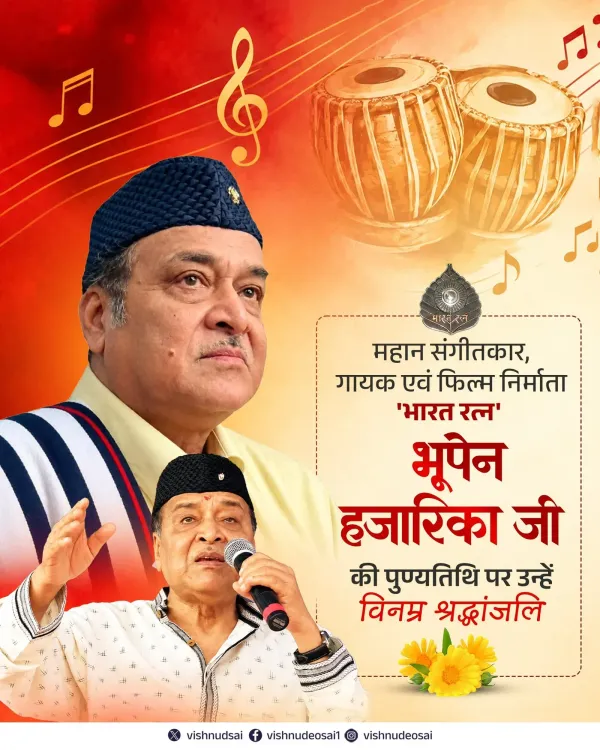
Chhattisgarh Chief Minister Vishnu Deo Sai paid homage to legendary Assamese singer-composer and Bharat Ratna recipient Bhupen Hazarika on his death anniversary, calling his contribution to Indian music and culture 'invaluable and forever memorable.'
Key Takeaways
Chhattisgarh CM Vishnu Deo Sai posted a tribute to Bhupen Hazarika on 5 November 2026 , Hazarika's death anniversary.
Hazarika was a legendary Assamese singer, lyricist and composer whose work spanned folk traditions and Indian cinema.
He was conferred the Bharat Ratna — India's highest civilian honour — posthumously in 2019 .
Annual commemorative events and performances of his works are held around 5 November in Assam and other states.
Tributes from leaders across geographies reflect Hazarika's rare status as a regional icon who achieved genuine national resonance.
India's Northeast gave the world a voice that could carry a river's grief and a mountain's joy in a single breath — and on 5 November 2026, Chhattisgarh Chief Minister Vishnu Deo Sai paused to remember it, offering a respectful tribute to legendary singer and composer Bhupen Hazarika on his death anniversary.
Posting on X in Hindi, CM Sai wrote: 'Mahan sangeet sadhak, prakhyat gayak evam Bharat Ratna se sammanit Bhupen Hazarika ji ki punyatithi par unhe vinamra shraddhanjali.' — 'Humble tribute to the great music devotee, renowned singer and Bharat Ratna awardee Bhupen Hazarika ji on his death anniversary.' He added that Hazarika's 'invaluable contribution to enriching Indian music and culture will always be remembered.'
A voice that belonged to all of India
Bhupen Hazarika was born in Assam and became one of the most consequential figures in Indian music — a singer, lyricist, composer and filmmaker whose work rooted itself in Assamese folk traditions while reaching audiences across every linguistic boundary. He composed and sang in Assamese, Hindi, Bengali and other languages, weaving the textures of the Brahmaputra valley into the mainstream of Indian cultural life.
His legacy was formally acknowledged when the Government of India conferred the country's highest civilian honour, the Bharat Ratna, upon him posthumously in 2019 — recognition that placed him alongside the most transformative figures in India's national story. The award came eight years after his passing and reflected a broader national reckoning with the Northeast's towering contributions to Indian art.
Northeast legacy, national remembrance
Tributes to Hazarika on his death anniversary have become a fixture on the Indian political calendar. Leaders across party lines and state borders use the occasion to affirm the cultural bridge his music built between the Northeast and the rest of the country — a bridge that carries real political significance in a region where ties to the national mainstream have often been contested and hard-won.
In Assam and several other states, annual commemorative events and performances of Hazarika's compositions are held around 5 November each year, keeping his songs alive for new generations. His music — suffused with the imagery of rivers, boatmen, and collective longing — continues to resonate far beyond its origins.
A politician from a different geography paying homage underscores exactly what Hazarika spent a lifetime achieving: music that refused to stay local.
Point of View
A point successive governments have been keen to publicly underline. The Bharat Ratna conferred posthumously in 2019 was itself a delayed but deliberate national statement. When a Chief Minister from a central Indian state like Chhattisgarh echoes that sentiment, it reflects how Hazarika's legacy has successfully transcended its regional origins to become a genuinely pan-Indian touchstone — precisely the kind of soft cultural integration that shapes political narratives around the Northeast.
NationPress
5 Nov 2026
Frequently Asked Questions
Who was Bhupen Hazarika?
Bhupen Hazarika was a legendary Assamese singer, lyricist, composer and filmmaker, widely regarded as one of the greatest cultural figures of Northeast India. His music drew on Assamese folk traditions and reached audiences across the country in multiple languages.
When did Bhupen Hazarika receive the Bharat Ratna?
Bhupen Hazarika was conferred the Bharat Ratna — India's highest civilian honour — posthumously in 2019 by the Government of India.
When is Bhupen Hazarika's death anniversary?
Bhupen Hazarika's death anniversary falls on 5 November, which is marked each year with commemorative events and musical performances in Assam and across India.
Why did Chhattisgarh CM Vishnu Deo Sai pay tribute to Bhupen Hazarika?
CM Sai posted a tribute on X on 5 November 2026, Hazarika's death anniversary, calling his contribution to Indian music and culture 'invaluable and forever memorable.' Such tributes have become a standard practice for Indian political leaders on the anniversaries of Bharat Ratna recipients and cultural icons.
What is Bhupen Hazarika's contribution to Indian music?
Hazarika enriched Indian music by blending Assamese folk traditions with mainstream Indian cinema and culture. He composed, sang and wrote in multiple languages, building a cultural bridge between the Northeast and the rest of India that earned him national recognition and the Bharat Ratna.