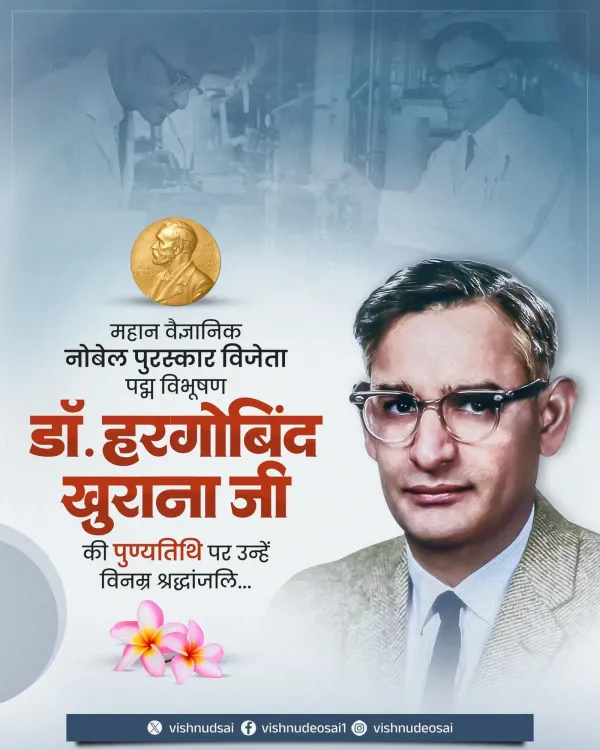
CM Vishnu Deo Sai Pays Tribute to Nobel Laureate Dr. Hargobind Khurana
Synopsis
Chhattisgarh Chief Minister Vishnu Deo Sai offered a solemn tribute to Nobel laureate and Padma Vibhushan awardee Dr. Hargobind Khurana on his death anniversary, saluting his foundational work in genetics and molecular biology that transformed modern science.
Key Takeaways
Chhattisgarh CM Vishnu Deo Sai posted a tribute to Dr.
Hargobind Khurana on his death anniversary on 9 November 2026 .
Khurana was awarded the Nobel Prize in Physiology or Medicine in 1968 for deciphering the genetic code.
He was also honoured with the Padma Vibhushan , India's second-highest civilian award.
CM Sai described his contributions to genetics and molecular biology as an invaluable legacy for the world of science.
The tribute reflects a broader Indian political tradition of publicly honouring pioneering scientists of Indian origin on anniversary dates.
A giant of molecular biology whose decoding of life's instruction manual changed science forever — Chhattisgarh Chief Minister Vishnu Deo Sai marked the death anniversary of Nobel laureate Dr. Hargobind Khurana on Monday, 9 November 2026, with a solemn tribute honouring the Indian-born scientist's towering legacy.
Posting in Hindi on X, CM Sai wrote: 'महान वैज्ञानिक, नोबेल पुरस्कार से सम्मानित, पद्मविभूषण डॉ. हरगोबिंद खुराना जी की पुण्यतिथि पर उन्हें विनम्र श्रद्धांजलि एवं सादर नमन।' — 'On the death anniversary of the great scientist, Nobel Prize laureate and Padma Vibhushan awardee Dr. Hargobind Khurana, I offer humble tribute and respectful salutation.' He added that Khurana's unparalleled contributions to genetics and molecular biology stand as an invaluable legacy for the world of science, and that his achievements will continue to inspire generations to come in the pursuit of knowledge, research, and innovation.
The Man Who Cracked the Genetic Code
Dr. Hargobind Khurana, born in undivided India, was awarded the Nobel Prize in Physiology or Medicine in 1968 — sharing it for research that deciphered how the nucleotides in nucleic acids control the synthesis of proteins, essentially explaining how DNA's four-letter alphabet spells out every living organism. It was one of the most consequential breakthroughs in the history of biology. India later honoured him with the Padma Vibhushan, the country's second-highest civilian award.
His work laid the groundwork for the biotechnology revolution that followed — from genetic engineering to the mRNA vaccine platforms that the world would come to rely on decades later. Few scientists of Indian origin have left as deep a mark on the foundations of modern medicine.
Why Political Tributes to Scientists Matter
Indian political leaders across the spectrum have made it a practice to mark the death and birth anniversaries of pioneering scientists of Indian origin. The gesture carries a signal beyond ceremonial courtesy: it anchors national identity to intellectual achievement, not just military or political history. For a country investing heavily in its science and technology ecosystem, invoking Khurana's name is also a reminder of what homegrown — or India-rooted — genius can produce on the world stage.
CM Sai's tribute, brief and dignified, fits squarely in that tradition — a moment to pause and place one scientist's extraordinary life inside the longer story of India's relationship with knowledge.
Point of View
Honoured by the world — fits neatly into the 'Bharat ka gaurav' framing that runs through many such remembrances. At the same time, these moments carry genuine educational value, surfacing a name that younger generations may not encounter in mainstream discourse. The challenge for policymakers is ensuring such tributes translate into sustained investment in science education rather than remaining purely symbolic.
NationPress
9 Nov 2026
Frequently Asked Questions
Who was Dr. Hargobind Khurana?
Dr. Hargobind Khurana was an Indian-born molecular biologist who won the Nobel Prize in Physiology or Medicine in 1968 for his pioneering work on the genetic code. He was also awarded the Padma Vibhushan, India's second-highest civilian honour.
Why did Vishnu Deo Sai pay tribute to Hargobind Khurana?
Chhattisgarh CM Vishnu Deo Sai posted a tribute on X on 9 November 2026 to mark Dr. Khurana's death anniversary, honouring his landmark contributions to genetics and molecular biology.
What did Hargobind Khurana win the Nobel Prize for?
Dr. Khurana shared the 1968 Nobel Prize in Physiology or Medicine for research that deciphered how nucleotides in DNA control protein synthesis — essentially cracking the molecular language of life.
What is the Padma Vibhushan?
The Padma Vibhushan is India's second-highest civilian award, conferred by the Government of India for exceptional and distinguished service to the nation.
What was Hargobind Khurana's contribution to genetics?
Khurana's research decoded the genetic code — explaining how the sequence of nucleotides in DNA directs the production of specific proteins, a discovery that became a cornerstone of modern molecular biology and biotechnology.