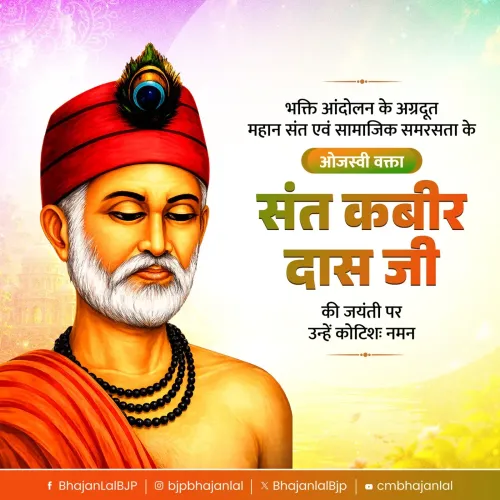
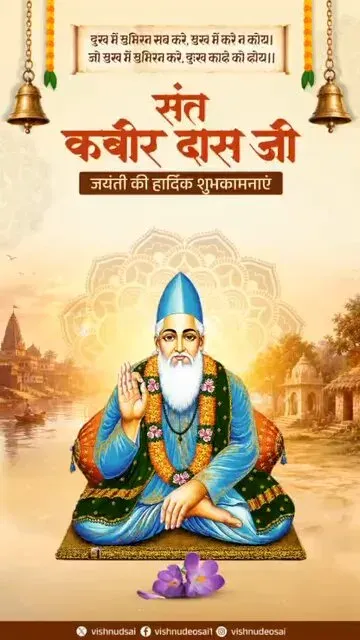
CM Sai Pays Tribute to Sant Kabir Das on Jayanti
Synopsis
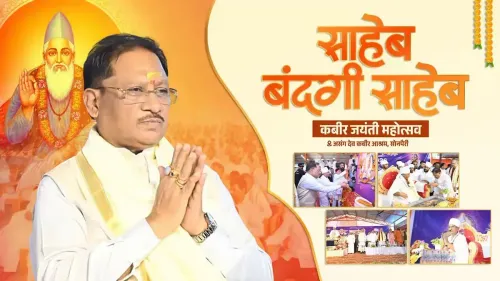
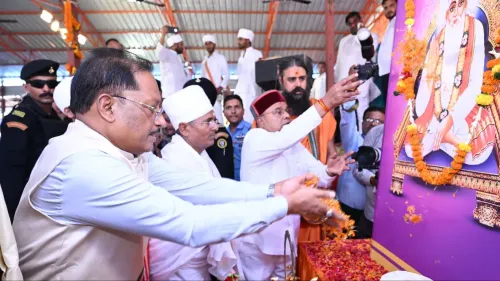
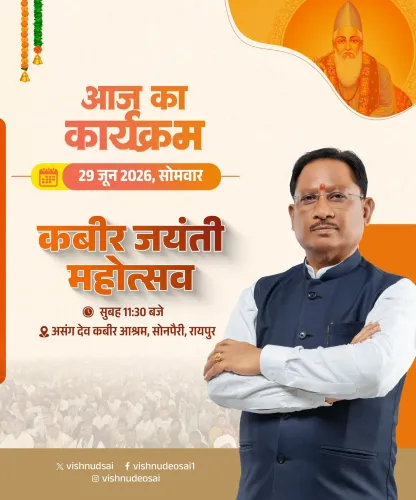
Chhattisgarh Chief Minister Vishnu Deo Sai on 29 June 2026 paid tribute to Sant Kabir Das on his Jayanti, calling on citizens to embrace the 15th-century poet-saint's teachings of truth, equality, and social harmony to build a developed Chhattisgarh.
Key Takeaways
CM Vishnu Deo Sai offered tribute to Sant Kabir Das on his birth anniversary on 29 June 2026 .
Sai described Kabir Das as the 'immortal pioneer of truth, harmony, and humanity' in a Hindi-language post on X.
The Chief Minister called on citizens to rise above 'pretence and discrimination' and imbibe Kabir's ideals.
Chhattisgarh hosts one of India's largest Kabir Panth communities, centred in Raipur district .
Sai linked Kabir's philosophy of social harmony directly to the goal of a 'developed Chhattisgarh.'
Chhattisgarh Chief Minister Vishnu Deo Sai on Monday, 29 June 2026, offered reverential tribute to the 15th-century poet-saint Kabir Das on his birth anniversary, invoking the saint's timeless teachings of truth, equality, and social harmony to inspire citizens toward building a 'harmonious and developed Chhattisgarh.'
Context
Kabir Das Jayanti is observed annually on the full moon day of the Hindu month of Jyeshtha, commemorating the birth of the revered 15th-century mystic poet and social reformer. Chief Minister Sai's post, written in Hindi, opened with the salutation 'saadar koti-koti naman' (a hundredfold respectful bow), describing Kabir Das as 'satya, samarasata aur manavata ke amar praneta' — 'the immortal pioneer of truth, harmony, and humanity.'
Sai noted that Kabir's 'kaaljayi vachan' (timeless words) showed society the path of truth, love, equality, and goodwill, and that those ideas continue to inspire people today to rise above pretence and discrimination.
Policy Backdrop
Sant Kabir Das, believed to have been born around 1398 CE in Varanasi, is one of India's most celebrated Bhakti movement saints. His dohas (couplets) challenged caste hierarchy, ritualism, and religious orthodoxy, drawing followers from both Hindu and Muslim communities. His philosophy of nirguna bhakti — devotion to a formless God — remains a touchstone for social reform movements across the subcontinent.
In Chhattisgarh, the Kabir Panth — a religious sect founded on his teachings — has a significant following, particularly among Scheduled Caste and Other Backward Class communities. The state hosts one of the largest Kabir Panthi populations in India, making tributes to the saint carry particular social and political resonance in the region.
Stakeholders and Impact
Chief Minister Sai's invocation of Kabir's ideals of 'samarasata' (social harmony) and development aligns with the BJP's broader outreach to Scheduled Caste, tribal, and backward communities in Chhattisgarh, where such constituencies form a substantial share of the electorate. By linking Kabir's philosophy explicitly to the goal of a 'developed Chhattisgarh,' the Chief Minister frames social cohesion as a precondition for the state's progress.
The Kabir Panth community, centred around the Damakheda seat of the sect in Raipur district, is likely to note the tribute. Kabir Jayanti observances across the state typically include public readings of dohas, community meals, and cultural programmes that cut across caste and religious lines.
What's Next
The Chief Minister's call for citizens to 'imbibe Kabir's ideals and contribute to building a harmonious and developed Chhattisgarh' signals that the state government may use this occasion to reinforce welfare and social-harmony messaging in the run-up to local administrative and community-level programmes. Kabir Jayanti observances across Chhattisgarh are expected to draw large gatherings, with government participation likely at district and block levels. The broader push to associate governance with Kabir's egalitarian ethos reflects an ongoing effort to ground development policy in cultural and spiritual identity.
Point of View
He is deploying a vocabulary that resonates deeply with Chhattisgarh's large Scheduled Caste, tribal, and Kabir Panthi constituencies. The BJP has consistently sought to appropriate the Bhakti saint tradition as a non-divisive, pan-Hindu cultural touchstone, and Sai's framing of Kabir's egalitarianism as a blueprint for state-building reinforces that strategy. The explicit call to contribute to a 'harmonious and developed Chhattisgarh' ties spiritual heritage to the government's governance narrative ahead of future electoral cycles. It reflects a pattern visible across BJP-governed states: using saint anniversaries to signal social inclusion while consolidating cultural identity politics.
NationPress
27 Sept 2026
Frequently Asked Questions
When is Kabir Das Jayanti celebrated in 2026?
Kabir Das Jayanti in 2026 falls on 29 June , observed on the full moon day of the Hindu month of Jyeshtha.
What did Chhattisgarh CM Vishnu Deo Sai say on Kabir Jayanti?
CM Sai paid tribute to Sant Kabir Das, describing him as the 'immortal pioneer of truth, harmony, and humanity,' and called on citizens to imbibe his ideals to build a harmonious and developed Chhattisgarh.
Who are the Kabir Panthis in Chhattisgarh?
The Kabir Panth is a religious sect founded on the teachings of Sant Kabir Das. Chhattisgarh has one of the largest Kabir Panthi populations in India, with the sect's principal seat located at Damakheda in Raipur district.
What were Sant Kabir Das's main teachings?
Sant Kabir Das, a 15th-century mystic poet from Varanasi, taught truth, love, equality, and social harmony. He challenged caste hierarchy, ritualism, and religious orthodoxy through his famous dohas (couplets).
Why is Kabir Jayanti significant in Chhattisgarh?
Chhattisgarh has a historically large Kabir Panthi community, particularly among Scheduled Caste and Other Backward Class groups, making the occasion one of considerable social and cultural importance in the state.