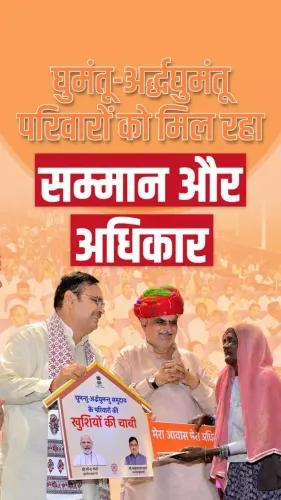
CM Bhajanlal Sharma allots homes to nomadic families in Jaipur
Synopsis
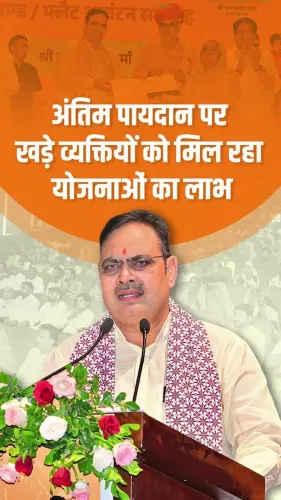
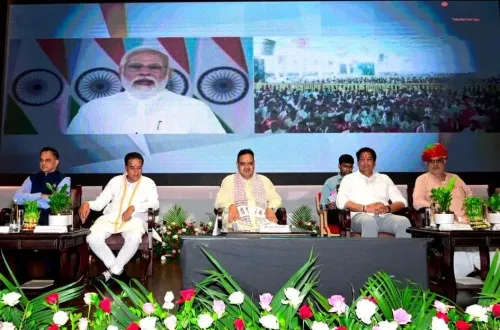
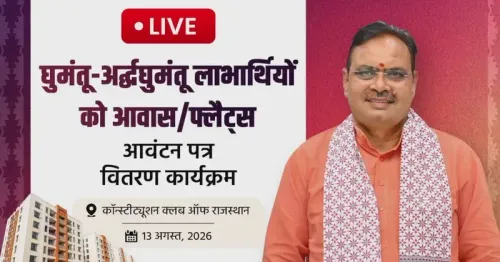
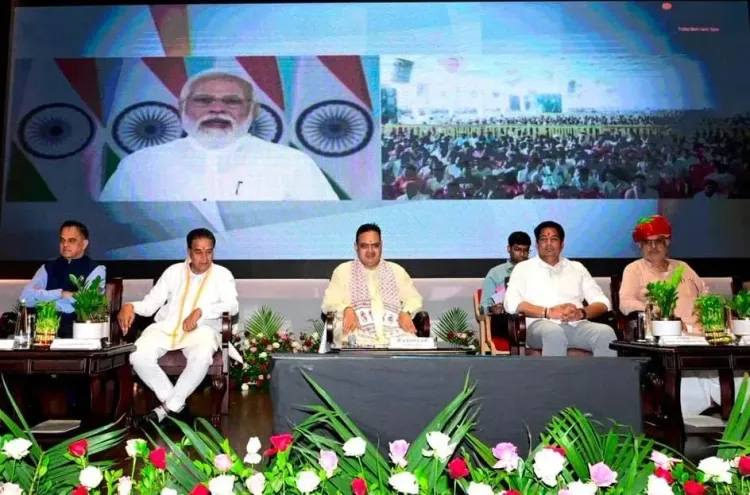
Chief Minister Bhajanlal Sharma addressed a flat-allotment ceremony for denotified, nomadic and semi-nomadic families at Constitution Club on 13 August 2026, framing the housing drive as fulfilment of the Antyodaya vision of Ambedkar and Deendayal Upadhyay under PM Modi's welfare agenda.
Key Takeaways
CM Bhajanlal Sharma addressed a flat-allotment ceremony for denotified, nomadic and semi-nomadic families at Constitution Club on 13 August 2026 .
The event is part of Rajasthan's implementation of centrally sponsored housing programmes, including Pradhan Mantri Awas Yojana , launched in June 2015 .
Sharma invoked both Dr.
Ambedkar and Pandit Deendayal Upadhyay's Antyodaya philosophy to frame the welfare outreach.
Denotified tribes were criminalised under the British-era Criminal Tribes Act of 1871 and denotified only in 1952 , leaving them historically excluded from welfare systems.
The Rajasthan BJP government, in power since December 2023 , is branding the state as a leader in welfare delivery under the #AapnoAgraniRajasthan campaign.
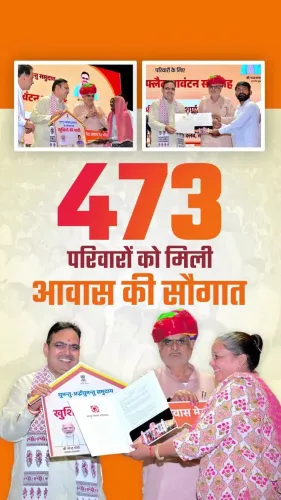
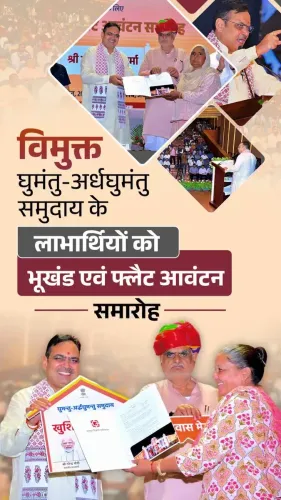
Homes for the historically homeless — that was the promise made concrete at Constitution Club, New Delhi, on 13 August 2026, when Chief Minister Bhajanlal Sharma presided over a flat-allotment ceremony for denotified, nomadic, and semi-nomadic families of Rajasthan, communities that colonial-era laws once branded as 'born criminals' and whose claim to a permanent address has remained elusive for generations.
The ceremony and what Sharma said
Addressing the gathering, CM Sharma invoked two ideological pillars — Dr. B.R. Ambedkar, architect of the Constitution and lifelong champion of the marginalised, and Pandit Deendayal Upadhyay, whose Antyodaya (upliftment of the last person) philosophy has become a cornerstone of BJP governance. He said that Prime Minister Narendra Modi is 'giving strength to the needy and deprived' by translating that twin legacy into concrete welfare action, and that relief is now reaching 'the person at the bottom rung.'
The allotment of residential flats to these families represents state-level delivery under the broader architecture of centrally sponsored housing programmes, most notably the Pradhan Mantri Awas Yojana (PMAY), launched in June 2015 to provide permanent, pucca housing to India's urban and rural poor.
Why denotified and nomadic tribes matter
India's denotified tribes (DNTs) carry a particularly heavy historical burden. Criminalised under the British-era Criminal Tribes Act of 1871 and formally 'denotified' only in 1952, these communities have spent decades on the margins — excluded from land records, welfare rolls, and often formal identity documents. Without a fixed address, accessing government schemes becomes a bureaucratic impossibility. A flat allotment ceremony is, for these families, not merely a housing event. It is an entry point into the formal state.
The invocation of both Ambedkar and Upadhyay at the same event is deliberate political architecture — threading the constitutional guarantee of equality with the RSS-rooted Antyodaya ethic to signal that welfare for the most marginalised is not charity but obligation.
Rajasthan's role in the PMAY delivery chain
State governments serve as the implementing arm of PMAY, identifying beneficiaries, acquiring land, constructing or procuring units, and conducting allotment. Rajasthan, with its large nomadic and semi-nomadic population spread across arid districts, has been an active participant in successive phases of the scheme. Events like Thursday's ceremony are the visible, human face of that bureaucratic pipeline — a beneficiary list becoming a set of keys.
The hashtag #AapnoAgraniRajasthan (Our Leading Rajasthan) attached to the post signals the state government's broader branding effort to position Rajasthan as a frontrunner in welfare delivery under the current BJP administration, which took office in December 2023.
For families who have never held a title deed, the weight of a flat key is immeasurable. Whether the next state budget accelerates further allotment phases will be the real measure of that promise.
Point of View
Sharma's office is signalling a deliberate outreach to DNT communities ahead of future electoral cycles. The broader pattern — states accelerating PMAY delivery for historically excluded groups — reflects a national push to close the gap between scheme design and last-mile delivery, though the scale of Thursday's allotment and whether it represents a new phase or a continuation of existing targets remains to be confirmed.
NationPress
28 Sept 2026
Frequently Asked Questions
Who are denotified tribes in India?
Denotified tribes (DNTs) are communities that were criminalised under the British-era Criminal Tribes Act of 1871 and formally denotified — removed from that criminal classification — in 1952 after independence. They have historically faced social exclusion, lack of land rights, and limited access to government welfare schemes.
What is the Pradhan Mantri Awas Yojana?
Pradhan Mantri Awas Yojana (PMAY) is a central government housing scheme launched in June 2015 to provide permanent, pucca houses to eligible urban and rural households, including marginalised and economically weaker sections of society.
What is Antyodaya philosophy?
Antyodaya is a concept articulated by BJP ideologue Pandit Deendayal Upadhyay in the 1960s, meaning 'upliftment of the last person.' It prioritises directing development resources to the poorest and most marginalised sections of society and has been adopted as a guiding framework by successive BJP governments.
What did CM Bhajanlal Sharma say at the flat-allotment ceremony?
CM Sharma said that Prime Minister Narendra Modi is giving strength to the needy and deprived by fulfilling the Antyodaya vision of Dr. B.R. Ambedkar and Pandit Deendayal Upadhyay, ensuring relief reaches the person at the bottom rung of society.
When did Bhajanlal Sharma become Chief Minister of Rajasthan?
Bhajanlal Sharma became Chief Minister of Rajasthan in December 2023 after the BJP won the state assembly elections.