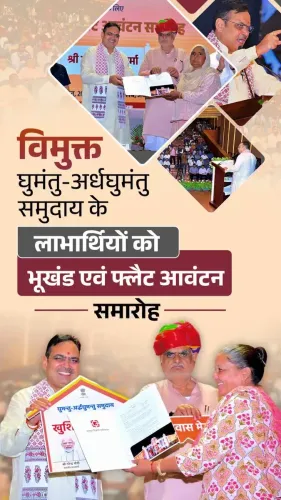
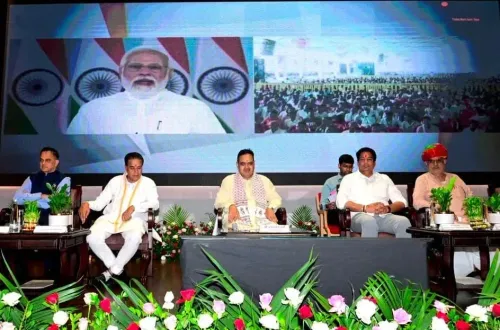
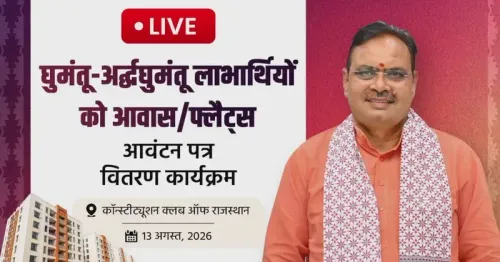
CM Bhajanlal hands housing allotment letters to Rajasthan's nomadic families
Synopsis
Chief Minister Bhajanlal Sharma distributed housing and flat allotment letters to nomadic and semi-nomadic beneficiaries in Jaipur on 13 August 2026, framing the drive as an extension of PM Modi's poverty-alleviation agenda to India's most marginalised communities.
Key Takeaways
CM Bhajanlal Sharma addressed a housing allotment event in Jaipur on 13 August 2026 .
Allotment letters for housing and flats were distributed to nomadic and semi-nomadic community beneficiaries.
Sharma attributed the welfare push to PM Narendra Modi 's leadership and poverty-alleviation framework.
The drive aligns with the Pradhan Mantri Awas Yojana , launched in 2015 to provide permanent housing to India's poor.
Rajasthan's BJP government, in power since December 2023 , has consistently aligned state welfare delivery with central schemes.
Further district-level allotment phases and state budget provisions for nomadic welfare remain key things to watch.
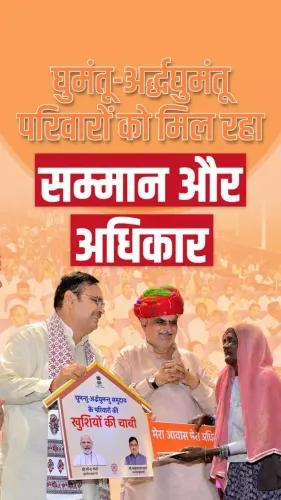
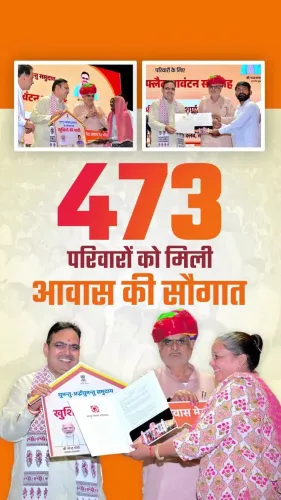
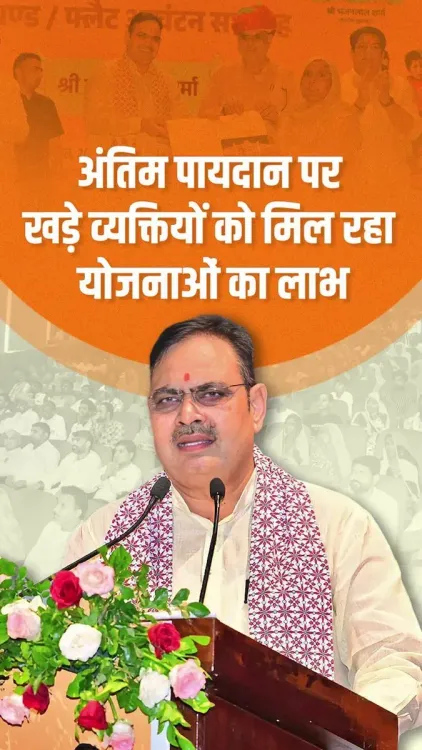
For communities that have spent generations without a permanent address, a single allotment letter can mean everything. On Thursday, 13 August 2026, Chief Minister Bhajanlal Sharma stood before a gathering in Jaipur and personally distributed housing and flat allotment letters to beneficiaries from nomadic and semi-nomadic communities — groups that have historically sat at the furthest edge of India's welfare map.
Addressing the event, CM Sharma credited the push to Prime Minister Narendra Modi, saying that welfare schemes running under Modi's leadership were reaching 'antim paaydaan par khade vyakti' — the person standing on the last rung. The remark framed the drive not as a state initiative alone, but as an extension of the Centre's poverty-alleviation architecture into one of Rajasthan's most overlooked populations.
Who nomadic and semi-nomadic communities are — and why housing matters most for them
Nomadic and semi-nomadic groups have long occupied a precarious position in India's social and administrative structure. Without fixed residences, many historically struggled to access identity documents, ration cards, or government entitlements — creating a compounding cycle of exclusion. A formal housing allotment breaks that cycle at its root, anchoring a family to an address that unlocks every downstream benefit.
Successive governments at the Centre have attempted to address this gap through targeted schemes. The Pradhan Mantri Awas Yojana (PMAY), launched in 2015, remains the backbone of India's formal housing push for the rural and urban poor, and state governments have used its framework to conduct allotment drives for specific marginalised sub-groups, including denotified, nomadic, and semi-nomadic communities.
Rajasthan's BJP government and the alignment with central welfare delivery
Since taking office in December 2023, CM Sharma's administration has made visible alignment with central welfare programs a signature of its governance approach. State-level events like Thursday's allotment drive serve a dual purpose: they deliver tangible benefits to beneficiaries on the ground while also reinforcing the political messaging that BJP governments — at both the state and national level — are working in concert for the poor.
Rajasthan's nomadic communities, spread across its vast semi-arid geography, represent a constituency that formal welfare machinery has often struggled to reach. An in-person allotment ceremony in the state capital signals administrative intent to close that gap — though the scale of coverage and the specific scheme sub-component under which these flats were allotted could not be independently verified from established public records.
The next test will be whether further allotment phases reach beneficiaries in Rajasthan's districts beyond Jaipur — and whether state budget provisions follow to sustain the momentum.
Point of View
CM Sharma reinforces the 'double engine government' narrative ahead of future electoral cycles. The focus on nomadic and semi-nomadic communities — historically outside the reach of formal welfare — signals an attempt to expand the BJP's social coalition in Rajasthan. Whether this translates into sustained, district-level coverage will determine its policy legacy beyond the optics of a single Jaipur event.
NationPress
28 Sept 2026
Frequently Asked Questions
Who are nomadic and semi-nomadic communities in Rajasthan?
Nomadic and semi-nomadic communities are groups that traditionally lived without fixed residences, often moving seasonally. In Rajasthan, they include various denotified tribes and itinerant communities who have historically lacked access to permanent housing, identity documents, and government welfare schemes.
What is the Pradhan Mantri Awas Yojana and how does it help these communities?
The Pradhan Mantri Awas Yojana (PMAY) was launched in 2015 to provide pucca (permanent) houses to eligible rural and urban poor households across India. State governments use its framework to conduct targeted allotment drives for marginalised sub-groups, including nomadic and semi-nomadic communities, giving them a formal address and access to downstream benefits.
What did CM Bhajanlal Sharma do at the Jaipur event on 13 August 2026?
CM Bhajanlal Sharma addressed a housing allotment distribution programme in Jaipur and personally distributed housing and flat allotment letters to beneficiaries from nomadic and semi-nomadic communities, crediting PM Narendra Modi's welfare agenda for the initiative.
Why is a housing allotment letter significant for nomadic families?
For nomadic families, a formal housing allotment provides a permanent address, which is the gateway to obtaining identity documents, ration cards, bank accounts, and other government entitlements that were previously inaccessible due to their lack of fixed residence.
When did Bhajanlal Sharma become Chief Minister of Rajasthan?
Bhajanlal Sharma became Chief Minister of Rajasthan in December 2023, after the BJP won the state assembly elections.