Punjab VB Nabs 14 in July Bribery Traps, Files 16 Court Challans
Synopsis
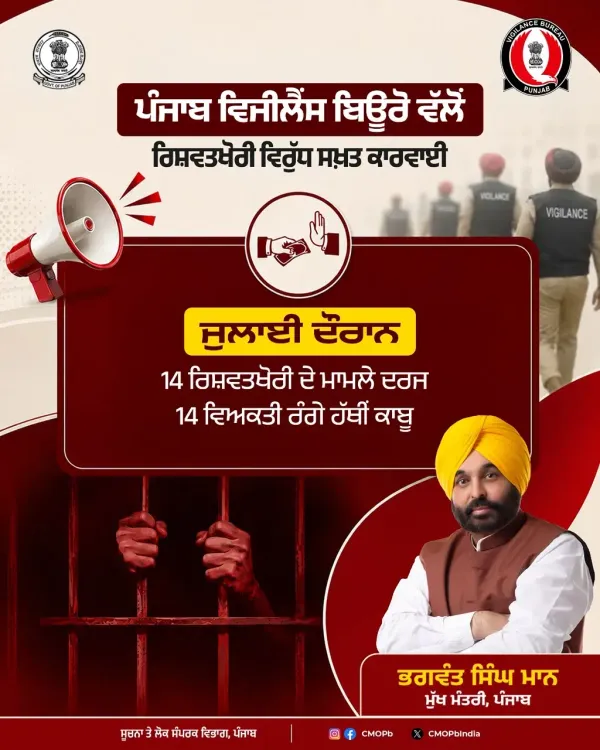
The Punjab Vigilance Bureau caught 14 individuals — 12 government officials and 2 private persons — accepting bribes in July 2026, while filing 16 court challans, registering 2 fresh enquiries, 1 disproportionate assets case, and 5 criminal cases against 7 accused.
Key Takeaways
14 trap cases were conducted by the Punjab Vigilance Bureau in July 2026 .
12 government employees and 2 private individuals were caught red-handed accepting bribes.
16 challans were submitted in various courts relating to vigilance cases.
2 fresh vigilance enquiries were registered for deeper investigation of corruption.
1 disproportionate assets case was filed against a public servant.
5 criminal cases were registered against 7 accused , including 5 government employees .
Fourteen trap operations. Twelve government officials caught red-handed. One month. The Punjab Vigilance Bureau (VB) has released its July 2026 enforcement tally, and the numbers signal that the state's anti-corruption machinery is running at sustained intensity under Chief Minister Bhagwant Mann's administration.
The Chief Minister's Office of Punjab announced on Thursday, August 13 that the Bureau apprehended 12 government employees and 2 private individuals while accepting bribes across 14 separate trap cases during July. Simultaneously, 16 challans — formal charge-sheets — were submitted before various competent courts, keeping the judicial pipeline active alongside field operations.
Disproportionate Assets, Criminal Cases, and Fresh Enquiries
Beyond the bribery traps, the Bureau registered 2 fresh vigilance enquiries to probe corruption cases in greater depth, and filed 1 disproportionate assets case — a charge that targets officials whose declared wealth cannot be explained by known income sources. Five criminal cases were also registered against 7 accused, of whom 5 are government employees. The breadth of the action — spanning trap arrests, court filings, asset probes, and criminal FIRs — reflects a multi-track enforcement posture rather than a single headline operation.
Mann Government's Zero-Tolerance Record Since 2022
When the Aam Aadmi Party swept Punjab's assembly elections in March 2022, a declared zero-tolerance policy on corruption was central to its pitch to voters. Since then, the government has steadily expanded the Vigilance Bureau's operational capacity and institutionalised monthly public disclosures of enforcement statistics — a transparency mechanism designed to hold the administration accountable to its own promises. The #ZeroTolerancePolicy hashtag on Thursday's post is not incidental; it is a deliberate signal that the campaign framing of 2022 is being carried into day-to-day governance in 2026.
The July report continues an unbroken pattern of such monthly releases, each one building a cumulative public record of trap cases, challans, and enquiries. Analysts watching Punjab's governance will now look to the judicial outcomes of the 16 challans filed last month — convictions, not just arrests, are the true measure of whether the enforcement chain holds.
Point of View
Quantifiable metric, updated publicly each month. This approach serves a dual purpose: it sustains electoral credibility on the zero-tolerance promise and creates a paper trail that makes it harder for future administrations to quietly wind down enforcement. The real test, however, lies downstream — whether the 16 challans filed in July translate into convictions, or whether the arrests remain the headline and the courts deliver a quieter story.
NationPress
13 Aug 2026
Frequently Asked Questions
How many people did Punjab Vigilance Bureau arrest in July 2026?
The Punjab Vigilance Bureau arrested 14 people in July 2026 — 12 government officials and 2 private individuals — all caught red-handed while accepting bribes in 14 separate trap operations.
What is a vigilance trap case in Punjab?
A trap case is a sting operation conducted by the Punjab Vigilance Bureau in which officials are caught in the act of accepting a bribe, typically using marked currency, allowing for immediate arrest and prosecution.
What is a disproportionate assets case?
A disproportionate assets case is registered against a public servant whose accumulated wealth significantly exceeds their known sources of income, indicating likely corruption over a period of time.
What is the Punjab Vigilance Bureau's role?
The Punjab Vigilance Bureau is a state agency responsible for investigating bribery, official misconduct, and disproportionate assets cases involving government employees in Punjab.
How has Bhagwant Mann's government tackled corruption in Punjab?
Since coming to power in March 2022, Chief Minister Bhagwant Mann's AAP government declared a zero-tolerance policy on corruption, strengthened the Vigilance Bureau's operational capacity, and introduced regular monthly public disclosures of enforcement actions.