CM Sai Slams UPA-Era Scams, Backs Modi's Self-Reliant India
Synopsis
Chhattisgarh CM Vishnu Deo Sai attacked the UPA government's corruption record on November 4, citing scams spanning sky to earth that cost Congress its mandate, while praising PM Modi's NDA for building a strong, prosperous, and self-reliant India.
Key Takeaways
Chhattisgarh CM Vishnu Deo Sai posted a sharp attack on UPA governance (2004–2014) on November 4, 2026 .
He invoked the metaphor of scams spanning 'sky, earth, and the depths below' to describe Congress-era corruption.
Major UPA-era cases cited in context include the 2G spectrum scam (2010) and the coal block allocation scam .
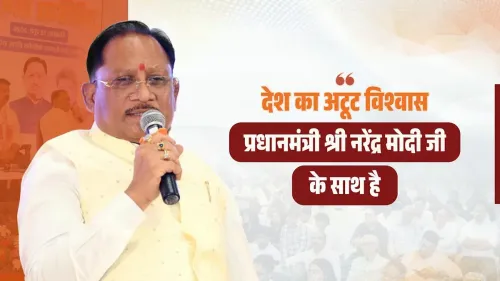
Sai credited the NDA under PM Narendra Modi with building a 'strong, prosperous, and self-reliant' India since 2014 .
The anti-UPA corruption narrative remains a core BJP campaign tool, particularly ahead of state assembly elections .
NDA reform measures including the Insolvency and Bankruptcy Code and direct-benefit transfers have been positioned as structural answers to UPA-era leakages.
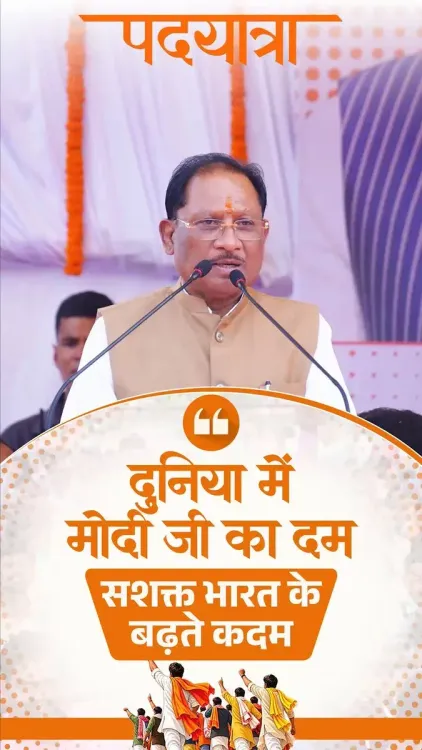
From sky to soil to the depths below — Chhattisgarh Chief Minister Vishnu Deo Sai left no metaphor unused on Wednesday, November 4, 2026, as he launched a pointed political salvo against the decade-long tenure of the UPA government, contrasting it sharply with what he called the nation-building mission of the NDA under Prime Minister Narendra Modi.
Posting in Hindi on X, CM Sai wrote: 'Aakaash, zameen aur paataal tak, ghotalon ke liye koi jagah nahin chodi gayi' — 'From the sky, to the earth, to the depths below, no space was left untouched by scams.' He argued this relentless corruption was why the public ultimately voted Congress out of power, and that India today is being shaped into a 'strong, prosperous, and self-reliant nation' under Modi's leadership.
The Scam Era That Defined a Decade of UPA Rule
Sai's broadside is rooted in a well-documented chapter of Indian political history. The UPA government (2004–2014), led by the Indian National Congress, was battered by a succession of high-profile corruption cases. The 2G spectrum scam of 2010 — in which telecom licences were allegedly allocated far below market value — and the coal block allocation scam, in which hundreds of coal deposits were distributed to private firms without competitive bidding, became flashpoints that dominated national discourse for years. Together, they set the political stage for the decisive 2014 general election, in which the NDA under Narendra Modi swept to a majority, ending a decade of coalition governance.NDA's Counter-Narrative: Transparency, Technology, Self-Reliance
Since 2014, the BJP-led NDA has built its governance identity around a sharp contrast with that era. Landmark reforms — including the Insolvency and Bankruptcy Code and the expansion of digital direct-benefit transfers — were positioned as structural answers to the leakages and cronyism that had defined the UPA years. The phrase Aatmanirbhar Bharat (Self-Reliant India) became the economic shorthand for this new direction, blending industrial ambition with a rejection of the dependency and opacity that critics associated with coalition-era deal-making.A BJP Rhetorical Playbook That Has Not Aged Out
What makes Sai's post notable is not its novelty — it is precisely the durability of this narrative that speaks loudest. More than a decade after the UPA's exit, senior BJP leaders from the national cabinet to state capitals continue to invoke the scam era as a live political reference point. For the party, the contrast between 2004–2014 and the post-2014 era remains one of its sharpest electoral weapons — one that gets redeployed with particular intensity ahead of state assembly contests. Chhattisgarh, which Sai governs, is no stranger to high-stakes political cycles, making the CM's choice to amplify this message on a national platform a signal worth reading carefully. If the UPA era gave BJP its founding grievance, the NDA's challenge now is to prove the alternative lives up to the contrast — and Sai's post is a reminder that the party intends to keep making that case.Point of View
Amplifying this nationally as a sitting chief minister signals alignment with the central party line and an interest in being seen as a credible Modi-era voice. The durability of the 'UPA versus NDA' contrast suggests BJP calculates that voters still respond to it — a calculation that will face its next real test at the ballot box.
NationPress
4 Nov 2026
Frequently Asked Questions
What scams did the UPA government face that BJP leaders like CM Sai refer to?
The UPA government (2004–2014) faced several major corruption cases, most notably the 2G spectrum scam of 2010 and the coal block allocation scam, in which government resources were allegedly allocated without competitive bidding, causing significant controversy.
Who is Vishnu Deo Sai and why did he make this post?
Vishnu Deo Sai is the Chief Minister of Chhattisgarh and a senior BJP leader. His post on November 4, 2026 contrasted UPA-era corruption with what he described as PM Modi's nation-building governance under the NDA.
What is Aatmanirbhar Bharat and how does it relate to this post?
Aatmanirbhar Bharat, or Self-Reliant India, is a flagship economic vision of the Modi government emphasising domestic manufacturing and reduced external dependency. CM Sai referenced this idea of a 'strong, prosperous, and self-reliant India' as the NDA's answer to the UPA era.
Why does BJP keep bringing up UPA scams even after so many years?
BJP strategists have consistently used the UPA corruption narrative as a contrast point to position the NDA as a cleaner, more accountable government. The strategy has proven electorally durable and is typically reactivated ahead of state and national elections.
What governance reforms did the NDA introduce to address corruption after 2014?
After coming to power in 2014, the NDA government introduced measures including the Insolvency and Bankruptcy Code to resolve corporate defaults and expanded digital direct-benefit transfers to reduce leakages in welfare delivery — both framed as corrections to UPA-era systemic failures.