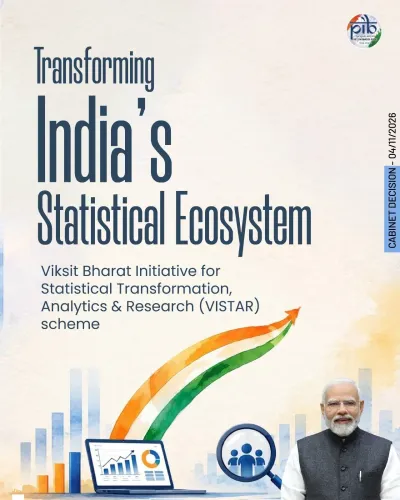
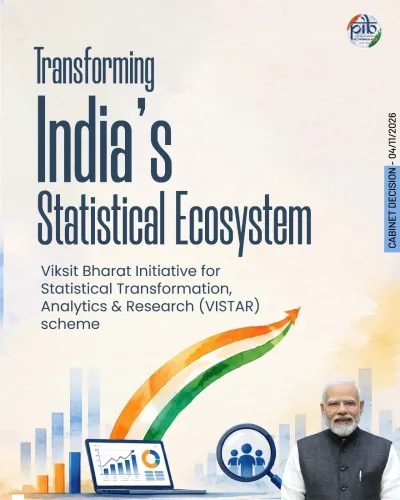
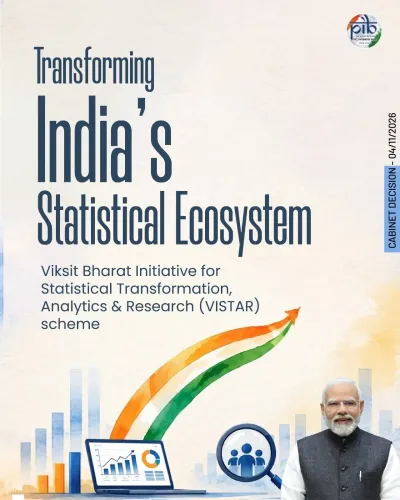
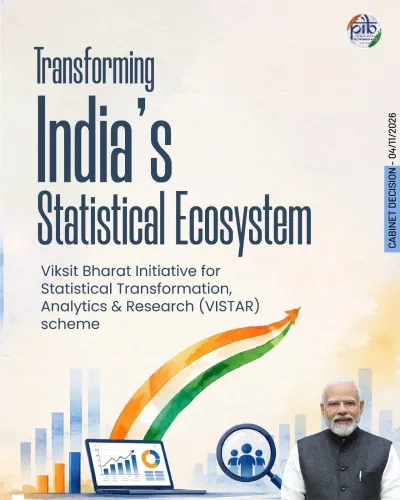
PM Modi: Cabinet clears VISTAR Scheme to overhaul India's stats system

Synopsis
The Union Cabinet has approved the VISTAR Scheme to overhaul India's statistical infrastructure, with Prime Minister Narendra Modi highlighting the use of AI, micro-level data focus, and modern systems as the pillars of better governance and policy delivery.
Key Takeaways
The Union Cabinet approved the VISTAR Scheme on 4 November 2026 to transform India's official statistical system.
Prime Minister Narendra Modi outlined three core pillars: use of technology and AI , a micro-level focus , and building modern statistical infrastructure.
The scheme fits a decades-long effort to strengthen evidence-based governance dating back to the formation of the National Statistical Commission in the early 2000s.
AI-driven data processing marks a significant step beyond traditional survey methodologies that have been criticised for being slow and poorly disaggregated.
Implementation timeline, budget allocation, and agency integration details are expected in forthcoming budget or parliamentary sessions .
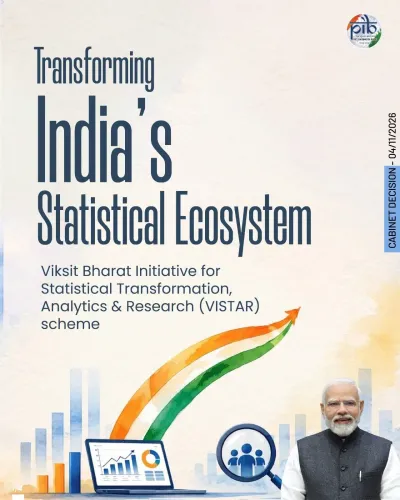
Better data, the argument goes, is the foundation of every good decision a government ever makes — and on Wednesday, 4 November 2026, Prime Minister Narendra Modi announced that the Union Cabinet had approved the VISTAR Scheme, a sweeping initiative designed to modernise India's statistical infrastructure from the ground up.
What the VISTAR Scheme sets out to do
In his post, Prime Minister Modi framed the scheme around a simple, hard-to-argue-with logic: 'Better data means better decisions, better policies and better delivery to people.' The VISTAR Scheme, he said, will transform India's statistical system by deploying technology and artificial intelligence, sharpening focus to the micro level, and building infrastructure that is both modern and future-ready.
The emphasis on AI and granular, micro-level data collection signals a significant departure from legacy survey methodologies that have long drawn criticism for being slow, patchy, and insufficiently disaggregated. Getting data down to the district or even village level has been a persistent demand from development economists and planners for decades.
A decades-long push for evidence-based governance
India's official statistical architecture has been under reform pressure since the early 2000s, when the National Statistical Commission was constituted to bring coherence and credibility to data systems spread across multiple ministries and agencies. Successive administrations have linked stronger statistics to better targeting of welfare programmes — the logic being that you cannot fix what you cannot measure, and you cannot measure what you cannot see at scale.
The VISTAR Scheme fits squarely into that lineage, but its explicit embrace of AI for data processing and analysis marks a step-change in ambition. Across multiple ministries — from agriculture to health to direct-benefit transfers — the Modi government has pushed digital tools into administrative workflows, and VISTAR extends that pattern to the very system that generates the numbers underpinning all of it.
What comes next: timeline, budget, and integration
The Cabinet clearance is the starting gun, not the finish line. The critical details — implementation timeline, budget allocation, and how VISTAR will integrate with existing statistical agencies — are expected to surface in upcoming budget or parliamentary sessions. How smoothly the new system interfaces with state-level data machinery will largely determine whether the scheme's micro-level ambitions translate into real policy gains on the ground.
India's welfare architecture, from food security to rural employment to health insurance, runs on the quality of its underlying data. If VISTAR delivers on its promise, the downstream effects on targeting, leakage reduction, and programme design could be substantial. The numbers will tell the story — eventually.
Point of View
Contemporary edge. Critics of India's data ecosystem, who have long flagged delays in census updates and gaps in granular welfare data, will watch the implementation details closely. The scheme's real test will be whether micro-level data actually improves last-mile delivery, or whether it remains an aspiration that stalls in inter-agency coordination.
NationPress
5 Nov 2026
Frequently Asked Questions
What is the VISTAR Scheme approved by the Indian Cabinet?
The VISTAR Scheme is a government initiative approved by the Union Cabinet to modernise India's statistical system by incorporating artificial intelligence, achieving micro-level data granularity, and building contemporary data infrastructure to support better policymaking.
Why did PM Modi announce the VISTAR Scheme?
Prime Minister Narendra Modi framed the scheme around the principle that better data leads to better decisions and policy delivery, aiming to transform India's legacy statistical systems into an AI-enabled, granular data architecture.
How will AI be used in the VISTAR Scheme?
While full technical details are yet to be released, the scheme is expected to deploy AI for data processing, analysis, and improved targeting accuracy, moving beyond traditional manual survey methods.
What is India's existing statistical infrastructure?
India's official statistical system is overseen by multiple agencies coordinated under the National Statistical Commission, established in the early 2000s to bring coherence to data collection across central ministries and states.
When will the VISTAR Scheme be implemented?
The Cabinet has cleared the scheme, but specific implementation timelines and budget allocations are expected to be announced in upcoming budget or parliamentary sessions.