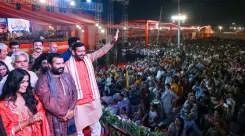
CM Sai Announces 100-Acre Medicity in Nava Raipur
Synopsis
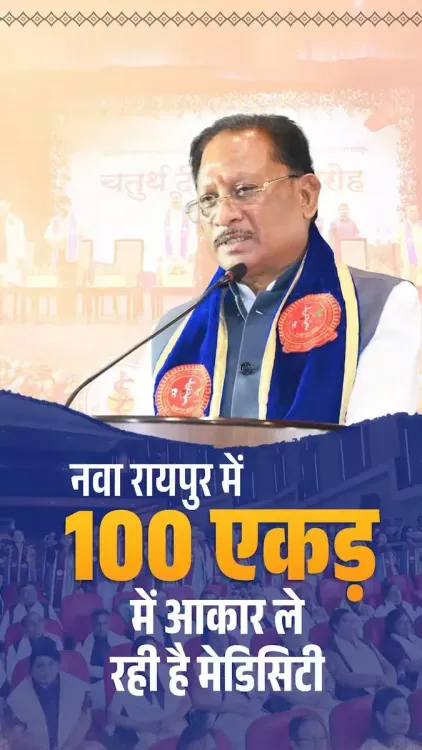
Chhattisgarh Chief Minister Vishnu Deo Sai has announced a 100-acre ultramodern Medicity in Nava Raipur, aiming to establish the state as a national medical hub and provide world-class healthcare to residents without leaving Chhattisgarh.
Key Takeaways
Chief Minister Vishnu Deo Sai announced a Medicity project being developed across 100 acres in Nava Raipur .
The project's stated goal is to make Chhattisgarh a leading medical hub in India.
The CM said residents should have access to world-class, modern, and affordable treatment within the state itself.
Nava Raipur was designed from its inception to include institutional and healthcare zones in its master plan.
Project cost, funding model, and timeline have not yet been officially disclosed.
The initiative follows a broader national pattern of states building integrated medical cities to reduce patient outflows to metros.
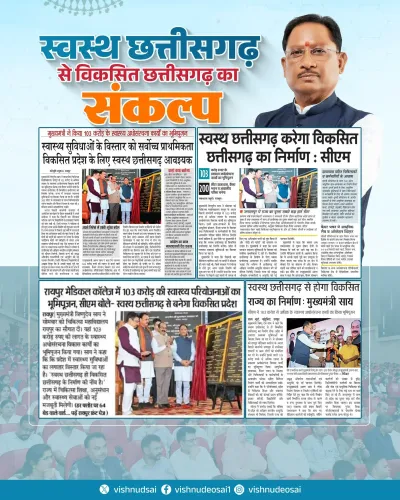
Chhattisgarh Chief Minister Vishnu Deo Sai on Friday, June 5, 2026, announced that a state-of-the-art Medicity spanning 100 acres is being developed in Nava Raipur, positioning the project as a cornerstone of the state's ambition to become a leading medical hub in India. The Chief Minister described the initiative as a major step toward building a 'healthy, empowered, and self-reliant Chhattisgarh.'
Context
Posting on X, CM Sai stated — 'स्वस्थ, सशक्त और आत्मनिर्भर छत्तीसगढ़ के निर्माण की दिशा में हम एक और बड़ा कदम बढ़ा रहे हैं' ['We are taking another big step towards building a healthy, empowered, and self-reliant Chhattisgarh']. He said the ultramodern Medicity being developed over 100 acres in Nava Raipur would give the state a new identity in the healthcare sector. The stated goal is to ensure that residents of Chhattisgarh have access to world-class, modern, and affordable treatment within their own state.
Policy Backdrop
Nava Raipur, the planned capital extension developed since the early 2000s, was designed from inception to house administrative and institutional infrastructure, including dedicated healthcare zones in its master plan. The project aligns with the National Health Policy 2017, which called for the establishment of centres of excellence and medical hubs in states to improve access to advanced care. Chhattisgarh has also benefited from central programmes such as Ayushman Bharat, and the state is already home to AIIMS Raipur, a premier central government medical institute established in 2012 to provide tertiary care and medical education.
Multiple Indian states have pursued integrated medical cities and clusters to reduce the outflow of patients to metros such as Mumbai, Delhi, and Hyderabad. Chhattisgarh's Medicity initiative follows a broader pattern among states seeking regional self-sufficiency in specialised treatment, particularly in BJP-governed states that have emphasised the self-reliance narrative in public health.
Stakeholders and Impact
The primary beneficiaries would be the residents of Chhattisgarh, who currently travel to larger cities for specialised care — a financial and logistical burden particularly acute for patients from tribal and rural districts. Medical professionals and healthcare investors would also be key stakeholders, as a dedicated medical zone of this scale could attract private hospitals, medical colleges, and allied health institutions to the state. If realised, the project could generate significant employment in healthcare, construction, and ancillary services.
Integration with existing infrastructure — including AIIMS Raipur and state medical colleges — will be critical to whether the Medicity achieves the 'world-class' standard the Chief Minister has articulated. The scale of 100 acres places this among the more ambitious state-level healthcare infrastructure projects announced in recent years.
What's Next
The announcement does not specify a project cost, funding model, or completion timeline; the tendering process and potential public-private partnership structure are yet to be made public. Observers will watch for formal project documents, land allocation orders, and whether the Medicity will be anchored by a central-government scheme or financed through state funds and private investment. The phasing of the project and its integration with AIIMS Raipur and existing medical colleges will determine the pace at which residents see tangible improvements in local healthcare access.
Point of View
Which took office in December 2023 and has been keen to demonstrate developmental momentum in a state that has historically lagged in tertiary healthcare capacity. Framing the project around 'self-reliance' — aatmanirbhar — mirrors the BJP's national messaging while addressing a genuine local pain point: the large number of Chhattisgarh patients who travel to Nagpur, Hyderabad, or Delhi for specialised care. However, the absence of a disclosed cost, timeline, or funding structure means the announcement is at this stage aspirational, and the political dividend will depend heavily on visible ground-level progress before the next electoral cycle. The project's success will also hinge on whether it can attract private hospital groups and specialists to a planned city that, despite two decades of development, still competes with the pull of established metros.
NationPress
21 Oct 2026
Frequently Asked Questions
What is the Chhattisgarh Medicity project?
The Chhattisgarh Medicity is a planned ultramodern healthcare complex being developed over 100 acres in Nava Raipur , announced by Chief Minister Vishnu Deo Sai on June 5, 2026 , with the aim of making Chhattisgarh a leading medical hub in India.
Where is the Medicity being built in Chhattisgarh?
The Medicity is being developed in Nava Raipur , the planned capital extension of Raipur that was designed from the early 2000s to include institutional and healthcare infrastructure zones.
What is the cost and timeline of the Nava Raipur Medicity?
As of the announcement on June 5, 2026 , the project cost, funding model, and completion timeline have not been officially disclosed by the Chhattisgarh government.
Why is Chhattisgarh building a Medicity?
The stated rationale is to provide world-class, affordable healthcare to Chhattisgarh residents within the state, reducing the need to travel to other cities for specialised treatment — a burden particularly felt by patients from rural and tribal areas.
Is there already a major hospital in Nava Raipur or Raipur?
AIIMS Raipur , established in 2012 as a central government premier medical institute, provides tertiary care and medical education in the state, and is expected to be a key reference point for the proposed Medicity's integration.