CM Sai Pushes Modern Infrastructure Drive in Nava Raipur
Synopsis
Chhattisgarh CM Vishnu Deo Sai announced on 29 May 2026 that Nava Raipur is seeing rapid infrastructure expansion, with government buildings, modern e-buses, and a water treatment plant being developed to improve civic life in the state's planned new capital.
Key Takeaways
CM Vishnu Deo Sai announced rapid infrastructure work under way in Nava Raipur as of 29 May 2026 .
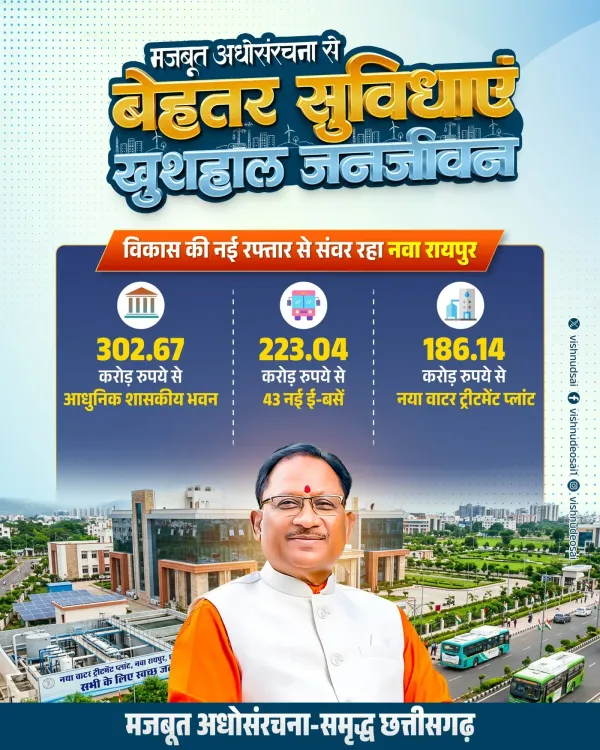
Three key projects cited: construction of government buildings , launch of modern electric buses , and establishment of an advanced water treatment plant .
Nava Raipur (Atal Nagar) is Chhattisgarh's planned new capital, developed since the state's formation in 2000 to decongest old Raipur .
The Naya Raipur Development Authority (NRDA) , set up in 2006 , is the nodal agency overseeing the township's development.
CM Sai framed the push under the 'Sushasan' (good governance) banner, promising better facilities, transport, and clean drinking water for every citizen.
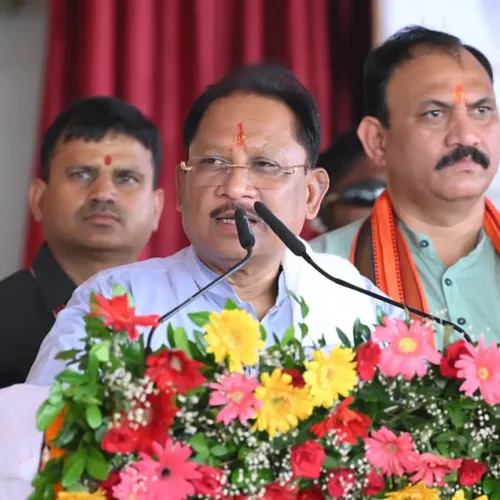
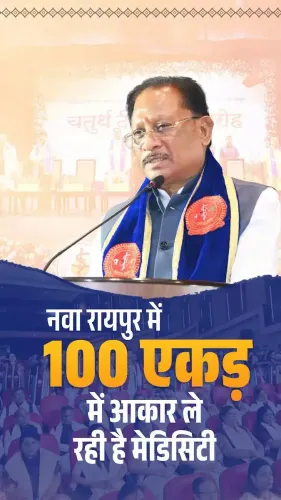
Chhattisgarh Chief Minister Vishnu Deo Sai on Friday, 29 May 2026, announced that rapid work is under way in Nava Raipur to expand modern infrastructure and civic amenities, citing the construction of government buildings, the launch of modern electric buses, and the establishment of an advanced water treatment plant as key deliverables for residents.
Context
Posting in Hindi on X, CM Sai wrote: 'नवा रायपुर में आधुनिक अधोसंरचना और नागरिक सुविधाओं के विस्तार की दिशा में तेजी से कार्य किए जा रहे हैं' ('Work is being carried out rapidly in Nava Raipur in the direction of expanding modern infrastructure and civic amenities'). He added that the construction of government buildings, operation of modern e-buses, and the setting up of a state-of-the-art water treatment plant would directly benefit what he called 'देवतुल्य जनता' — the 'godlike public' — a phrase common in Chhattisgarhi political address.
The Chief Minister framed these initiatives under the banner of 'Sushasan' (good governance), stating that the government's goal is to ensure every citizen has access to better facilities, convenient transport, and clean drinking water.
Policy Backdrop
Nava Raipur, also known as Atal Nagar, is the planned new capital city of Chhattisgarh, conceived after the state's formation in 2000 to decongest the older city of Raipur and create a purpose-built administrative and civic hub. The Naya Raipur Development Authority (NRDA) was constituted in 2006 to oversee master planning and infrastructure rollout for the township.
The three pillars highlighted by CM Sai — government building construction, electric bus services, and water treatment — align with national urban missions that promote sustainable transport and reliable water supply in emerging cities. BJP-led state governments have increasingly emphasised integrated civic infrastructure as a governance metric, and Chhattisgarh's push in Nava Raipur fits that broader pattern.
Stakeholders and Impact
Residents of Nava Raipur and the wider Raipur metropolitan area stand to benefit most directly. Modern e-buses would reduce dependence on private vehicles and cut emissions, while a functional water treatment plant would address long-standing concerns about safe drinking water access in the rapidly growing township.
Government employees and institutions relocating to Nava Raipur would also benefit from the completion of official buildings, which form the administrative backbone of the new capital. Urban planners and civic bodies operating under the NRDA are the primary implementation agencies for these projects.
What's Next
Completion timelines and specific budget allocations for the e-bus fleet and the water treatment plant are expected to become clearer in forthcoming state budget sessions or assembly announcements. The Chhattisgarh government's ability to deliver on these commitments will be closely watched as a test of its 'Sushasan' governance pitch ahead of future electoral cycles.
With Nava Raipur still maturing as an urban centre, sustained infrastructure investment will be critical to attracting residents, institutions, and businesses away from the congested older city — a challenge that has faced every Indian planned capital project since independence.
Point of View
Positioning the BJP-led Chhattisgarh government as an active deliverer of urban infrastructure rather than a mere policy announcer. By spotlighting e-buses, water treatment, and government buildings together, the administration is building a composite 'Sushasan' narrative ahead of future electoral scrutiny. The choice of Nava Raipur as the showcase is strategic: a planned capital that has long underperformed its promise now becomes a visible proof point for the state's development ambitions. This mirrors a wider pattern among BJP-governed states of using smart-city and clean-mobility investments as both governance tools and political messaging.
NationPress
13 Oct 2026
Frequently Asked Questions
What infrastructure projects are being developed in Nava Raipur?
According to CM Vishnu Deo Sai, Nava Raipur is seeing construction of government buildings, launch of modern electric buses, and establishment of an advanced water treatment plant to improve civic amenities for residents.
What is Nava Raipur and why is it significant?
Nava Raipur, also called Atal Nagar, is the planned new capital city of Chhattisgarh, developed since 2000 to decongest old Raipur and serve as a modern administrative and civic hub for the state.
Who is overseeing the development of Nava Raipur?
The Naya Raipur Development Authority (NRDA), constituted in 2006, is the state agency responsible for master planning and infrastructure execution in Nava Raipur.
What does 'Sushasan' mean in the context of Chhattisgarh politics?
'Sushasan' means 'good governance' in Hindi and is a key political slogan used by CM Vishnu Deo Sai's BJP government in Chhattisgarh to describe its focus on delivering tangible civic benefits to citizens.
Will Nava Raipur get electric buses?
CM Sai's post on 29 May 2026 confirmed that modern e-buses are being operationalised in Nava Raipur as part of the government's urban infrastructure expansion drive, though specific fleet size and timelines were not detailed in the post.