CM Saini greets states on formation day, invokes Viksit Bharat
Synopsis
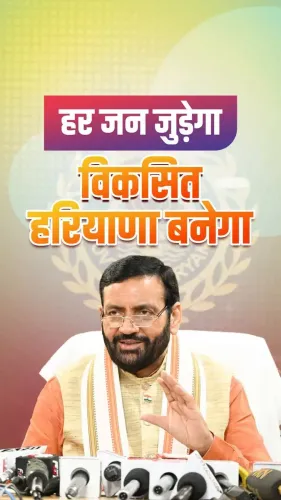
Haryana CM Nayab Singh Saini on 1 November 2026 greeted Punjab, Madhya Pradesh, Andhra Pradesh, Chhattisgarh, Karnataka, Kerala, Tamil Nadu, Lakshadweep, Andaman and Nicobar Islands, and Puducherry on their formation anniversaries, calling India's cultural diversity its greatest strength and urging citizens to advance PM Modi's Viksit Bharat vision.
Key Takeaways
Haryana CM Nayab Singh Saini posted formation-day greetings on 1 November 2026 covering ten states and union territories .
The States Reorganisation Act of 1956 created several of the celebrated states — Andhra Pradesh, Karnataka, Kerala and Madhya Pradesh — on this date.
Punjab was reorganised in 1966 ; Chhattisgarh became a state on 1 November 2000 .
Saini described India's diverse languages and cultural heritage as the country's 'greatest strength.' The message explicitly linked regional celebrations to PM Narendra Modi's Viksit Bharat initiative targeting a developed India by 2047 .
The framing follows a consistent BJP pattern of anchoring state-level milestones to the central government's development agenda.
On Sunday, 1 November 2026, a date when a sweep of Indian states and union territories mark their formation anniversaries, Haryana Chief Minister Nayab Singh Saini extended greetings to the people of Punjab, Madhya Pradesh, Andhra Pradesh, Chhattisgarh, Karnataka, Kerala, Tamil Nadu, Lakshadweep, Andaman and Nicobar Islands, and Puducherry — and used the moment to tie regional pride to the national vision of a developed India.
A single date, ten regions, one message
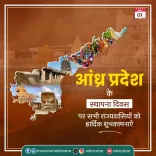
Posting in Hindi on 1 November, CM Saini wrote: 'Aaj sthapna diwas mana rahe Punjab, Madhya Pradesh...' — 'Heartfelt congratulations and best wishes to all the families of [these states and union territories] celebrating their foundation day today.' The geographic breadth of the message is no accident: 1 November is one of the most significant dates on India's federal calendar, carrying the weight of the States Reorganisation Act of 1956, which carved out several linguistic states including Andhra Pradesh, Karnataka, Kerala, and Madhya Pradesh on a single day. Punjab followed through the Punjab Reorganisation Act of 1966, while Chhattisgarh was born as a new state on 1 November 2000.
The coincidence of so many foundation anniversaries on one date is a direct legacy of the linguistic reorganisation movement — a defining chapter in how independent India chose to govern its diversity. Every 1 November, the map lights up with celebrations from the Deccan coast to the Malabar shore to the heartland plains.
Diversity as strength, development as destination
Saini's message moved quickly from celebration to conviction. 'Our country's diverse languages, rich traditions and glorious cultural heritage are India's greatest strength,' he wrote. The framing is deliberate and politically familiar: BJP chief ministers have consistently used state formation days to argue that India's linguistic and cultural plurality is a source of unity, not fragmentation — a counter-narrative to any suggestion that the federal compact is under strain.
The closing line carried the sharpest ideological weight. Saini called on citizens to 'strengthen this spirit of unity and development' and contribute to Prime Minister Narendra Modi's 'Viksit Bharat' resolve. The Viksit Bharat initiative — the central government's flagship framework to transform India into a fully developed nation by 2047, the centenary of independence — has become the standard rhetorical anchor for BJP leaders linking local milestones to a national arc.
BJP's formation-day playbook and what it signals
Indian political leaders across parties issue formation-day messages as a matter of routine. What makes BJP messaging distinctive is the consistent pivot: regional identity is acknowledged and honoured, then immediately channelled into the central government's development agenda. For Saini, a chief minister navigating a large, border state in a politically competitive north India, projecting alignment with Modi's vision on a high-visibility symbolic date serves an internal party signal as much as a public one.
With Viksit Bharat programmes rolling out across infrastructure, skilling, and digital public goods, the next question is whether the states celebrated today — several of which are governed by opposition parties — will find common ground with the centre's framework on the ground, beyond the goodwill of a single November morning.
Point of View
Saini performs inclusive nationalism while the closing Viksit Bharat pivot converts that goodwill into ideological alignment with the centre. The pattern matters because several of the states greeted are governed by opposition parties, making the message as much an outreach to those electorates as a routine courtesy. Whether citizens in those states read the Viksit Bharat call as aspiration or appropriation will shape how the BJP's federal messaging lands ahead of future electoral cycles.
NationPress
1 Nov 2026
Frequently Asked Questions
Why do so many Indian states celebrate formation day on 1 November?
The States Reorganisation Act of 1956 came into effect on 1 November 1956 , redrawing state boundaries largely on linguistic lines and creating Andhra Pradesh, Karnataka, Kerala and Madhya Pradesh on that single date, making 1 November a shared foundation day for multiple states.
When was Chhattisgarh formed?
Chhattisgarh was carved out of Madhya Pradesh and established as a separate state on 1 November 2000 , which is why it also observes its formation day on this date.
What is the Viksit Bharat initiative mentioned by CM Saini?
Viksit Bharat ('Developed India') is a central government vision championed by Prime Minister Narendra Modi to transform India into a fully developed nation by 2047 , the centenary of independence, spanning infrastructure, digital public services, skilling and economic growth.
Which states and union territories did CM Nayab Saini greet on formation day?
CM Saini greeted the people of Punjab, Madhya Pradesh, Andhra Pradesh, Chhattisgarh, Karnataka, Kerala, Tamil Nadu, Lakshadweep, Andaman and Nicobar Islands, and Puducherry in his 1 November 2026 message.
When was Punjab reorganised as a state?
Punjab was reorganised under the Punjab Reorganisation Act of 1966 , which separated it from what is now Haryana, with the new Punjab state observing its foundation day on 1 November .