CM Saini Hails Modi's Push to Showcase Sikh Heritage Globally
Synopsis
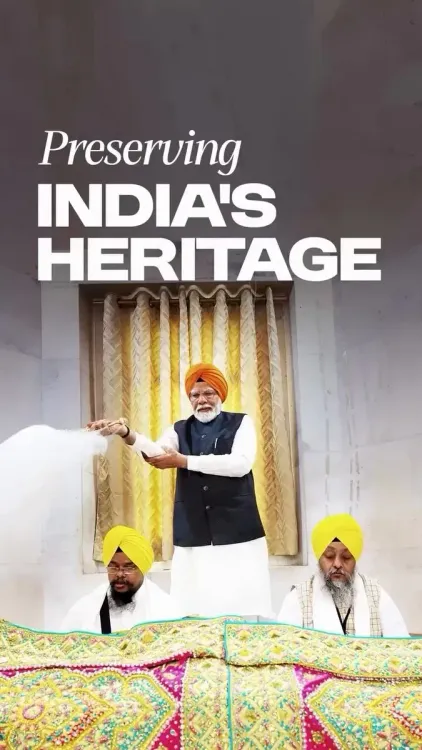
Haryana Chief Minister Nayab Singh Saini on 13 July 2026 credited PM Narendra Modi with raising India's civilisational and Sikh spiritual heritage to new global heights, citing decisions on Sikh Gurus' teachings, the Sahibzadas' martyrdom, and sacred site preservation as proof of the government's cultural commitment.
Key Takeaways
CM Nayab Singh Saini posted on 13 July 2026 praising PM Modi's efforts to promote India's cultural and spiritual heritage globally.
The post specifically highlighted respect for Sikh Gurus' teachings and the sacrifice of the Sahibzadas as central to the government's cultural agenda.
The Kartarpur Sahib Corridor , operationalised in 2019 , remains a landmark policy gesture toward Sikh heritage access.
The Swadesh Darshan scheme (2014-15) included dedicated circuits for Sikh religious heritage site development.
Saini framed cultural preservation as a defining feature of a 'developed and culturally empowered India' — echoing the Viksit Bharat narrative.
Haryana 's state government signalled full alignment with the central government's cultural diplomacy priorities.
Haryana Chief Minister Nayab Singh Saini on Monday, 13 July 2026, praised Prime Minister Narendra Modi for elevating India's civilisational, cultural and spiritual heritage on the world stage, with specific reference to the teachings of Sikh Gurus, the martyrdom of the Sahibzadas, and the preservation of sacred heritage sites.
Context
Posting in Hindi on X, CM Saini wrote that under PM Modi's leadership, India is carrying its rich civilisation and spiritual legacy to new heights on the global platform — 'भारत अपनी समृद्ध सभ्यता, संस्कृति और आध्यात्मिक विरासत का गौरव विश्व पटल पर नई ऊंचाइयों तक पहुँचा रहा है' ('India is taking the pride of its rich civilisation, culture and spiritual heritage to new heights on the world stage'). He specifically cited decisions taken by the Prime Minister regarding the teachings of Sikh Gurus, the sacrifice of the Sahibzadas, and the protection of sacred heritage as evidence of a deep commitment to faith and legacy.
The post concluded with the assertion that India is not merely preserving its cultural identity but presenting it with pride before the entire world — framing this as the hallmark of a 'developed and culturally empowered India.'
Policy Backdrop
The Swadesh Darshan scheme, launched in 2014-15, included dedicated circuits for the development of Sikh religious heritage sites, signalling early intent to integrate religious tourism with cultural diplomacy. A landmark moment came in 2019 when the central government operationalised the Kartarpur Sahib Corridor, enabling Indian pilgrims to visit Guru Nanak Dev Ji's shrine in Pakistan without a visa — widely regarded as a significant gesture toward the Sikh community and cross-border heritage access.
These initiatives sit within a broader pattern in which successive central governments have woven cultural diplomacy into foreign policy, using India's religious and civilisational legacies — spanning Sikhism, yoga, Buddhism and ancient archaeological sites — as instruments of soft power at multilateral forums.
Stakeholders and Impact
The Sikh community, both within India and in the global diaspora, is the primary stakeholder in policies that centre on Sikh Gurus' teachings and the memory of the Sahibzadas — the four sons of Guru Gobind Singh Ji whose martyrdom holds deep significance in Sikh historical consciousness. Heritage tourism operators and pilgrimage site administrators also stand to benefit from continued state investment in sacred site preservation.
Haryana, home to a substantial Sikh population and several historically significant Gurdwaras, has a direct stake in how the central government's cultural agenda is articulated and implemented at the state level. CM Saini's public endorsement reinforces alignment between the state government and the BJP-led central government on cultural policy priorities.
What's Next
Observers will watch for further central or state announcements on Sikh heritage memorials, new pilgrimage infrastructure, or India's participation in upcoming international cultural summits where spiritual traditions are foregrounded. The framing of cultural preservation as integral to Viksit Bharat — a 'developed India' — suggests that heritage diplomacy will remain a recurring theme in BJP political communication ahead of future electoral cycles. How the government translates this rhetoric into specific policy action on Sikh sites will be the measure that matters most to communities on the ground.
Point of View
With Sikh heritage as a politically resonant pillar. The explicit invocation of the Sahibzadas' martyrdom and Sikh Gurus' teachings signals continued outreach to a community that has had a complex relationship with the party. Framing cultural preservation within the 'Viksit Bharat' rubric is a deliberate rhetorical move that ties heritage policy to the ruling party's broader development branding. The statement carries added weight coming from Haryana's Chief Minister, a state where Sikh identity and agrarian politics intersect in electorally significant ways.
NationPress
14 Jul 2026
Frequently Asked Questions
What did Haryana CM Nayab Singh Saini say about PM Modi and Sikh heritage?
CM Saini praised PM Modi for elevating India's Sikh and civilisational heritage on the global stage, citing the government's decisions on Sikh Gurus' teachings, the Sahibzadas' martyrdom, and preservation of sacred sites as evidence of deep commitment to cultural legacy.
What is the Kartarpur Sahib Corridor?
The Kartarpur Sahib Corridor, operationalised in 2019, allows Indian Sikh pilgrims to visit the shrine of Guru Nanak Dev Ji in Pakistan without a visa, and is widely considered a landmark heritage initiative by the Modi government.
Who are the Sahibzadas referenced in CM Saini's post?
The Sahibzadas are the four sons of Guru Gobind Singh Ji whose martyrdom is a central event in Sikh historical memory and a touchstone for discussions of Sikh heritage preservation in India.
What is the Swadesh Darshan scheme and its link to Sikh heritage?
Swadesh Darshan, launched in 2014-15, is a central government scheme for developing religious and heritage tourism circuits; it included a dedicated circuit for Sikh religious sites across India.
Why is Haryana's CM commenting on Sikh heritage policy?
Haryana has a significant Sikh population and several historically important Gurdwaras, making Sikh heritage a politically and culturally relevant issue for the state's Chief Minister to address publicly.