CM Nayab Saini Marks Children's Day with Child Safety Pledge
Synopsis
Haryana Chief Minister Nayab Singh Saini marked International Children's Day on June 1, 2026, calling for a collective pledge to give every child a safe, educated, and fear-free environment — framing child welfare as the strongest foundation of a developed India.
Key Takeaways
Haryana CM Nayab Singh Saini posted a Children's Day message on June 1, 2026 , calling for a society-wide pledge on child safety and empowerment.
He described a 'safe, educated, values-driven and empowered future for children' as the strongest foundation of a developed nation.
International Children's Day is observed globally on June 1 ; India ratified the UN Convention on the Rights of the Child in 1992 .
The POCSO Act, 2012 and the Beti Bachao Beti Padhao scheme (launched 2015 ) form the core of India's child protection and girl-child welfare framework.
Haryana was among the original focus states for the Beti Bachao Beti Padhao scheme due to historically skewed child sex ratios.
Policy observers will watch for Haryana state budget allocations toward child protection committees and school safety programmes.
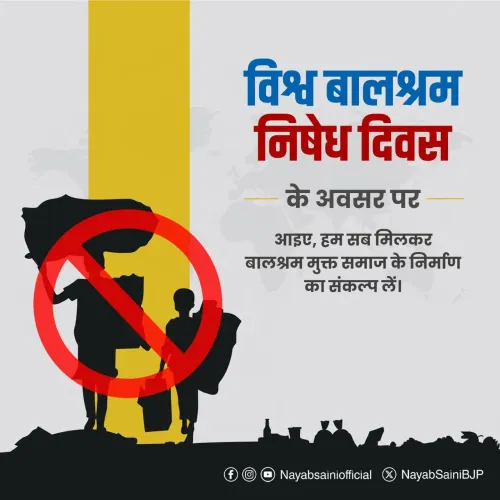
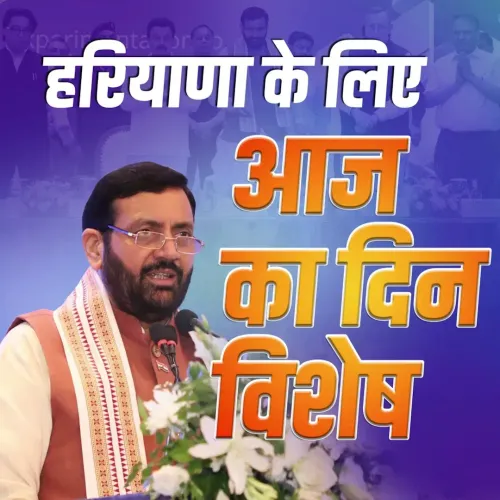
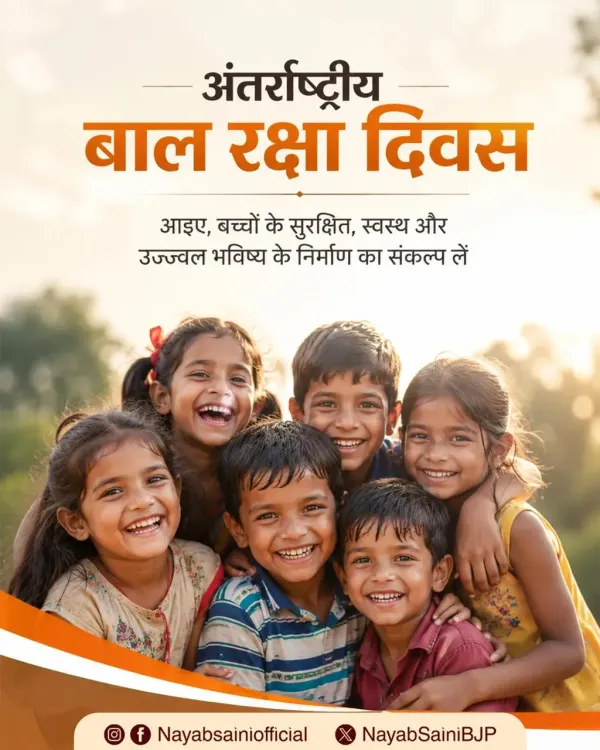
Haryana Chief Minister Nayab Singh Saini on Monday, June 1, 2026, marked International Children's Day by calling on all citizens to pledge that every child receives a safe, dignified, and fear-free environment in which to realise their full potential.
Posting in Hindi on the occasion, CM Saini wrote: 'बच्चों का सुरक्षित, शिक्षित, संस्कारित और सशक्त भविष्य ही एक विकसित राष्ट्र की सबसे मजबूत नींव है' — 'A safe, educated, values-driven and empowered future for children is the strongest foundation of a developed nation.' He urged society to collectively ensure that each child can 'give wings to their dreams, hone their talent, and realise their limitless possibilities.'
Context
International Children's Day, observed on June 1 each year, is a global occasion to affirm the rights and welfare of children. In India, the day draws attention to ongoing commitments under the UN Convention on the Rights of the Child, which India ratified in 1992. The convention obligates signatory states to guarantee children's rights to safety, education, and freedom from exploitation.
CM Saini, who assumed office in March 2024, leads a state where education and social welfare have been prominent policy priorities alongside Haryana's agricultural economy. His message on this occasion reinforces the state government's stated commitment to child-centric governance.
Policy Backdrop
India's child protection architecture rests on several legislative and programmatic pillars. The Protection of Children from Sexual Offences (POCSO) Act, 2012, remains the primary statute safeguarding children from abuse, providing fast-track courts and stringent penalties. At the grassroots level, Child Protection Committees function at district and block levels across states including Haryana.
On the education and gender front, the centrally-sponsored Beti Bachao Beti Padhao scheme, launched in 2015, specifically targeted Haryana as one of its original focus districts given historically skewed child sex ratios. The scheme has since expanded nationally, aiming to improve girl-child enrolment and retention in schools. Haryana's performance under these programmes has been a benchmark for evaluating state-level child welfare outcomes.
India's Sustainable Development Goals commitments — particularly SDG 4 (quality education) and SDG 10 (reduced inequalities) — also frame the broader policy environment in which such pledges are made.
Stakeholders and Impact
The primary stakeholders are the children and families of Haryana, numbering in the millions across rural and urban districts. For families in economically vulnerable pockets of the state, government-backed child protection and education schemes represent a critical safety net. Civil society organisations working on child rights in Haryana have consistently called for stronger implementation of existing laws rather than new legislative measures.
The message also signals to school administrators, local governance bodies, and district child protection units that child safety remains a stated priority for the state's political leadership. Observers note that such public affirmations carry weight in directing administrative attention and budget conversations at the state level.
What's Next
The immediate focus will be on whether CM Saini's public pledge translates into concrete administrative action — particularly in the form of Haryana's state budget allocations for child protection committees, school safety programmes, and girl-child welfare schemes. Policy watchers will look for new guidelines or enhanced funding for district-level child welfare infrastructure in the months ahead. A developed India, as CM Saini framed it, will ultimately be measured by how consistently the state turns such pledges into protected childhoods.
Point of View
But its framing — linking child welfare directly to the vision of a 'developed nation' — echoes the BJP's broader 'Viksit Bharat' narrative ahead of state governance milestones. For Haryana, a state with a historically uneven child sex ratio, such public affirmations carry symbolic weight in signalling political intent. The real test will be whether this translates into measurable budget commitments for child protection infrastructure at the district level. Analysts will track whether the pledge is followed by policy action or remains a seasonal statement of intent.
NationPress
17 Oct 2026
Frequently Asked Questions
Why is International Children's Day celebrated on June 1?
International Children's Day is observed on June 1 each year, originating from a 1925 World Conference on Child Welfare in Geneva. It is distinct from India's Children's Day, which falls on November 14 . The day is used globally to reaffirm commitments to child rights and welfare.
What did Haryana CM Nayab Singh Saini say on Children's Day 2026?
CM Nayab Singh Saini called for a collective pledge to ensure every child receives a safe, dignified, and fear-free environment to realise their dreams. He stated that a 'safe, educated, values-driven and empowered future for children is the strongest foundation of a developed nation.'
What is the POCSO Act and how does it protect children in India?
The Protection of Children from Sexual Offences (POCSO) Act, 2012 is India's primary law against child sexual abuse. It mandates fast-track courts, child-friendly procedures, and stringent penalties for offenders, and applies across all states including Haryana .
What is the Beti Bachao Beti Padhao scheme and does it cover Haryana?
Beti Bachao Beti Padhao was launched in 2015 to address declining child sex ratios and promote girl-child education. Haryana was among its original focus states due to historically low sex ratios, and the scheme has since expanded nationally.
When did Nayab Singh Saini become Chief Minister of Haryana?
Nayab Singh Saini assumed office as Chief Minister of Haryana in March 2024 . He is a leader of the Bharatiya Janata Party (BJP) .