CM Saini Shares Poetic Tribute to Women's Strength
Synopsis
Haryana Chief Minister Nayab Singh Saini posted a Hindi poem on June 14, 2026, honouring women as gentle yet unconquerable — a force to whom even death concedes. The verse aligns with the BJP's sustained Nari Shakti messaging in a state long scrutinised for its gender indicators.
Key Takeaways
Haryana Chief Minister Nayab Singh Saini posted a four-line Hindi poem on X on June 14, 2026 , celebrating women's strength.
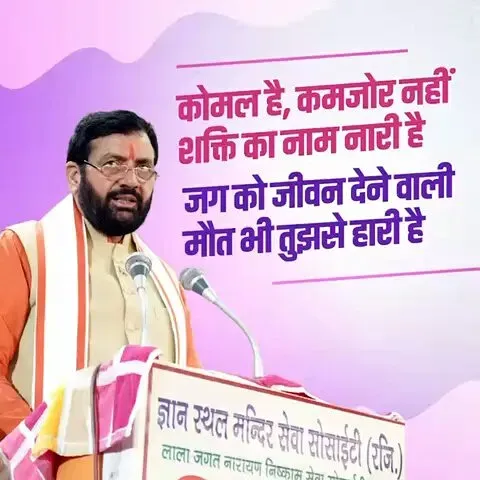
The verse declares: 'She is gentle, not weak / Woman is the name of strength / Even death has lost to you.' The post was accompanied by a video and carries no explicit occasion or scheme reference.
Haryana was one of the original focus states of the Beti Bachao Beti Padhao scheme launched in 2015 due to its low child sex ratio.
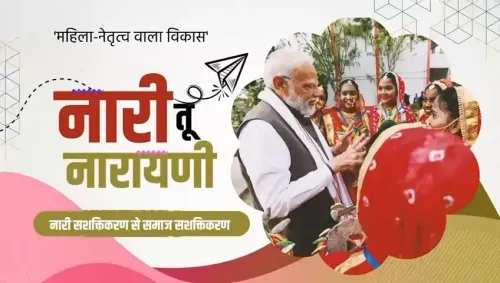
BJP -led state governments have consistently used Nari Shakti messaging as part of gender-focused political outreach.
Any follow-up policy announcement linked to women's welfare in Haryana will be closely watched.
Haryana Chief Minister Nayab Singh Saini on Sunday, June 14, 2026, shared a Hindi poem on X celebrating the strength and resilience of women, describing womanhood as a force that conquers even death.
The four-line verse posted by Saini reads: 'Komal hai, kamzor nahin / Shakti ka naam Naari hai / Jag ko jeevan dene waali / Maut bhi tujhse haari hai' — translated as: 'She is gentle, not weak / Woman is the name of strength / She who gives life to the world / Even death has lost to you.'
Context
The poem is a brief but pointed affirmation of Nari Shakti — a phrase widely used in Indian political discourse to denote women's empowerment. Saini did not attach a specific occasion or scheme to the post, though it was accompanied by a video. The verse frames femininity not as fragility but as an elemental force, invoking the imagery of a life-giver who transcends mortality.
Haryana has historically been at the centre of national conversations around gender, particularly concerning skewed child sex ratios and female foeticide. Such social-media messaging from the state's top executive carries contextual weight beyond ceremonial expression.
Policy Backdrop
The Beti Bachao Beti Padhao scheme, launched nationally in 2015, was piloted with Haryana as one of its primary focus states, given the state's historically low sex ratio at birth. The programme sought to arrest sex-selective practices and improve educational outcomes for girls.
BJP-led state governments have consistently used social-media platforms to amplify messages around Nari Shakti, positioning women's dignity and strength as a core political value. Saini's post fits within this established pattern of gender-focused outreach from the party's state leadership.
Stakeholders and Impact
The primary audience for such messaging is Haryana's women — a demographic that state and central governments have prioritised through welfare schemes, safety legislation, and economic inclusion programmes over the past decade. Symbolic affirmations from a sitting Chief Minister carry both political and social signalling value.
Civil society groups working on gender equity in Haryana have long argued that rhetorical celebrations of womanhood must be matched by measurable improvements in safety, employment, and health outcomes for women in the state.
What's Next
Observers will watch whether this post precedes or accompanies any concrete policy announcement — such as an expansion of women's welfare schemes during an upcoming Haryana assembly session or alignment with a central government gender programme. The BJP's broader Nari Shakti messaging has, in the past, served as a prelude to scheme launches or budgetary allocations targeting women's welfare. Any follow-up action will determine whether this tribute translates into policy momentum.
Point of View
The post shifts the rhetorical register from protection to empowerment — a subtle but meaningful distinction in BJP's evolving Nari Shakti narrative. The absence of a specific occasion suggests this is proactive brand-building rather than reactive communication. Whether it signals an imminent policy move or remains symbolic will define its lasting resonance.
NationPress
13 Sept 2026
Frequently Asked Questions
What did Haryana CM Nayab Singh Saini post on June 14 2026?
He posted a four-line Hindi poem on X celebrating women as the embodiment of strength, stating that even death concedes to a woman's power.
What does the Hindi poem posted by Nayab Saini mean in English?
The poem translates as: 'She is gentle, not weak / Woman is the name of strength / She who gives life to the world / Even death has lost to you.'
What is Nari Shakti and why does BJP use the term?
Nari Shakti literally means 'women's power' and has become a central phrase in BJP's political vocabulary to signal commitment to women's dignity, safety, and economic inclusion.
What is the Beti Bachao Beti Padhao scheme and how does it relate to Haryana?
Beti Bachao Beti Padhao is a national scheme launched in 2015 to address declining child sex ratios; Haryana was one of its first focus states because of its historically low sex ratio at birth.
Is there a specific event linked to Nayab Saini's women's tribute post?
No specific occasion or event was mentioned in the post; the precise trigger for the June 14 2026 tribute has not been officially stated.