CM Saini Slams Congress Over Anti-Cheating Law Debate
Synopsis
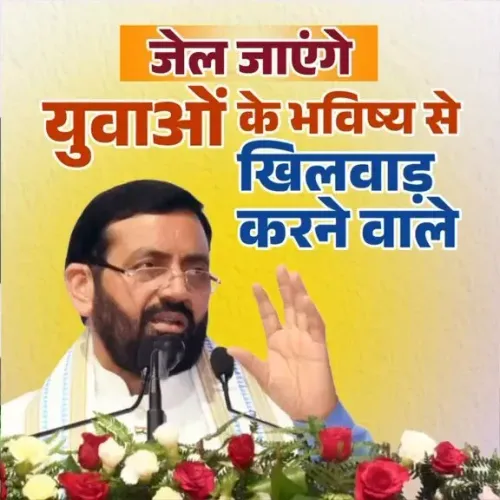
Haryana CM Nayab Singh Saini accused Congress and Rahul Gandhi of letting electoral frustration since 2014 drive unparliamentary conduct in Parliament, diverting attention from the Public Examinations (Prevention of Unfair Means) Act, 2024 — a law he says is vital to GenZ's future.
Key Takeaways
Haryana CM Nayab Singh Saini posted on July 29, 2026 accusing Rahul Gandhi and Congress of unparliamentary conduct and indecent language in Parliament.
Saini linked the behaviour to 'continuous defeats since 2014 ', framing it as electoral frustration rather than principled opposition.
The specific flashpoint is the Public Examinations (Prevention of Unfair Means) Act, 2024 , a central law targeting paper leaks and exam malpractice.
The law was passed in response to multiple high-profile paper leak incidents that disrupted recruitment for lakhs of young aspirants across India.
Saini positioned Congress's alleged disruption as an attack on GenZ 's future, sharpening the BJP's pro-youth messaging.
Parliamentary disruption over legislative priorities has been a recurring pattern since 2014, with anti-cheating legislation now the latest flashpoint.
A decade of electoral defeats, Haryana Chief Minister Nayab Singh Saini argued on Wednesday, July 29, 2026, has pushed Rahul Gandhi and the broader Congress ecosystem to the edge of unparliamentary conduct — using the floor of the House to derail debate on a law that directly shapes the futures of millions of young Indians.
Posting in Hindi, Saini wrote that the 'frustration of continuous defeats since 2014' — 2014 se lagatar haar ki hatasha — has brought Congress to a threshold of 'unparliamentary behaviour and indecent language' in Parliament. His sharpest charge: that instead of seriously engaging with the anti-cheating law, a subject he framed as critical to #GenZ's future, the opposition was engineering a distraction.
What the anti-cheating law actually does
The legislation at the centre of Saini's post is the Public Examinations (Prevention of Unfair Means) Act, 2024 — a central law Parliament passed to impose stiff penalties on paper leaks, cheating networks, and other malpractices in competitive and public examinations. The law came in direct response to a string of high-profile paper leak scandals that had derailed the recruitment dreams of lakhs of aspirants across the country. For India's vast pool of job-seeking youth, its passage was a concrete promise: that the system would no longer be rigged against honest candidates.
The 2014 shadow and the pattern of disruption
Saini's framing is deliberate and well-worn in BJP political communication. Since 2014, the ruling coalition has repeatedly accused the Indian National Congress of choosing protest and walkout over substantive legislative engagement — a charge Congress contests by pointing to what it calls the government's own failures on youth unemployment and exam integrity. The anti-cheating bill, however, gives the BJP a particularly sharp edge: it is difficult to oppose a law designed to protect students, and difficult to defend disrupting debate on it.
The broader parliamentary pattern is consistent: opposition protests, procedural disruptions, and rhetorical escalations have punctuated nearly every major session since 2014. What changes each cycle is the specific legislation that becomes the flashpoint. This time, it is a law that sits squarely in the anxieties of young India.
Whether Parliament moves to tighten rules on conduct — or whether states accelerate implementation of the anti-cheating provisions — the political cost of being seen as obstructing protections for students is one no party wants to carry into the next election cycle.
Point of View
Any perception that Congress is impeding the anti-cheating law carries real political cost. The post also signals that the BJP intends to make parliamentary conduct — not just policy outcomes — a campaign issue heading into future electoral cycles.
NationPress
29 Jul 2026
Frequently Asked Questions
What did Haryana CM Nayab Singh Saini say about Congress in Parliament?
Saini accused Congress and Rahul Gandhi of resorting to unparliamentary behaviour and indecent language in Parliament, arguing that the frustration of continuous electoral defeats since 2014 has driven the opposition to disrupt serious debate — specifically on the anti-cheating law meant to protect students.
What is the Public Examinations (Prevention of Unfair Means) Act, 2024?
It is a central law passed by Parliament in 2024 to crack down on paper leaks, cheating, and malpractices in public and competitive examinations, imposing strict penalties to protect the integrity of recruitment processes for millions of job aspirants.
Why is Saini linking Congress to GenZ's future?
Saini argues that the anti-cheating law directly affects the future of India's GenZ youth who depend on fair competitive exams for jobs, and that Congress disrupting debate on the law is therefore an attack on young people's opportunities.
Has Congress responded to Saini's accusations about parliamentary conduct?
No official response from Congress to this specific post has been verified. Congress has historically contested BJP's characterisation of its parliamentary conduct, arguing that disruptions are often a response to the government's own handling of legislative sessions.
What is the significance of the '2014 onwards' framing Saini uses?
Since 2014, the BJP has consistently used the narrative that Congress's opposition behaviour is driven by electoral frustration rather than genuine legislative concern. It is a recurring political frame intended to delegitimise Congress's parliamentary interventions.