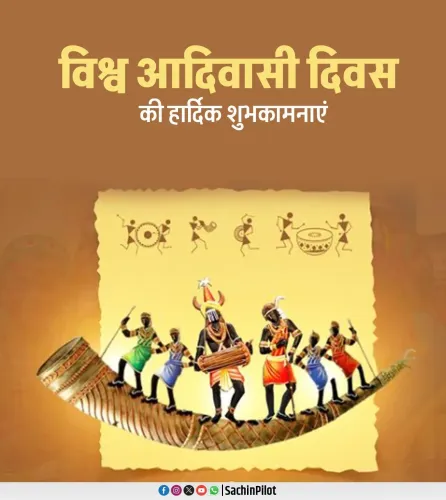
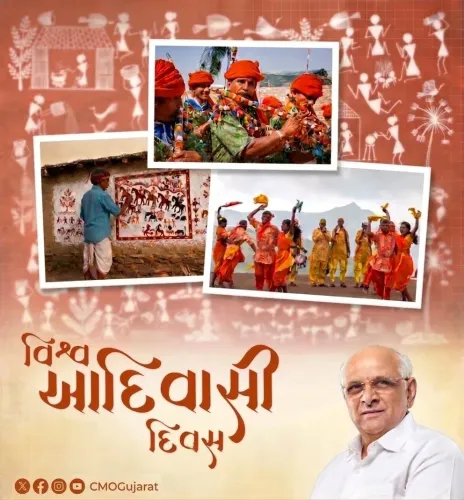
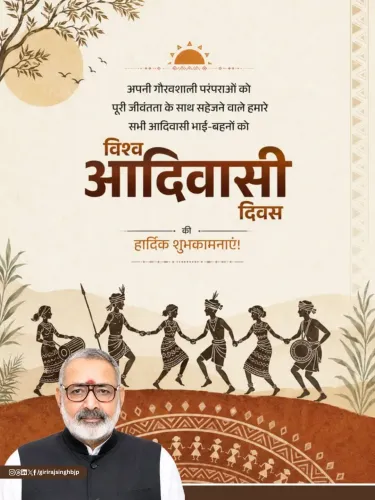
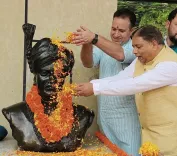
CM Samrat Choudhary greets tribal communities on World Tribal Day
Synopsis
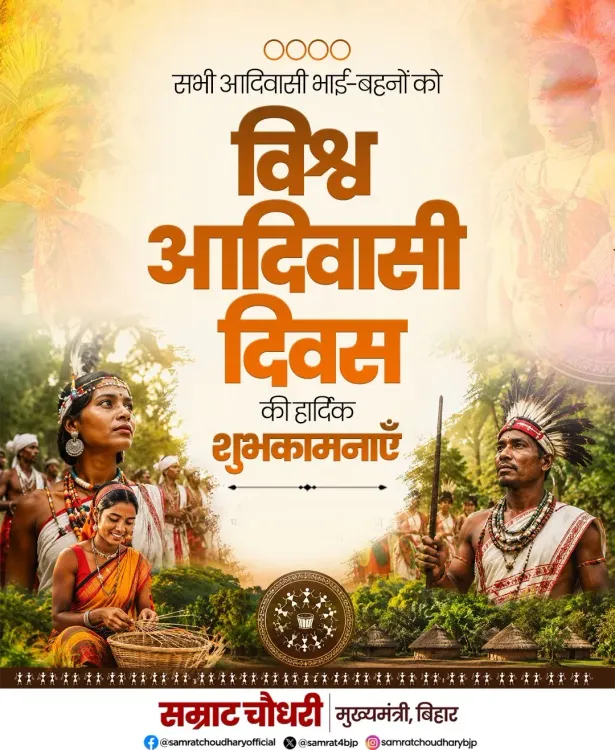
Bihar Chief Minister Samrat Choudhary marked International Day of the World's Indigenous Peoples on 9 August 2026, saluting Adivasi communities for protecting forests, water, and land while preserving their cultural heritage.
Key Takeaways
Bihar Chief Minister Samrat Choudhary posted greetings on 9 August 2026 for Vishwa Adivasi Diwas (World Tribal Day).
The message saluted tribal communities for safeguarding jal, jungle, zameen — water, forests, and land — alongside their cultural heritage.
The International Day of the World's Indigenous Peoples has been observed on 9 August every year since it was proclaimed by the UN General Assembly in 1994 .
The jal-jungle-zameen phrase echoes the Forest Rights Act, 2006 , which recognised Scheduled Tribes' rights over forest land and resources.
Bihar's tribal population, concentrated near the Jharkhand border, makes the message locally significant beyond ceremonial convention.
On a day the world pauses to honour its oldest living cultures, Bihar Chief Minister Samrat Choudhary extended heartfelt greetings to tribal communities across the country on International Day of the World's Indigenous Peoples, observed every year on 9 August.
Posting on X on Sunday, 9 August 2026, the Chief Minister wrote: 'जल, जंगल और जमीन की रक्षा के साथ अपनी समृद्ध संस्कृति, परंपरा और विरासत को संजोने वाले आदिवासी समाज के योगदान को सादर नमन' — a respectful salute to the Adivasi community for safeguarding water, forests, and land while preserving their rich culture, tradition, and heritage.
The phrase that carries decades of struggle
The invocation of jal, jungle, zameen — water, forest, land — is not rhetorical decoration. It is the foundational demand of tribal rights movements across India for generations, enshrined most concretely in the Scheduled Tribes and Other Traditional Forest Dwellers (Recognition of Forest Rights) Act, 2006. That law recognised the rights of Adivasi communities over forest land and resources they had stewarded for centuries before formal land records existed. When a sitting Chief Minister reaches for that phrase, he is consciously anchoring his message in that long arc of struggle and recognition.A UN observance, an Indian resonance
The United Nations General Assembly proclaimed 9 August as the International Day of the World's Indigenous Peoples in 1994, choosing the date to mark the first meeting of the UN Working Group on Indigenous Populations. In India, the day is observed as Vishwa Adivasi Diwas, with state governments, tribal welfare departments, and community organisations holding events that spotlight constitutional safeguards under the Fifth and Sixth Schedules and the broader question of Scheduled Tribe welfare. Bihar's Adivasi population, concentrated largely in the Santhal Pargana belt and districts bordering Jharkhand, has historically been central to debates over forest rights, displacement, and cultural preservation — making the Chief Minister's message locally resonant beyond its ceremonial register. Every 9 August is a reminder that indigenous rights are not a settled chapter. They are a living negotiation between communities, constitutions, and the land itself.Point of View
The message also reinforces Bihar's administrative identity as a state with a significant Adivasi constituency bordering Jharkhand, where tribal politics are especially competitive. The framing around cultural preservation rather than specific welfare schemes keeps the message broad and uncontroversial while still planting the BJP's flag on indigenous rights discourse. It is a textbook example of how incumbents use ceremonial occasions to speak to a community without making commitments that can be scrutinised.
NationPress
23 Sept 2026
Frequently Asked Questions
When is World Tribal Day or Vishwa Adivasi Diwas observed?
World Tribal Day , officially the International Day of the World's Indigenous Peoples, is observed every year on 9 August . The date was proclaimed by the UN General Assembly in 1994 to mark the first meeting of the UN Working Group on Indigenous Populations.
What does jal jungle zameen mean in the context of tribal rights?
Jal, jungle, zameen — water, forest, land — is the foundational demand of India's tribal rights movements, asserting Adivasi communities' rights to the natural resources they have traditionally depended on. It is also the spirit behind the Forest Rights Act, 2006 .
What did Bihar CM Samrat Choudhary say on World Tribal Day 2026?
Bihar Chief Minister Samrat Choudhary extended greetings to all tribal communities, saluting their contribution in protecting water, forests, and land while preserving their rich culture, tradition, and heritage.
What is the Forest Rights Act and how does it relate to tribal communities?
The Scheduled Tribes and Other Traditional Forest Dwellers (Recognition of Forest Rights) Act, 2006 legally recognises the rights of tribal communities over forest land and resources they have historically stewarded, reversing decades of exclusion from formal land records.
Why does Bihar's Chief Minister's message on tribal day matter?
Bihar has a significant Scheduled Tribe population, particularly in districts bordering Jharkhand. A sitting Chief Minister's message on Vishwa Adivasi Diwas signals political attention to this community and echoes constitutional commitments to tribal welfare and cultural preservation.