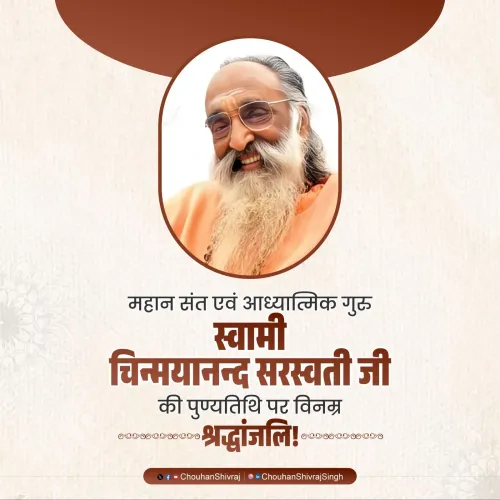
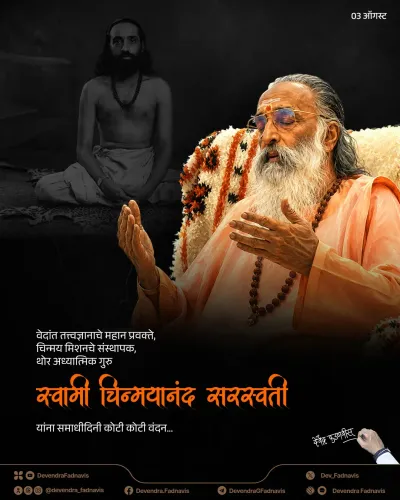
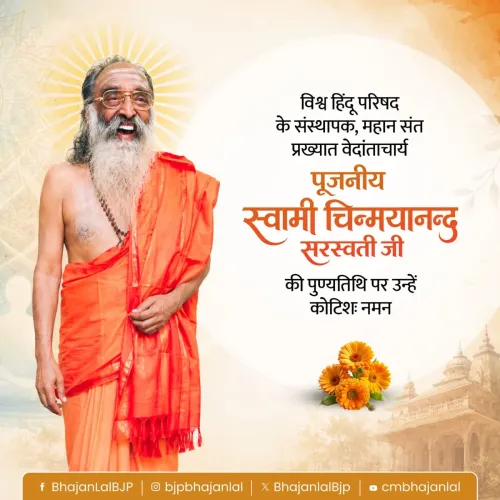
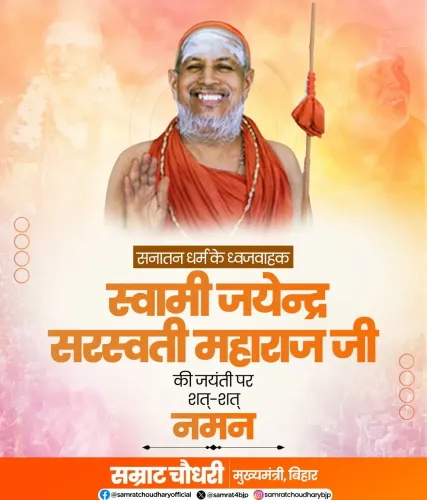
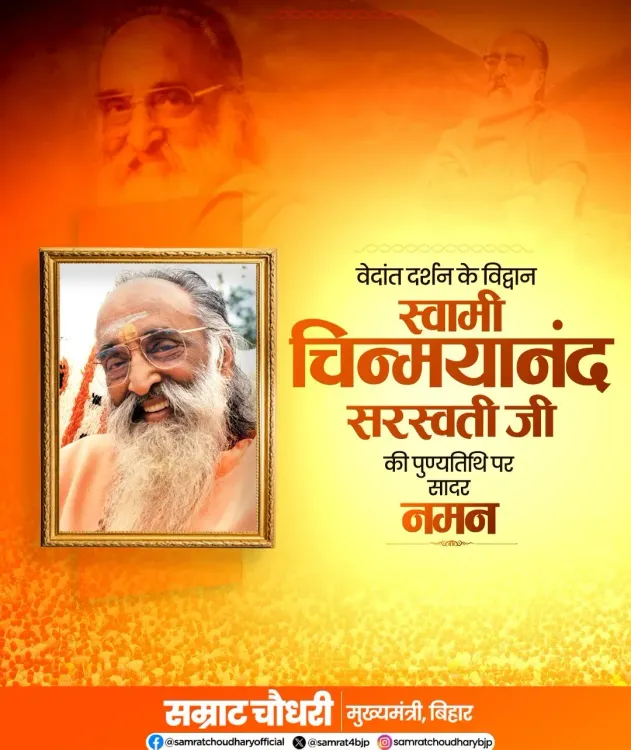
CM Samrat Choudhary pays tribute to Swami Chinmayananda
Synopsis
Bihar Chief Minister Samrat Choudhary marked the death anniversary of Swami Chinmayananda Saraswati on 3 August 2026, honouring the Vedanta scholar who founded Chinmaya Mission in 1953 and shaped India's spiritual and cultural landscape until his death in 1993.
Key Takeaways
Bihar Chief Minister Samrat Choudhary paid tribute to Swami Chinmayananda Saraswati on his death anniversary on 3 August 2026 .
He described the Swami as a 'towering scholar of Vedantic philosophy' and a 'pioneer of spiritual consciousness.' Swami Chinmayananda founded Chinmaya Mission in 1953 to propagate Advaita Vedanta through public discourses.
The Mission now operates globally, running schools, study groups, and cultural programmes in India and abroad.
The tribute reflects a consistent BJP practice of publicly acknowledging major Hindu spiritual figures on their death anniversaries.
On the death anniversary of one of modern India's most towering Vedanta scholars, Bihar Chief Minister Samrat Choudhary offered his homage to Swami Chinmayananda Saraswati on Monday, 3 August 2026, honouring a legacy that continues to shape spiritual and cultural life across the country.
Choudhary described Swami Chinmayananda as a 'वेदांत दर्शन के प्रकाण्ड विद्वान' — a towering scholar of Vedantic philosophy — and saluted him as a 'pioneer of spiritual consciousness and a great carrier of Indian culture.' He added that the Swami's 'knowledge, contemplation, and spiritual message will forever guide humanity.'
A life built on Vedanta and public discourse
Swami Chinmayananda Saraswati founded Chinmaya Mission in 1953 with a singular purpose: to bring the ancient teachings of Advaita Vedanta out of monasteries and into public life. Through decades of open discourses — jnana yajnas — he reached millions of ordinary Indians who had never engaged with classical philosophy. He continued this work until his death in 1993.
Chinmaya Mission today operates as a global organisation running schools, study groups, and cultural programmes across India and in several countries. The anniversary typically sees its centres organise study camps and commemorative events honouring his teachings.
BJP's consistent acknowledgement of Hindu spiritual figures
Choudhary's tribute fits a well-established pattern: senior BJP leaders regularly mark the death anniversaries of major Hindu spiritual figures with public statements, treating such acknowledgements as part of cultural continuity rather than electoral signalling. The gesture carries no direct policy dimension — it is an act of institutional memory, a reminder that Vedantic thought remains a living current in Indian public life.
The Swami's insistence that philosophy must be lived, not merely studied, gave Chinmaya Mission its enduring character — and gives tributes like this one a resonance beyond the ritual.
Point of View
Lending the tribute a broad respectability. In Bihar, where Choudhary governs a diverse electorate, invoking a universally respected spiritual figure is low-risk and high-signal. The gesture costs nothing politically and banks cultural capital with a significant segment of the electorate.
NationPress
17 Sept 2026
Frequently Asked Questions
Who was Swami Chinmayananda Saraswati?
Swami Chinmayananda Saraswati was a Hindu spiritual leader and Vedanta scholar who founded Chinmaya Mission in 1953 to spread Advaita philosophy through public discourses. He passed away in 1993.
What is Chinmaya Mission?
Chinmaya Mission is a global spiritual and educational organisation founded in 1953 by Swami Chinmayananda. It runs schools, study camps, and cultural programmes across India and internationally.
Why did Bihar CM Samrat Choudhary post about Swami Chinmayananda?
Bihar Chief Minister Samrat Choudhary posted a tribute on the death anniversary of Swami Chinmayananda Saraswati, honouring the Vedanta scholar's contributions to Indian spiritual and cultural life.
When did Swami Chinmayananda die?
Swami Chinmayananda Saraswati passed away in 1993, having spent decades conducting public Vedanta discourses across India and building Chinmaya Mission into a major spiritual organisation.
What does Samrat Choudhary do as Bihar Chief Minister?
Samrat Choudhary is the Chief Minister of Bihar and a senior BJP leader. He regularly uses public platforms, including social media, to acknowledge national cultural and spiritual milestones.