CM Samrat Choudhary Pays Tribute to Peshwa Nana Saheb on Punyatithi
Synopsis
Bihar Chief Minister Samrat Choudhary on June 23, 2026, paid tribute to Peshwa Nana Saheb on his punyatithi, calling the 1857 revolt leader an enduring symbol of national self-respect, courage, and sacrifice whose legacy will inspire future generations.
Key Takeaways
Bihar Chief Minister Samrat Choudhary paid homage to Peshwa Nana Saheb on his punyatithi on June 23, 2026 .
Nana Saheb Peshwa , adopted son of Baji Rao II , led the 1857 revolt in Kanpur and is celebrated as a symbol of anti-colonial resistance.
Choudhary described Nana Saheb's spirit as an 'indomitable' source of inspiration for national self-respect, courage, and struggle.
BJP leaders have consistently issued tributes to 1857 revolt figures as part of a broader pattern of commemorating pre-independence resistance leaders.
The 170th anniversary of the 1857 revolt in 2027 is expected to prompt expanded state and central government commemorations.
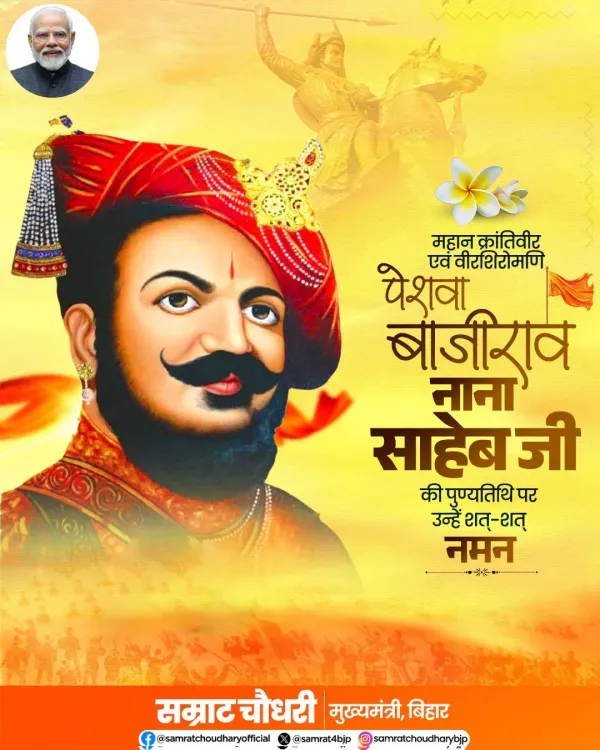
Bihar Chief Minister Samrat Choudhary on Tuesday, June 23, 2026, paid homage to Peshwa Nana Saheb on the revolutionary leader's punyatithi (death anniversary), hailing him as a symbol of national pride, courage, and resistance against colonial rule.
Posting on X, Chief Minister Choudhary wrote: 'महान क्रांतिवीर एवं वीरशिरोमणि पेशवा बाजीराव नाना साहेब जी की पुण्यतिथि पर उन्हें शत्-शत् नमन।' — translated as: 'Heartfelt salutations to the great revolutionary and supreme brave Peshwa Bajirao Nana Saheb on his death anniversary.' He added that Nana Saheb's 'indomitable spirit of national self-respect, courage, and struggle will always remain an inspiration,' and that his dedication to the motherland and legacy of valour 'will remain a beacon of inspiration for generations to come.'
Context
Nana Saheb Peshwa — born Dhondu Pant and adopted son of the last Peshwa, Baji Rao II — was one of the foremost leaders of the 1857 revolt against British rule. He led the uprising in Kanpur (Cawnpore) and became a defining symbol of indigenous resistance to colonial authority. Following the suppression of the revolt, Nana Saheb disappeared and was never captured by British forces; he is venerated as a martyr and freedom fighter across India.
His exact date of death remains a matter of historical dispute, as no definitive record of his fate after 1857 has been established. The punyatithi observed by public figures is a commemorative tradition rather than a historically confirmed date.
Policy Backdrop
Tributes to leaders of the 1857 revolt have been a consistent feature of BJP leaders' public communications, foregrounding narratives of indigenous resistance and national pride. In 2007, on the 150th anniversary of the revolt, the central government and BJP-led state governments organised nationwide commemorations highlighting figures including Nana Saheb.
Chief Minister Choudhary's tribute follows this established pattern, positioning pre-independence military and political leaders as touchstones of national identity. Bihar, as a state with deep historical connections to India's independence movement, regularly sees such commemorations from its political leadership.
Stakeholders and Impact
Such public tributes are directed primarily at Indian youth and the broader citizenry, reinforcing awareness of lesser-celebrated figures from the 1857 uprising. Educational institutions and cultural organisations in Bihar and across India often use such occasions to organise seminars, essay competitions, and awareness programmes centred on revolt-era leaders.
The tribute also signals the Bihar government's alignment with a broader national narrative that frames the 1857 revolt as India's first war of independence — a characterisation that carries significant political and pedagogical weight.
What's Next
With the 170th anniversary of the 1857 revolt approaching in 2027, state governments and the central government are expected to ramp up commemorative events, curriculum references, and cultural programmes honouring revolt leaders including Nana Saheb. Bihar may announce state-level events or educational initiatives in the run-up to that milestone, consistent with the pattern seen during the 150th anniversary in 2007.
Point of View
BJP leaders in states like Bihar reinforce a historical framing that positions the party as the custodian of India's freedom struggle legacy. With the 170th anniversary of the 1857 revolt approaching in 2027, such tributes are likely to intensify in frequency and scale. The pattern also reflects a broader strategy of using commemorative politics to connect with youth and regional pride simultaneously.
NationPress
21 Sept 2026
Frequently Asked Questions
Who is Peshwa Nana Saheb and why is he remembered?
Peshwa Nana Saheb, born Dhondu Pant and adopted son of Baji Rao II, was a key leader of the 1857 revolt against British rule in Kanpur. He is remembered as a symbol of indigenous resistance and national pride in India.
What did Bihar CM Samrat Choudhary say about Nana Saheb?
Chief Minister Samrat Choudhary paid tribute to Nana Saheb on his punyatithi on June 23, 2026, calling him an 'indomitable' symbol of national self-respect, courage, and struggle, and said his legacy would inspire future generations.
When is Peshwa Nana Saheb's punyatithi observed?
Peshwa Nana Saheb's punyatithi is observed on June 23 by various political and cultural organisations, though his exact date of death remains historically disputed as he disappeared after the 1857 revolt and was never captured.
Why do BJP leaders pay tribute to 1857 revolt figures?
BJP leaders regularly honour 1857 revolt figures to foreground narratives of indigenous resistance and national pride, framing these leaders as foundational symbols of India's freedom struggle and national identity.
What events are expected around the 1857 revolt anniversary in 2027?
With the 170th anniversary of the 1857 revolt approaching in 2027, state governments including Bihar and the central government are expected to organise expanded commemorations, educational programmes, and cultural events honouring revolt leaders such as Nana Saheb.