Bihar CM Samrat Choudhary Pays Tribute to Raja Man Singh I
Synopsis
Bihar Chief Minister Samrat Choudhary on July 6, 2026 paid tribute to Raja Man Singh I, the Kachwaha Rajput ruler of Amer and Mughal general, on his death anniversary, hailing his valour and cultural legacy as golden chapters of Indian history.
Key Takeaways
Bihar Chief Minister Samrat Choudhary posted a tribute to Raja Man Singh I on his death anniversary on July 6, 2026 .
Raja Man Singh I (c.
1550–1614 ) was the Kachwaha Rajput ruler of Amer and a senior general under Emperor Akbar .
Man Singh led Mughal campaigns across Bengal, Odisha, and the Deccan and is credited with expanding the Amber Fort complex and patronising Hindu temples.
Choudhary described Man Singh as the 'pride of Sanatan culture' and a 'brave warrior' whose legacy belongs to the 'golden chapters of Indian history.' The tribute reflects a broader BJP pattern of commemorating medieval Rajput rulers to reinforce Sanatan cultural continuity and connect with the Rajput community .
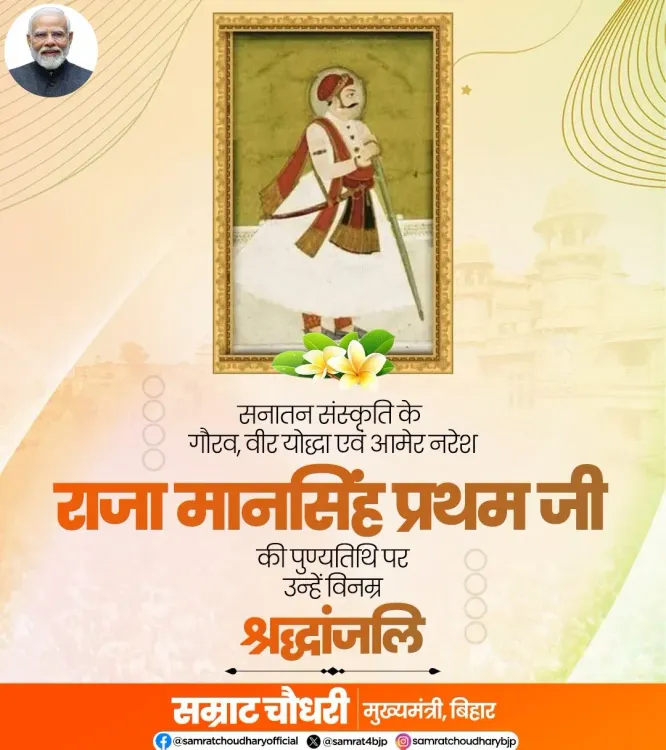
Bihar Chief Minister Samrat Choudhary on Monday, July 6, 2026, paid tribute to Raja Man Singh I, the celebrated Kachwaha Rajput ruler of Amer and a senior Mughal general, on the occasion of the warrior-king's death anniversary. The BJP leader hailed Man Singh's valour, leadership, and historical contributions as enduring chapters in Indian history.
In his post on X, Choudhary wrote: 'Sanatan Sanskriti ke gaurav, veer yoddha evam Amer Naresh Raja Man Singh Pratham ji ki punyatithi par unhe vinamra shraddhanjali' — offering 'humble tribute on the death anniversary of Raja Man Singh I, pride of Sanatan culture, brave warrior and ruler of Amer.' He added that Man Singh's courage, leadership, and historical contribution 'will always be remembered in the golden chapters of Indian history.'
Context
Raja Man Singh I, who lived from approximately 1550 to 1614, was one of the most powerful military commanders of the Mughal era under Emperor Akbar. As the ruler of the Kachwaha Rajput kingdom of Amer — present-day Amber, Rajasthan — he commanded major campaigns across Bengal, Odisha, and the Deccan. His reign is associated with significant expansion of the Amer fort complex and patronage of Hindu temples, cementing his legacy as both a military figure and a cultural patron.
Death anniversary tributes to medieval Rajput rulers have become a recurring feature of political discourse, particularly among BJP leaders who frame such figures within the narrative of Sanatan Dharma and martial heritage.
Policy Backdrop
The tribute fits a broader pattern of state-level commemoration of medieval Hindu military history observed across Rajasthan, Bihar, and other states. BJP-aligned leaders frequently mark the anniversaries of Rajput warriors and rulers, emphasising their contributions to territorial defence, temple patronage, and cultural continuity. Such commemorations are seen as part of a wider effort to integrate regional martial histories into mainstream national memory.
Man Singh I occupies a nuanced place in this narrative: he served loyally within the Mughal imperial structure yet is celebrated for expanding Kachwaha power and preserving Hindu cultural institutions during his tenure.
Stakeholders and Impact
The Rajput community, spread across Rajasthan and parts of Bihar, constitutes a significant political constituency for the BJP. Tributes to icons like Raja Man Singh I resonate strongly with this demographic, reinforcing a sense of historical pride and cultural identity. Heritage conservationists and historians who track the Amber Fort legacy also regard Man Singh's contributions as foundational to Rajasthan's architectural and military history.
As Bihar Chief Minister, Choudhary's public acknowledgment of a Rajasthani ruler underscores the cross-regional appeal that BJP leaders cultivate through shared Sanatan cultural references, bridging state-specific identities under a pan-Hindu historical framework.
What's Next
Observers will watch for similar anniversary tributes to other Rajput or regional martial figures in the coming months, as well as any state-level proposals for heritage-site conservation linked to Kachwaha history or the Amer region. The frequency and visibility of such commemorations from senior BJP leaders, including Chief Ministers, signal the continued political salience of medieval Hindu martial heritage in electoral messaging ahead of future assembly cycles.
Point of View
Framing them as pillars of Sanatan civilisational continuity. The choice of Man Singh — a ruler who operated within the Mughal imperial system yet is remembered for Kachwaha expansion and temple patronage — reflects the party's broader effort to reclaim complex historical figures as unambiguous Hindu cultural icons. For Choudhary, a Bihar-based leader invoking a Rajasthani ruler, the gesture signals cross-regional solidarity among BJP's core Rajput and Hindu nationalist constituencies. As assembly cycles approach, such commemorative messaging is likely to intensify, serving as low-cost, high-visibility cultural outreach.
NationPress
5 Oct 2026
Frequently Asked Questions
Who was Raja Man Singh I?
Raja Man Singh I (c. 1550–1614) was the Kachwaha Rajput ruler of Amer in present-day Rajasthan and one of the most powerful military commanders under Emperor Akbar . He led Mughal campaigns in Bengal, Odisha, and the Deccan, and is celebrated for expanding the Amber Fort and patronising Hindu temples.
Why did Bihar CM Samrat Choudhary pay tribute to Raja Man Singh I?
Bihar Chief Minister Samrat Choudhary paid tribute on Man Singh I's death anniversary, describing him as the 'pride of Sanatan culture' and a 'brave warrior.' BJP leaders regularly mark such anniversaries to honour medieval Rajput figures and reinforce cultural heritage narratives.
What is the significance of Raja Man Singh I's death anniversary?
Raja Man Singh I's death anniversary is observed as an occasion to remember his military campaigns, his role in expanding the Amer kingdom, and his patronage of Hindu cultural institutions. Political tributes on this day reflect the continued resonance of Rajput history in Indian public life.
What is Amer and its connection to Raja Man Singh I?
Amer (also spelled Amber) is a historic Kachwaha Rajput stronghold in present-day Rajasthan . Raja Man Singh I significantly expanded its fort complex and temples during his reign, making it one of the most celebrated medieval heritage sites in India.
How does BJP use tributes to Rajput rulers politically?
BJP leaders, including Chief Ministers, routinely post tributes to Rajput and other Hindu martial figures on their death anniversaries. The practice reinforces the party's Sanatan cultural identity, resonates with the Rajput community as a key constituency, and frames medieval history within a broader Hindu civilisational narrative.