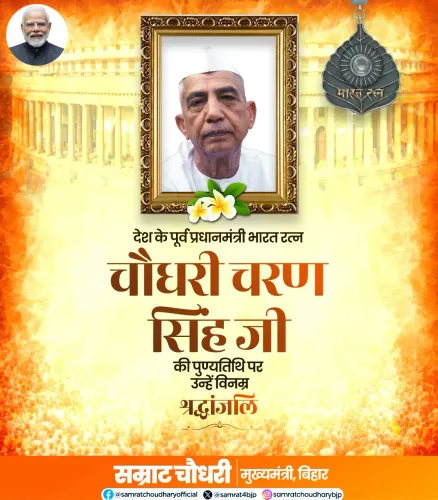
CM Samrat Choudhary Pays Tribute to PC Mahalanobis

Synopsis
Bihar Chief Minister Samrat Choudhary on 28 June 2026 paid tribute to Padma Bhushan awardee Prof. Prasanta Chandra Mahalanobis on his death anniversary, calling him a visionary institution-builder whose contributions to Indian statistics and policy-making remain an enduring source of inspiration.
Key Takeaways
Bihar CM Samrat Choudhary posted a tribute to Prof.
PC Mahalanobis on his death anniversary, 28 June 2026 .
Mahalanobis was honoured with the Padma Bhushan , India's third-highest civilian award.
He founded the Indian Statistical Institute (ISI) in Kolkata in 1931 .
He was the principal architect of India's Second Five-Year Plan (1956–61) .
CM Choudhary described his contributions to statistics, policy-making, and institutional development as 'an everlasting source of inspiration.' The tribute reflects the broader political acknowledgement of Mahalanobis's non-partisan scientific legacy.
Bihar Chief Minister Samrat Choudhary on Sunday, 28 June 2026, paid tribute to Prof. Prasanta Chandra Mahalanobis on his death anniversary, honouring the statistician's foundational contributions to India's statistical and policy-making institutions.
Posting on X, CM Choudhary described Mahalanobis as a 'visionary institution-builder and great statistician' (दूरदर्शी संस्थान निर्माता, महान सांख्यिकीविद्), and offered heartfelt condolences on the occasion. He noted that Mahalanobis's 'invaluable contributions to statistics, policy-making, and institutional development in India will always remain a source of inspiration.'
Context
Prof. Prasanta Chandra Mahalanobis (1893–1972) was one of India's most distinguished scientists and a pioneer of modern statistics. He was awarded the Padma Bhushan, India's third-highest civilian honour, in recognition of his exceptional service to the nation. His death anniversary on 28 June is observed by scholars, policymakers, and public figures across the country.
CM Choudhary's tribute invoked Mahalanobis's triple legacy: statistical science, policy architecture, and institution-building — three pillars that shaped post-Independence India's planning framework.
Policy Backdrop
Mahalanobis founded the Indian Statistical Institute (ISI) in Kolkata in 1931, which later became a deemed university of national importance. He was the principal architect of India's Second Five-Year Plan (1956–61), embedding a heavy-industry-led growth model that defined economic policy for decades. He also created the Mahalanobis distance, a widely used statistical measure in data science and multivariate analysis.
His work institutionalised rigorous data collection and quantitative planning within the Indian state, influencing how governments — at the Centre and in states — approach evidence-based policy to this day.
Stakeholders and Impact
The tribute from Bihar's Chief Minister carries particular resonance given the state's ongoing reliance on national statistical frameworks for welfare targeting, poverty measurement, and development planning. Bihar has been a significant beneficiary of data-driven central schemes, making Mahalanobis's institutional legacy directly relevant to its governance landscape.
Political leaders across party lines have historically honoured Mahalanobis's death anniversary, reflecting the non-partisan stature of his scientific contributions. CM Choudhary's post aligns with this tradition while also signalling the BJP-led state government's acknowledgement of India's pre-liberalisation intellectual heritage.
What's Next
As India continues to modernise its statistical infrastructure — with ongoing debates around census data, GDP measurement methodology, and welfare enumeration — the principles Mahalanobis championed remain at the centre of policy discourse. Tributes such as this one from senior state leaders help sustain public awareness of the institutional foundations that underpin India's developmental state.
Point of View
Acknowledging a figure closely associated with Nehruvian planning — a tradition the BJP has otherwise sought to reframe. It signals that Mahalanobis's scientific and institutional legacy transcends political divides and remains a touchstone for Indian governance. For Bihar, a state heavily dependent on central data frameworks for welfare delivery, invoking Mahalanobis carries practical resonance beyond ceremonial respect. The tribute also arrives at a moment when India's statistical credibility is under active public scrutiny, lending it quiet contemporary relevance.
NationPress
26 Sept 2026
Frequently Asked Questions
Who is Prof. Prasanta Chandra Mahalanobis?
Prof. Prasanta Chandra Mahalanobis (1893–1972) was a pioneering Indian statistician who founded the Indian Statistical Institute in Kolkata in 1931 and was the chief architect of India's Second Five-Year Plan. He was awarded the Padma Bhushan for his extraordinary contributions to science and public service.
Why is 28 June significant for PC Mahalanobis?
28 June is the death anniversary of Prof. PC Mahalanobis, observed each year by scholars and public figures to honour his legacy in statistics, institution-building, and national planning.
What did Bihar CM Samrat Choudhary say about PC Mahalanobis?
CM Samrat Choudhary called Mahalanobis a 'visionary institution-builder and great statistician' and stated that his contributions to statistics, policy-making, and institutional development in India will always remain a source of inspiration.
What is the Indian Statistical Institute founded by Mahalanobis?
The Indian Statistical Institute (ISI), founded by Mahalanobis in Kolkata in 1931, is a premier research institution and deemed university of national importance, recognised globally for its work in statistics and data science.
What is the Mahalanobis distance?
The Mahalanobis distance is a statistical measure developed by Prof. PC Mahalanobis that quantifies how far a point is from a distribution, widely used today in multivariate analysis, data science, and pattern recognition.