CM Sawant Highlights Goa's Logistics Push on National Logistics Day
Synopsis
On National Logistics Day, 28 June 2026, Goa Chief Minister Pramod Sawant highlighted the sector's role in driving economic growth and reaffirmed the state's commitment to strengthening its ports, road networks, airports and maritime infrastructure to boost trade, tourism, industry and employment.
Key Takeaways
Goa Chief Minister Pramod Sawant marked National Logistics Day on 28 June 2026 with a statement on the sector's economic importance.
Sawant identified ports, road networks, airports and maritime infrastructure as key logistics assets being strengthened in Goa.
He described logistics as a 'key pillar in boosting trade, tourism, industry and employment' in the state.
The statement aligns with India's National Logistics Policy (2022) , which targets reducing logistics costs to single-digit percentages of GDP.
Goa's strategic position on the western coast, anchored by the Mormugao Port Authority and two airports, makes it a significant node in the national freight network.
The message signals continued state-level political commitment to logistics-linked infrastructure investment.
Goa Chief Minister Pramod Sawant on Sunday, 28 June 2026 marked National Logistics Day by underscoring the sector's critical role in powering economic growth, and highlighted the state's ongoing investments in ports, roads, airports, and maritime infrastructure as central to its development strategy.
Context
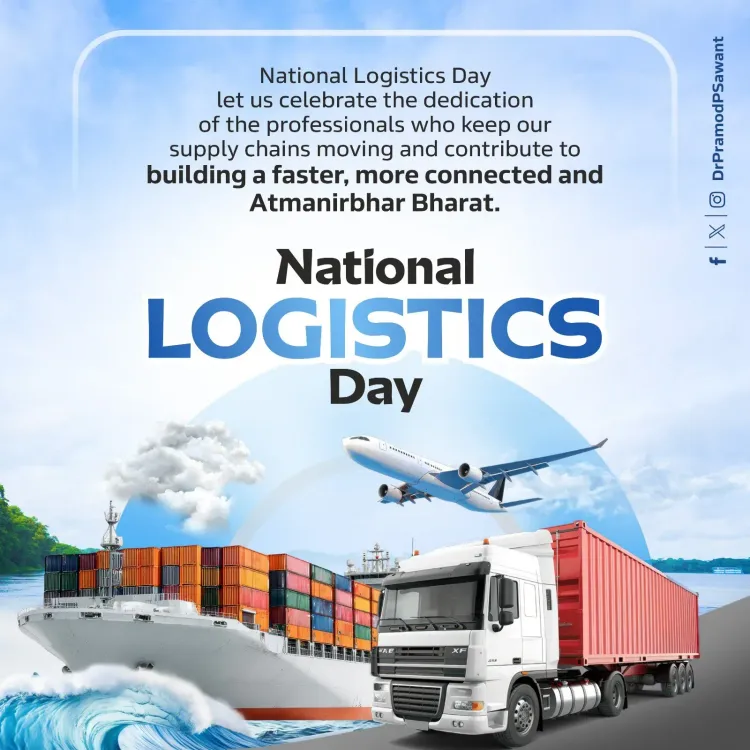
National Logistics Day is observed annually on 28 June to recognise the contribution of the logistics industry to trade facilitation and supply-chain efficiency across India. Chief Minister Sawant used the occasion to draw attention to Goa's multi-modal infrastructure assets, framing logistics as a 'key pillar in boosting trade, tourism, industry and employment.'
In his post, Sawant stated that the day 'recognizes the indispensable role of the logistics sector in driving economic growth, enabling trade and ensuring the seamless movement of goods across the nation.' The message positions logistics not merely as a support function but as a foundational driver of the state's broader economic ambitions.
Policy Backdrop
India's logistics sector has been a focus of central policy attention, with the National Logistics Policy (NLP) launched in September 2022 aiming to cut logistics costs from roughly 13-14 per cent of GDP to single digits and improve the country's ranking on global logistics performance indices. States have been encouraged to align their own infrastructure plans with the NLP framework.
Goa occupies a strategically significant position in India's western coastal logistics corridor. The state is home to the Mormugao Port Authority, one of India's major ports historically significant for iron-ore exports, as well as the Dabolim airport and the upcoming Mopa (Manohar International Airport), which expanded the state's air-connectivity footprint. Road and rail linkages connecting Goa's hinterland to national freight networks have also seen incremental upgrades in recent years.
Stakeholders and Impact
The logistics sector in Goa directly intersects with the state's three dominant economic pillars: tourism, mining and industry, and fisheries and agriculture. Efficient port operations determine the competitiveness of bulk-cargo industries, while reliable road and air connectivity underpins the hospitality supply chain that sustains Goa's tourism economy.
Employment in logistics — spanning port workers, truck operators, warehouse staff, and freight forwarders — represents a significant share of non-tourism blue-collar jobs in the state. Any expansion in logistics capacity therefore carries direct implications for livelihoods across coastal and inland communities alike.
For industry, smoother movement of goods reduces input costs and transit times, making Goa a more attractive destination for manufacturing and export-oriented units. The Chief Minister's remarks signal continued state-level commitment to infrastructure spending that supports these constituencies.
What's Next
Chief Minister Sawant's statement on National Logistics Day is likely to be followed by more detailed policy announcements as the state progresses with port modernisation and road-network expansion projects. The alignment of Goa's infrastructure agenda with the national logistics framework will be a key indicator of how effectively the state translates political messaging into ground-level investment and capacity creation.
As India pushes to reduce overall logistics costs and improve supply-chain resilience, coastal states like Goa that hold natural port advantages are well-placed to attract logistics-linked industrial investment — provided the enabling infrastructure keeps pace with demand.
Point of View
Roads, airports and maritime assets in a single breath, he is signalling to investors and the Centre that Goa is a willing partner in the national logistics efficiency drive. The timing aligns with a broader BJP-governed state pattern of using sectoral observance days to reinforce infrastructure narratives ahead of budget cycles and investment summits. Whether the rhetoric translates into measurable project milestones will determine its political and economic durability.
NationPress
26 Sept 2026
Frequently Asked Questions
What is National Logistics Day and when is it observed?
National Logistics Day is observed on 28 June each year in India to recognise the contribution of the logistics sector to trade, supply chains and economic growth.
What did Goa CM Pramod Sawant say on National Logistics Day 2026?
Chief Minister Pramod Sawant stated that the logistics sector is 'indispensable' to economic growth and highlighted Goa's investments in ports, road networks, airports and maritime infrastructure as central to boosting trade, tourism, industry and employment.
What are Goa's key logistics infrastructure assets?
Goa's primary logistics assets include the Mormugao Port Authority on the western coast, the Dabolim airport, the Manohar International Airport at Mopa, and road and rail connections to the national freight network.
What is India's National Logistics Policy?
The National Logistics Policy (NLP) was launched in September 2022 with the goal of reducing India's logistics costs from around 13-14 per cent of GDP to single digits and improving the country's global logistics performance ranking.
How does logistics growth affect employment in Goa?
Logistics expansion in Goa directly supports employment for port workers, truck operators, warehouse staff and freight forwarders, making it a significant source of non-tourism blue-collar jobs in the state.