CM Sawant Credits Modi Govt for Goa's Infrastructure Gains
Synopsis
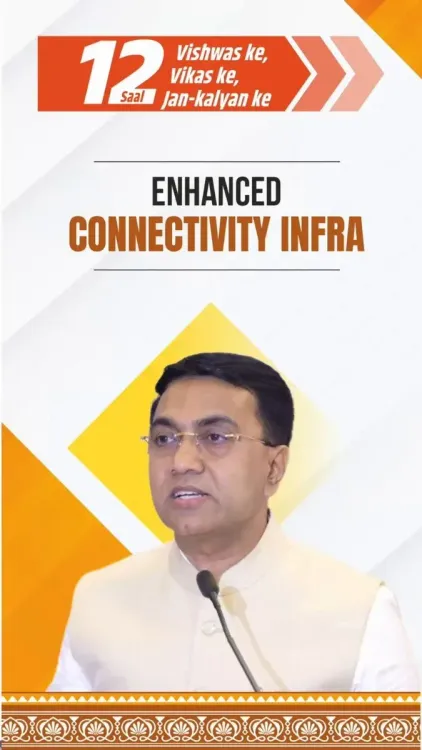
Goa Chief Minister Pramod Sawant credited the Modi-led Union Government on June 12, 2026 for significant upgrades to the state's air, road, and rail infrastructure. Framed within BJP campaign hashtags marking PM Modi's tenure, the statement highlights central-state coordination on connectivity as a driver of Goa's economic growth.
Key Takeaways
CM Pramod Sawant on June 12, 2026 credited the Union Government under PM Modi for improvements in Goa 's air, road, and rail infrastructure.
The post was tagged with #LongestServingElectedPMModi and #12YearsOfNariShakti , linking it to BJP campaigns marking PM Modi 's milestones.
The UDAN scheme (launched 2016 ) and Bharatmala Pariyojana (approved 2015 ) are among the central programmes that have shaped Goa 's connectivity upgrades.
The PM Gati Shakti master plan integrates multi-modal transport planning, with Goa cited in official statements as a beneficiary of airport modernisation and highway improvements.
Goa 's tourism-dependent economy makes transport connectivity a direct lever for growth, benefiting the hospitality sector and local businesses.
Completion of ongoing highway widening and rail doubling projects, and fresh central funding in the next Union Budget , are the key developments to watch.
Goa Chief Minister Pramod Sawant on Friday, June 12, 2026, credited the Union Government under Prime Minister Narendra Modi for what he described as significant improvements in Goa's air, road, and rail infrastructure, saying these upgrades have enhanced connectivity and driven economic growth in the state.
Context
Posting on X, CM Sawant stated that 'Goa has witnessed significant improvements in air, road, and rail infrastructure, enhancing connectivity and driving economic growth' — attributing the progress directly to the 'steadfast support' of the Modi-led Union Government. The post was tagged with the hashtags #LongestServingElectedPMModi and #12YearsOfNariShakti, situating it within a broader BJP campaign marking milestones of Prime Minister Modi's tenure.
Goa's economy is heavily dependent on tourism, making transport connectivity a critical policy lever. Smoother air, road, and rail links directly influence tourist arrivals, business logistics, and the livelihoods of residents across the coastal state.
Policy Backdrop
Several central government schemes have shaped Goa's infrastructure trajectory over the past decade. The UDAN regional connectivity scheme, launched in 2016, was designed to expand affordable air travel to smaller airports, including those serving Goa, opening new routes and reducing dependence on a single airport hub.
On the road front, the Bharatmala Pariyojana, approved in 2015, accelerated national highway development across states, with Goa among the beneficiaries of highway widening and upgrades. More recently, the PM Gati Shakti national master plan has sought to integrate multi-modal transport planning — aligning roads, railways, ports, and airways — to reduce logistics costs and stimulate state-level growth. Goa has been cited in official statements as a state that has gained from airport modernisation and improved highway corridors under this integrated framework.
Stakeholders and Impact
Goa's tourism industry stands as the primary beneficiary of better connectivity. Faster rail links and expanded air routes reduce travel times for domestic and international tourists, directly supporting hotels, hospitality businesses, and the informal economy that depends on visitor footfall.
Goan businesses, particularly those involved in export logistics and manufacturing, also stand to gain from improved road and rail networks that lower the cost of moving goods to ports and inland markets. Central-state coordination on these projects has been a consistent feature of NDA governance since 2014, with state governments like Goa's BJP administration acting as implementation partners for centrally sponsored schemes.
What's Next
Attention will now turn to the completion status of ongoing highway widening and rail doubling works within Goa, as well as whether fresh central funding for the state's infrastructure pipeline features in the next Union Budget. CM Sawant's public acknowledgement of central support also signals continued political alignment between the state government and New Delhi on infrastructure priorities.
As Goa positions itself as a year-round destination rather than a seasonal one, sustained investment in multi-modal connectivity will be central to whether the state can diversify its tourism base and attract higher-value economic activity beyond its traditional peak season.
Point of View
Sawant frames development as a top-down gift from New Delhi rather than a product of state initiative, a framing that serves both governance communication and party branding. The hashtag pairing — linking infrastructure to a '12 years of Nari Shakti' campaign — suggests this post is part of a coordinated BJP digital push rather than a standalone policy announcement. For analysts, the more substantive question is whether the infrastructure improvements cited translate into measurable economic diversification for Goa beyond its traditional tourism season.
NationPress
26 Oct 2026
Frequently Asked Questions
What infrastructure improvements has Goa seen under PM Modi?
Goa has seen upgrades in air, road, and rail connectivity under central schemes including UDAN for regional air travel, Bharatmala Pariyojana for national highways, and the PM Gati Shakti multi-modal transport framework. CM Sawant credited these to the Union Government 's support in his June 12, 2026 post.
What is the UDAN scheme and how does it benefit Goa?
The UDAN regional connectivity scheme , launched in 2016 , aims to make air travel affordable and accessible by expanding routes to smaller airports. Goa has benefited from new air routes opened under the scheme, reducing dependence on a single airport and supporting tourist arrivals.
What is Bharatmala Pariyojana and its role in Goa's road development?
Bharatmala Pariyojana , approved in 2015 , is a central government programme to accelerate national highway construction and upgrades across India. Goa has been among the states to receive highway widening and improvement works under this initiative.
Why is infrastructure important for Goa's economy?
Goa 's economy depends heavily on tourism, making air, road, and rail connectivity critical for sustaining and growing visitor numbers. Better infrastructure also lowers logistics costs for local businesses and supports economic diversification beyond the peak tourist season.
What is PM Gati Shakti and how does it relate to Goa?
PM Gati Shakti is a national master plan that integrates planning across roads, railways, ports, and airways to reduce logistics costs. Goa has been cited in official statements as a beneficiary of airport modernisation and highway improvements under this integrated framework.