CM Sawant Hails Modi's Infrastructure Push on 12 Years of Naya Bharat
Synopsis
Goa Chief Minister Pramod Sawant on 16 June 2026 lauded PM Narendra Modi's infrastructure record, citing highways, Vande Bharat trains, ports, metro networks, and digital infrastructure as proof of 12 years of transformative governance under #12YearsOfNayaBharatNirman.
Key Takeaways
Goa CM Pramod Sawant posted on 16 June 2026 crediting PM Modi with 'unprecedented' infrastructure growth across India.
The post was part of BJP's #12YearsOfNayaBharatNirman campaign marking 12 years of the party's Union government since May 2014 .
Sectors highlighted include highways, expressways, railways, airports, ports, Vande Bharat trains , metro networks, digital infrastructure, and inland waterways.
Key schemes underpinning the push include Bharatmala Pariyojana (34,800 km of highways), Sagarmala Project , Smart Cities Mission , and PM Gati Shakti (launched October 2021).
The National Infrastructure Pipeline announced in 2019-20 envisaged an outlay of Rs 111 lakh crore across sectors.
Future markers include Union Budget capital expenditure allocations and completion milestones for greenfield airports and inland waterway terminals.
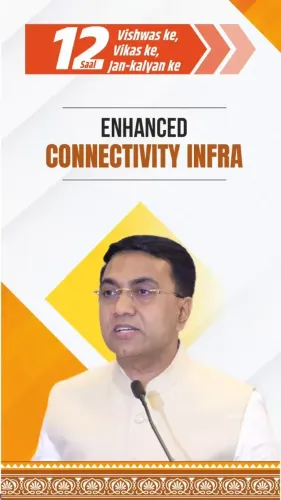
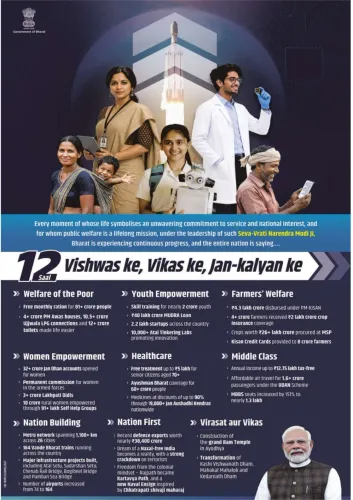
Goa Chief Minister Pramod Sawant on Tuesday, 16 June 2026, took to X to credit Prime Minister Narendra Modi with driving what he called 'unprecedented infrastructure development at remarkable speed and scale' across India, invoking the hashtag #12YearsOfNayaBharatNirman to mark 12 years of the BJP-led Union government.
Context
Sawant's post arrives as the ruling Bharatiya Janata Party (BJP) marks a dozen years since it came to power at the Centre in May 2014. The hashtag #12YearsOfNayaBharatNirman — broadly translating to '12 Years of Building a New India' — has been used by party leaders and state governments to highlight what they describe as a transformation in public infrastructure. Sawant, himself a senior BJP leader, joined this coordinated messaging from Panaji, Goa.
The post enumerates a wide sweep of sectors: highways, expressways, railways, airports, ports, Vande Bharat trains, metro networks, digital infrastructure, inland waterways, and smart urban development. Sawant frames these collectively as 'the foundation of a modern, connected and self-reliant India.'
Policy Backdrop
The infrastructure push Sawant references draws from several flagship Union government programmes launched since 2014. The Bharatmala Pariyojana, approved by the Cabinet in 2017, targets 34,800 km of new and upgraded highways. The Sagarmala Project, launched in 2015, focuses on port-led coastal development, while the Smart Cities Mission, also from 2015, aims at technology-enabled urban renewal.
On the rail front, the Vande Bharat Express — India's semi-high-speed train — first entered service in 2019 on the New Delhi–Varanasi route and has since been expanded across the country. The PM Gati Shakti National Master Plan, launched on 13 October 2021, provides a unified digital platform for coordinating multimodal infrastructure planning across Union ministries and state governments. The National Infrastructure Pipeline, announced in the 2019-20 Union Budget, envisaged an outlay of Rs 111 lakh crore across sectors over five years.
Successive Union Budgets since 2014 have raised capital expenditure on roads, railways, ports, and airports, with the stated aim of lowering logistics costs and integrating domestic markets — a strategy that also underpins the broader Atmanirbhar Bharat (self-reliant India) agenda.
Stakeholders and Impact
The beneficiaries of this infrastructure expansion span a broad cross-section: logistics firms stand to gain from reduced freight costs as highway and port capacity grows; urban commuters benefit from expanding metro networks; and rail passengers have access to faster, more comfortable services through Vande Bharat and upgraded corridors. Port operators and inland waterway users are also directly affected by investments under Sagarmala and related schemes.
For Goa specifically, improved connectivity — including road and port infrastructure — has implications for the state's tourism-driven economy and its logistics links to neighbouring states. Sawant's endorsement of national infrastructure policy also reinforces the alignment between the state government and the Union government on development priorities.
What's Next
Attention will now turn to forthcoming Union Budget allocations for ongoing expressway corridors, metro expansion projects, and greenfield airport completions. Milestones for inland waterway terminals and the next tranche of Vande Bharat deployments will serve as measurable markers of the programme's progress. As the BJP continues to build its 12-year governance narrative ahead of electoral cycles, infrastructure delivery timelines and their ground-level impact are likely to remain central to both political messaging and public scrutiny.
Point of View
Using infrastructure as the party's most tangible governance proof point. The enumeration of sectors — from Vande Bharat to digital infrastructure — signals a deliberate effort to broaden the appeal beyond any single voter segment. At 12 years, the BJP is clearly pivoting from promise to legacy-building, and infrastructure, with its visible physical footprint, is the safest terrain on which to do so. Whether the messaging translates into electoral dividends will depend on how citizens in states like Goa experience last-mile connectivity and service quality on the ground.
NationPress
15 Sept 2026
Frequently Asked Questions
What is #12YearsOfNayaBharatNirman?
#12YearsOfNayaBharatNirman is a BJP campaign hashtag marking 12 years since the party came to power at the Centre in May 2014, used by leaders to highlight governance and infrastructure achievements under PM Narendra Modi.
What infrastructure schemes did CM Sawant refer to?
Sawant's post referenced highways, expressways, railways, airports, ports, Vande Bharat trains, metro networks, digital infrastructure, inland waterways, and smart urban development — all part of Union government flagship programmes such as Bharatmala, Sagarmala, PM Gati Shakti, and the Smart Cities Mission.
When did the first Vande Bharat train start service?
The first Vande Bharat Express began service in 2019 on the New Delhi–Varanasi route, and the network has since been expanded across multiple states.
What is PM Gati Shakti?
PM Gati Shakti is a National Master Plan launched on 13 October 2021 that provides a unified digital platform for coordinated multimodal infrastructure planning across Union ministries and state governments.
What is the National Infrastructure Pipeline outlay?
The National Infrastructure Pipeline, announced in the 2019-20 Union Budget, envisaged a total outlay of Rs 111 lakh crore across roads, railways, ports, airports, and other sectors over five years.