White House Hosts Artemis III Crew as US Moon Return Nears

Synopsis
The White House hosted the Artemis III astronaut crew on October 30, 2026, as NASA advances its first crewed lunar landing mission targeting the Moon's south pole — marking a symbolic and political milestone in America's bid to return humans to the Moon for the first time since Apollo.
Key Takeaways
The White House hosted Artemis III astronauts on October 30, 2026 , declaring 'America is going back to the Moon.' Artemis III is NASA's first planned crewed lunar landing under the modern Artemis program, targeting the Moon's south pole .
The Artemis program was established in 2017 as the successor to Apollo, with a mandate to land the first woman and next man on the Moon.
The Artemis Accords , introduced in 2020 , have built a multilateral international framework around American-led lunar exploration.
China is pursuing parallel crewed lunar ambitions, giving Artemis III a significant geopolitical dimension beyond scientific exploration.
The White House visit sustains political momentum and public support for NASA funding ahead of a technically demanding mission.
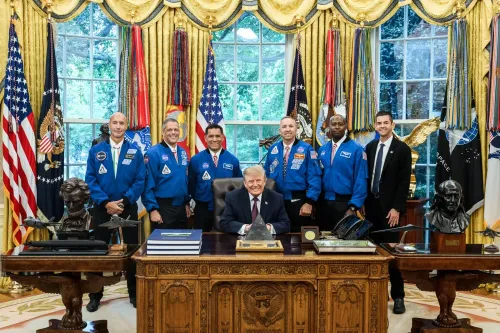
America's next moonwalkers stepped into the White House, and the message from Washington could not be clearer: the United States is returning to the lunar surface. The White House confirmed on Friday, October 30, 2026, that the astronauts selected for Artemis III — NASA's first crewed lunar landing mission since Apollo — had visited the executive residence, a moment the administration framed with a bold declaration: 'America is going back to the Moon.'
Artemis III and the South Pole Target
Artemis III is the centrepiece of NASA's broader Artemis program, which was established in 2017 as the modern successor to the Apollo era. Unlike Apollo's equatorial landings, Artemis III is aimed at the Moon's south pole — a region of intense scientific interest because permanently shadowed craters there are believed to hold water ice, a resource that could one day support sustained human presence and deep-space exploration.
The mission carries a historic mandate: to land the first woman and the next man on the lunar surface, reopening a chapter in human spaceflight that has been closed for more than five decades. The White House visit signals that the crew is operationally real, publicly visible, and politically backed at the highest level.
From the Artemis Accords to a Competitive Lunar Race
The Artemis program does not operate in a vacuum. The Artemis Accords, introduced in 2020, established principles for international cooperation on lunar activities — covering transparency, interoperability, and the peaceful use of outer space. Dozens of nations have since signed on, building a multilateral architecture around American-led lunar return.
That architecture has an urgency to it. China has announced its own crewed lunar ambitions, framing the Moon's south pole as a strategic destination. The parallel timelines have lent Artemis a geopolitical dimension that goes well beyond exploration: whichever nation establishes a sustainable lunar foothold first shapes the norms, the resource access, and the prestige of the next era of space power.
What a White House Visit Actually Signals
Presidential and executive-level engagements with astronaut crews are a deliberate political instrument — a way of tethering national identity to a mission before it launches. The optics of the Artemis III crew in the White House mirror moments from Apollo, when crews met presidents ahead of history-making flights. It also serves a practical purpose: sustaining congressional and public appetite for NASA's funding ahead of what will be one of the most technically demanding missions ever attempted.
The programme relies on a web of commercial partners — including a lunar lander developed under NASA's Human Landing System contracts — alongside international contributions from partner agencies. Each public milestone, including this visit, helps keep that coalition cohesive and motivated.
The Moon's south pole has waited billions of years. America's astronauts are finally in the room where it gets decided — and the countdown clock is running.
Point of View
With the Artemis Accords enrolling allied nations into a US-led lunar governance framework before China can set competing norms. The visit reinforces that the executive branch is fully invested in keeping Artemis funded and on schedule, a signal aimed as much at Congress and aerospace contractors as at the public. If Artemis III lands successfully, it will be the most consequential moment in American space history since 1972 — and this White House appearance is how that story officially begins.
NationPress
31 Oct 2026
Frequently Asked Questions
What is Artemis III and when will it land on the Moon?
Artemis III is NASA's first crewed lunar landing mission under the Artemis program, targeting the Moon's south pole. The exact launch date has not been officially confirmed as of October 2026.
Who are the Artemis III astronauts who visited the White House?
The White House confirmed the Artemis III crew visited on October 30, 2026, but specific astronaut names were not detailed in the official announcement.
Why is NASA targeting the Moon's south pole for Artemis III?
The lunar south pole contains permanently shadowed craters believed to hold water ice, which could support long-term human presence on the Moon and serve as a resource for future deep-space missions.
What is the Artemis Accords and which countries have signed it?
The Artemis Accords, introduced in 2020, are a set of principles for peaceful and transparent international cooperation on lunar activities. Dozens of countries have signed on, building a multilateral framework around US-led lunar exploration.
Is China also planning to land astronauts on the Moon?
Yes, China has announced plans for its own crewed lunar landing, also targeting the Moon's south pole, making the Artemis program a key element of a broader geopolitical space competition.