White House Names Artemis III Moon Crew for 2027
Synopsis
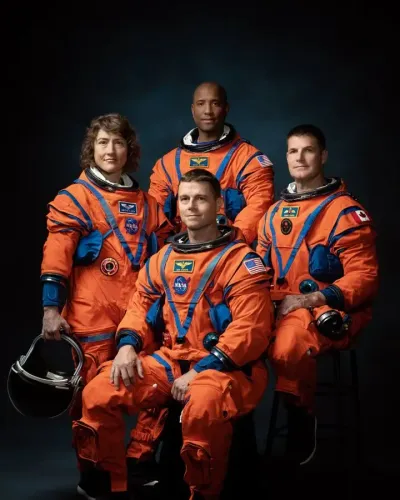
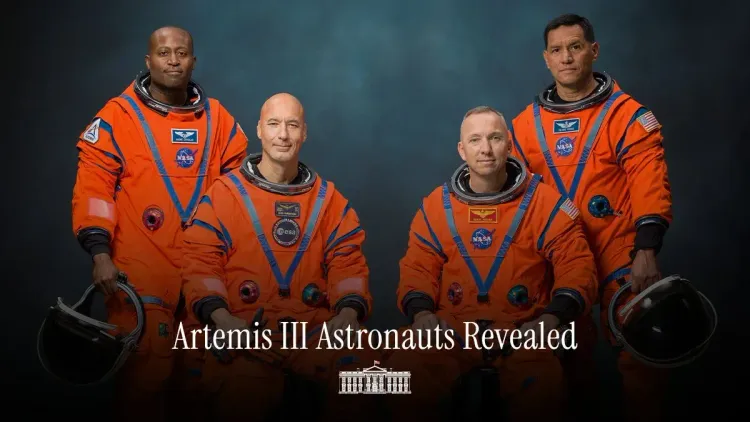
The White House has named four astronauts — Andre Douglas, Luca Parmitano, Randy Bresnik, and Frank Rubio — as the crew for Artemis III, NASA's planned first crewed Moon landing since 1972, targeting 2027. The crew includes both NASA and ESA astronauts, reflecting the international Artemis Accords partnership framework.
Key Takeaways
The White House announced the Artemis III crew on June 9, 2026 , targeting a 2027 lunar landing.
The four-member crew comprises Andre Douglas , Luca Parmitano (ESA), Randy Bresnik , and Frank Rubio .
Frank Rubio previously completed a record 371-day ISS mission in 2022-2023.
Luca Parmitano is the first ESA astronaut named to an Artemis lunar landing crew, reflecting international partnership commitments.
Artemis III targets the lunar south pole , a region of interest for water-ice deposits.
The mission would be the first crewed Moon landing since Apollo 17 in December 1972 .
The White House on Tuesday, June 9, 2026, announced the four-member crew for Artemis III, the mission targeting the first crewed lunar landing since 1972, with a target launch year of 2027. The announcement named Andre Douglas, Luca Parmitano, Randy Bresnik, and Frank Rubio as the crew for the historic mission to the Moon's south pole region.
Context
Artemis III is the centerpiece of NASA's Artemis program, which was formally initiated in 2017 with the goal of achieving a sustainable human presence on the Moon. The mission is designed to land astronauts near the lunar south pole, a region of scientific interest due to confirmed water-ice deposits in permanently shadowed craters. It would mark the first time humans have set foot on the Moon since Apollo 17 in December 1972.
The crew brings together experience from both NASA and the European Space Agency (ESA). Luca Parmitano, an Italian ESA astronaut, previously commanded Expedition 60/61 aboard the International Space Station and conducted the first spacewalk by an Italian astronaut. His inclusion underscores the international partnership architecture at the heart of the Artemis framework.
Policy Backdrop
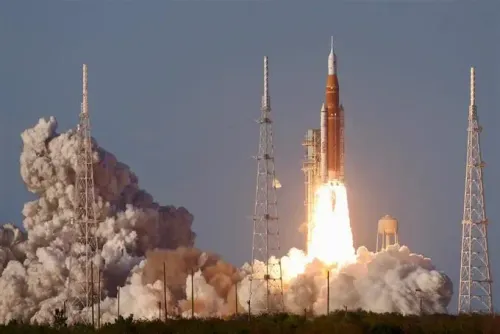
The Artemis program has spanned multiple US administrations, reflecting a durable bipartisan consensus around lunar exploration. In 2022, Artemis I completed the first uncrewed integrated flight test of the Space Launch System (SLS) rocket and the Orion spacecraft, validating the hardware stack intended to carry crews to the Moon. The program operates under the Artemis Accords, a framework launched in 2020 that has drawn in dozens of partner nations committed to peaceful and transparent space exploration.
The broader strategic context includes intensifying competition in space. The United States has explicitly framed the return to the Moon as a matter of national priority, running parallel to the space ambitions of China and Russia, both of which have announced their own lunar programmes. Congressional funding decisions will remain a key variable in whether the 2027 target holds.
The Crew
Andre Douglas, from NASA's 2021 astronaut class, brings an engineering and test pilot background to the mission. Randy Bresnik is a veteran NASA astronaut who flew on STS-129 and later commanded Expedition 52/53 aboard the ISS. Frank Rubio set a record for the longest single US spaceflight, completing a 371-day ISS mission in 2022-2023. Together, the four represent a blend of deep spaceflight experience and next-generation astronaut training.
The naming of an ESA astronaut in the crew also signals the operational depth of international Artemis partnerships. Under the Artemis Accords model, non-US astronauts can earn mission seats in exchange for their agencies' contributions to the broader lunar exploration architecture.
What's Next
Before Artemis III can launch, the programme must complete Artemis II, a crewed lunar flyby that will serve as the first test of the SLS-Orion stack with humans aboard. Congressional appropriations for NASA's exploration budget will be closely watched, as funding gaps have historically caused schedule slippage in large-scale space programmes. The 2027 landing target, while ambitious, now has named faces attached to it — raising the political and institutional stakes for delivery.
Point of View
Not merely diplomatic paperwork. For India, which signed the Artemis Accords in 2023, this crew announcement is a reminder that the pathway to crewed lunar participation runs through deeper bilateral space cooperation with Washington. The broader arc here is one of accelerating US institutional commitment to the Moon as a strategic domain, with the crew announcement serving as a forcing function for funding and contractor timelines.
NationPress
13 Sept 2026
Frequently Asked Questions
Who are the Artemis III astronauts?
The Artemis III crew named by the White House consists of Andre Douglas , Luca Parmitano , Randy Bresnik , and Frank Rubio . Parmitano is a European Space Agency astronaut, while the other three are NASA astronauts.
When will Artemis III launch?
The White House announcement targets 2027 for the Artemis III lunar landing mission. The precise launch date depends on the completion of Artemis II and ongoing congressional funding decisions.
What is the Artemis III mission?
Artemis III is NASA's planned first crewed Moon landing since 1972. It aims to land astronauts near the lunar south pole , a region believed to hold water-ice deposits in permanently shadowed craters.
Has India signed the Artemis Accords?
Yes, India signed the Artemis Accords in 2023, joining a growing coalition of nations committed to peaceful and transparent lunar exploration under the US-led framework.
Who is Frank Rubio and why is he significant?
Frank Rubio is a NASA astronaut who completed a 371-day mission aboard the International Space Station in 2022-2023, the longest single spaceflight by a US astronaut at the time. He is now named to the Artemis III lunar landing crew.